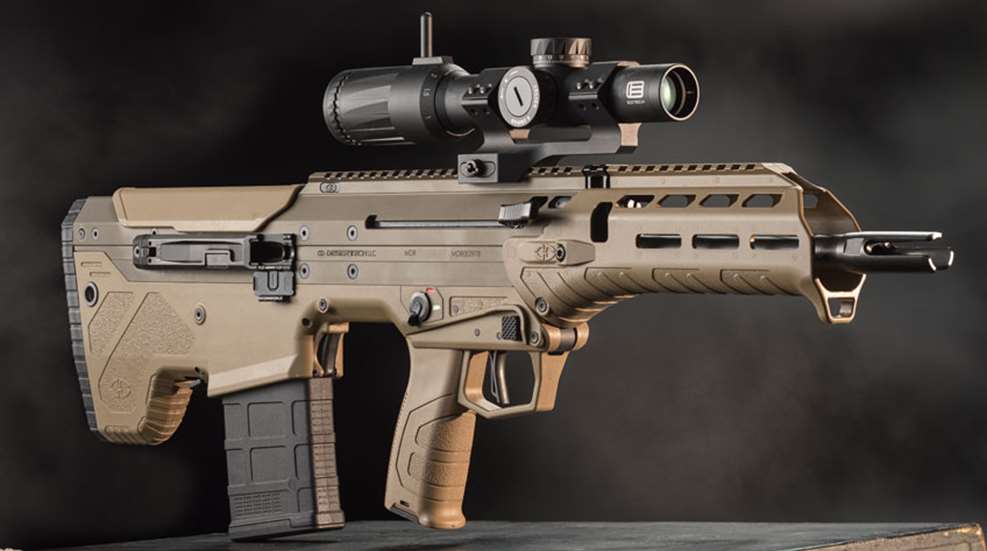
Located in West Valley City, Utah, Desert Tech launched its specialized lineup of bullpup bolt-action rifles in 2007. In 2014, the company shifted gears with proof-of-concept models of the cartridge-convertible semi-automatic Micro Dynamic Rifle (MDR), but it would be another three years before the system was ready to ship.
From 2017 to 2019, the company listened to customer feedback and implemented free upgrades for those guns that had already left the factory. As of this writing, the MDR’s extractor and gas-piston system were re-designed to provide a high level of reliability with a wide variety of ammunition. The latest upgrades, including a wider extractor claw and a six-position adjustable gas valve, are being installed as standard equipment on all newly manufactured MDRs.
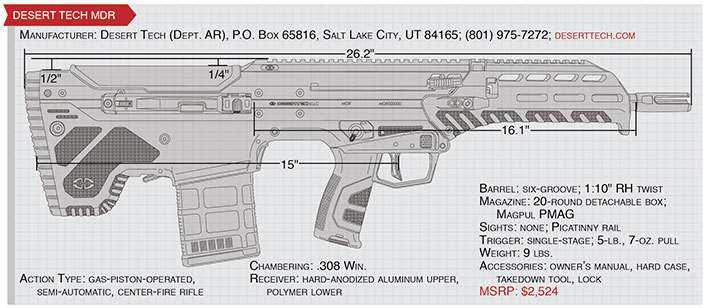
The MDR is a short-stroke, gas-piston-driven semi-automatic. The lower receiver and removable handguard are constructed from polymer, while the upper receiver is made of hard-anodized, aircraft-grade aluminum. Like other bullpup rifles, the MDR’s trigger and fixed pistol grip are located forward of the magazine well. This allows for the use of a 16.1" barrel while keeping the rifle at a compact overall length of just 26.2".
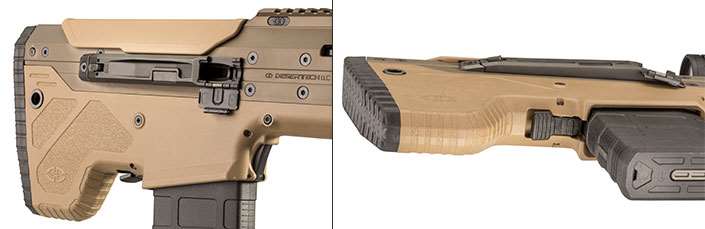
The .308 Win. configuration of the MDR weighs in at 9 lbs. with an empty 20-round Magpul PMAG inserted in the magazine well. Although this may sound heavy compared to some semi-automatic configurations, the majority of the rifle’s weight is located between the pistol grip and the textured rubber recoil pad.
The resulting rearward balance, along with the rifle’s compact profile, gives the MDR quick and easy handling characteristics. Conversation kits that allow the MDR to fire .223 Rem. and .300 Blackout ammunition using standard AR-15 magazines are offered by the company, and new for 2020, a 6.5 mm Creedmoor kit has also been announced.
The 16.1" .308 Win. barrel has a 1:10" rifling twist rate, with the muzzle threaded at 5/8x24 TPI for accessories. It ships with a steel, three-prong flash hider installed. The polymer handguard sports a hand stop, textured gripping surface, adjustable gas block ports and M-Lok accessory slots at the 3-, 6- and 9-o’clock positions. The top of the handguard features a molded-in 10-slot Picatinny rail that aligns with the single slot atop the gas block and the 21 slots integral to the aluminum upper receiver.
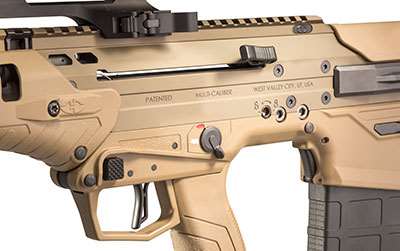
Controls are set up for both right- and left-handed users, including bilateral charging handles, forward magazine release buttons and safety selectors, as well as a bolt catch and a secondary magazine release lever located at the center rear and front of the magazine well, respectively, allowing for ambidextrous use. Even the ejection port is reversible. The forward square-button magazine release is positioned to be operated with the tip of the trigger finger.
The non-reciprocating charging handles are spring-loaded to fold down against the receiver when not in use. They swing up to lock into place in both the forward and rear positions. When closing the bolt, the handles can be slapped down, much like the handle of the H&K MP5 or the Steyr AUG.
The metallic, 45-degree safety selector is operated by the shooting hand; it swings down into the Fire position. It’s smooth and well-placed for easy operation, but it does not produce a distinctive “click” when it reaches either the Safe or Fire positions. The bolt-release lever is located behind the magazine well, and is pressed up to close the bolt when it has been locked back in the open position by an empty magazine.
The shoulder stock features left- and right-side ejection ports outfitted with cleverly designed removable covers. One cover is a filler plate that prevents spent cases from being ejected to the side where it’s been installed. The other has a 1.25"-wide, spring-loaded dustcover that drops open to allow spent cases to be ejected forward toward the muzzle of the rifle.
This prevents brass from striking the operator should he or she fire from the weak-side shoulder as well as other personnel to the side. It’s noteworthy that the rifle’s firing mechanism and port cover work in concert to mechanically guide brass out of the port. Also, switching the port covers is a quick, no-tools procedure.
Perhaps one of the trickiest components to do well in a bullpup rifle is the trigger design. This is because the forward-positioned trigger is not directly connected to the firing mechanism. Instead, it uses relatively long linkages to drop the hammer, and as a result, bullpups have a reputation for heavy, gritty trigger pulls. However, Desert Tech has done a good job of addressing that potential shortcoming by cleaning up the MDR’s trigger. Our test sample exhibited a smooth 5-lb., 7-oz., trigger pull without any take-up.
The MDR doesn’t ship with sights, so we mounted a 1-4X riflescope to test accuracy at 100 yds. At the range, the rifle ran flawlessly with all of the selected ammunition. The gas system can be adjusted to fit the circumstances, with settings to reduce gas pressure for sound suppressors or to increase the pressure for adverse environmental conditions. We did not find it necessary to adjust the gas system.
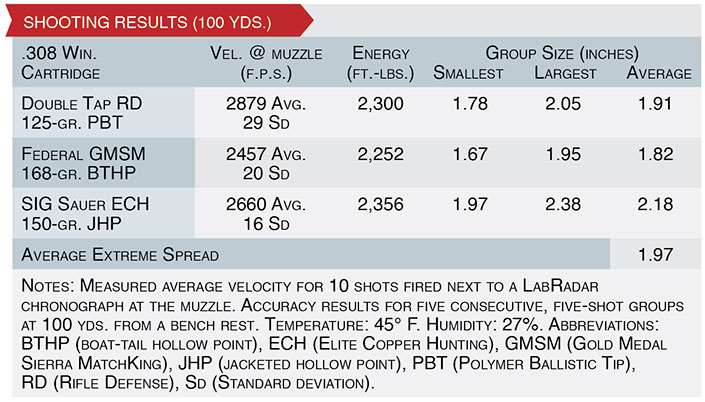
Although the 2017 version of the Desert Tech MDR still needed some improvements, the current version tested for this review demonstrated a level of reliability and accuracy that shows this platform has evolved past its earlier growing pains into a fully developed platform. While this firearm would likely not be considered inexpensive by many consumers, it does cost less than some competing models. Add to that its fully ambidextrous configuration and its compact profile, and the MDR is a rifle worthy of consideration.
Most Popular