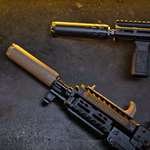
Signed July 4, President Donald Trump’s One Big Beautiful Bill (OBBB) gave law-abiding gun owners a welcome victory by eliminating the National Firearms Act of 1934’s (NFA) prohibitive $200 tax on suppressors and short-barreled rifles and shotguns. Still, many gun owners are justifiably frustrated that the hard-fought effort to entirely remove these items from the NFA was thwarted by an unelected Senate parliamentarian.
After all, President Franklin Delano Roosevelt’s administration was deliberate in structuring the NFA as a tax to evade concerns over the lack of congressional jurisdiction to regulate firearms (Congress’ authority to lay excise taxes, however, was uncontroversial). Remember, the framers of the U.S. Constitution created a federal government of limited powers, and the NFA was enacted before Supreme Court case law vastly expanded Congress’ lawmaking authority under the Commerce Clause.
Therefore, it was especially galling that the parliamentarian—a holdover appointee of Sen. Harry Reid (D-Nev.)—ruled that removal of certain items from the NFA’s scope was “extraneous” to the OBBB, a budget-reconciliation measure. Can it be that something is a taxing scheme when judging its constitutionality, but a gun-control law when it’s considered for inclusion in a budget bill? Heads, government wins; tails, citizens lose?
As I made clear in NRA-ILA’s July 3 statement when Congress sent the OBBB to President Trump’s desk, zeroing out the NFA tax was only the first step in this fight.
The next step took place on August 1, when NRA and other Second Amendment groups filed a lawsuit challenging the constitutionality of the NFA in the U.S. District Court for the Eastern District of Missouri. The lawsuit, Brown v. ATF, makes clear that with the OBBB’s elimination of the suppressor and short-barreled-firearm tax, the accompanying NFA regulatory regime is no longer justifiable as an exercise of Congress’ taxing power.
As noted, the NFA relies on the federal government’s enumerated taxing power. The requirements that suppressor and short-barreled-firearm makers and transferees submit sensitive personal information, including a photograph and fingerprints, and that all implicated firearms and accessories be recorded in a federal registry, are ostensibly to ensure the government can collect its tax revenue. Without any tax to collect, the rest of the burdensome scheme should be void.
As NRA’s complaint points out, this dependence on Congress’s taxing power was acknowledged by the NFA’s backers. In a 1934 hearing on the NFA before the House Committee on Ways and Means (the legislative committee dedicated to taxes), Attorney General Homer Cummings admitted that Congress has “no inherent powers to go into certain localities and deal with local crime,” rather, “[i]t is only when we can reach those things under … the power of taxation, that we can act.” Similarly, then-Assistant Attorney General Joseph Keenan stated the measure, “follows the theory of taxation” and that the legislation didn’t ban NFA firearms outright because Congress doesn’t have “the power to do that under the Constitution.”
NRA’s suit also notes that the U.S. Supreme Court has held that the NFA is “only a taxing measure.” The 1937 case Sonzinsky v. U.S. brought a constitutional challenge to the NFA’s $200 tax on dealers as unconstitutional gun control. Citing Congress’ taxing authority, the Court upheld the registration requirement as “obviously supportable as in aid of the revenue purpose.”
Even NRA’s detractors appear to understand the soundness of these arguments. As the OBBB was working its way through the Senate, anti-gun Sen. Chris Murphy (D-Conn.) offered a last-minute amendment to increase the bill’s tax on suppressors and short-barreled firearms from $0 to $1 (and, later, to $4,709). The desperate ploy appeared designed to preserve the NFA regulatory scheme on these items under the taxing power by ensuring there was an actual tax the government was required to collect.
Of course, the NFA is also an impermissible restriction on Second Amendment-protected arms. NRA’s case makes clear that suppressors and short-barreled rifles are in common use for lawful purposes and that there is no historical tradition supporting the NFA’s oppressive regulation of these items. In the case of suppressors, the complaint points out that the Trump administration agrees that they are protected arms. A recent government filing in a case in the Fifth Circuit acknowledged: “In the view of the United States, the Second Amendment protects firearm accessories and components such as suppressors.”
Politics, as the reconciliation effort demonstrated, can be frustrating. But it’s important to keep in mind that progress in the fight to protect gun owners’ rights isn’t always linear. The OBBB opened a crucial new avenue to attack the U.S. government’s first foray into oppressive gun control. The key for gun-rights supporters is to stay motivated and keep moving forward. As this NFA lawsuit shows, NRA will keep fighting every step of the way.
Most Popular