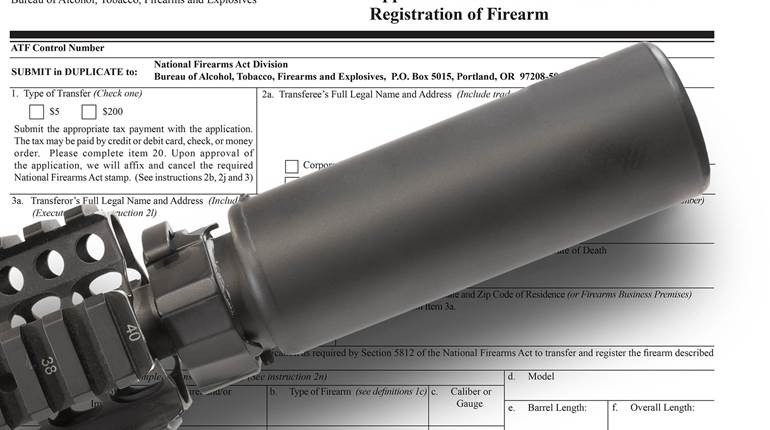
Administrative rules are not the most glamorous aspect of national governance. But they are fundamental to bureaucracy’s inner workings and how they affect, for better or for worse, the daily lives of ordinary Americans. In the July issue, I wrote about a comprehensive regulatory overhaul the Bureau of Alcohol, Tobacco, Firearms and Explosives (ATF) launched in April (see ATF’s “‘New Era of Reform’ Kicks into High Gear”). This month, I want to update you on NRA’s response. When it comes to day-to-day advocacy for your rights in the nation’s capital, this is where the rubber meets the road.
The effort began with President Trump’s Executive Order 14206, “Protecting Second Amendment Rights.” This provoked a comprehensive review of federal policies “to assess any ongoing infringements of the Second Amendment rights of our citizens” and a “plan of action … to protect the Second Amendment rights of all Americans.”
NRA was involved from the outset, presenting the administration with a blueprint of some 50 reforms that could be undertaken without additional Congressional legislation.
Many of those suggestions were addressed in ATF’s sweeping regulatory reset, which included 34 separate rulemakings or interim final rules that were opened for comments.
Americans elect representatives and senators to Congress, and Congress writes federal laws, which are then signed or vetoed by the president. Administrative agencies—i.e., the administrative state—then implement and enforce these laws on behalf of the executive branch.
The administrative state has an uneasy relationship with the U.S. Constitution, as that charter does not explicitly authorize the sprawling network of departments, bureaus, agencies, commissions and boards that comprises most of the U.S. government. Moreover, these entities often seem to be performing functions the Constitution assigns to the three branches of government: making, executing and adjudicating rules and policies. Yet none of their members are accountable to the voters.
In theory, the administrative state is staffed by politically disinterested subject-matter experts whose only function is to bring their state-of-the-art know-how to bear on running the government as intelligently and efficiently as possible. Their status as protected career employees is supposed to enable them to discharge their duties free of undue political pressure.
But the notion of the “Deep State” paints a different, more sinister, picture of a permanent professional class that pursues its own agenda and that considers itself, and not the constitutional branches of government, the true locus of power in Washington, D.C.
Whatever one’s opinion of it, the administrative state isn’t going anywhere, and effective advocacy requires knowing how to navigate its complex processes. There are laws designed to make agency actions transparent and to require agencies to seek public input on important decisions. There is also oversight by federal courts. The current U.S. Supreme Court, featuring three Trump appointees, has reined in the discretion of administrative agencies with several important decisions.
NRA excels in maneuvering through this landscape. Its input on ATF’s recent proposals encompassed nine separate comments totaling nearly 150 pages of text, with hundreds of footnotes citing binding authority in statutes, case law and existing regulations.
Congressional law requires administrative agencies to take this regulatory input seriously and to either change or justify their determinations in response to it.
NRA’s comments opined on topics such as who is eligible to possess and receive firearms under federal law; what information a person must provide when acquiring a firearm from a federally licensed dealer (FFL); protections for gun owners traveling with firearms through multiple jurisdictions with different rules; how long the government may retain information about firearm purchases; the standards for the government to take adverse action against FFLs; whether one eligible person can buy a gun for another eligible person; and what sorts of state-issued licenses or permits allow people to buy a gun from an FFL without a background check.
Given the number of proposals and the limited comment periods, we prioritized the rulemakings with the broadest scope and most direct impact on ordinary gun owners. Our input was designed to ensure the final rules are as fine-tuned as possible and, in a few cases, to curb continued overreach.
You can find all of NRA’s public comments at regulations.gov. Click the “Comments” tab and enter “National Rifle Association” in the search box. Then, on the right side of the page in the “SORT BY” menu, choose “Posted (Newer-Older).”
Submitting regulatory comments isn’t the stuff of splashy D.C. headlines. But it is a high-impact measure that can visibly move the needle on your right to keep and bear arms. Stay tuned as we report in the coming months on the outcome of this critical process.
Most Popular