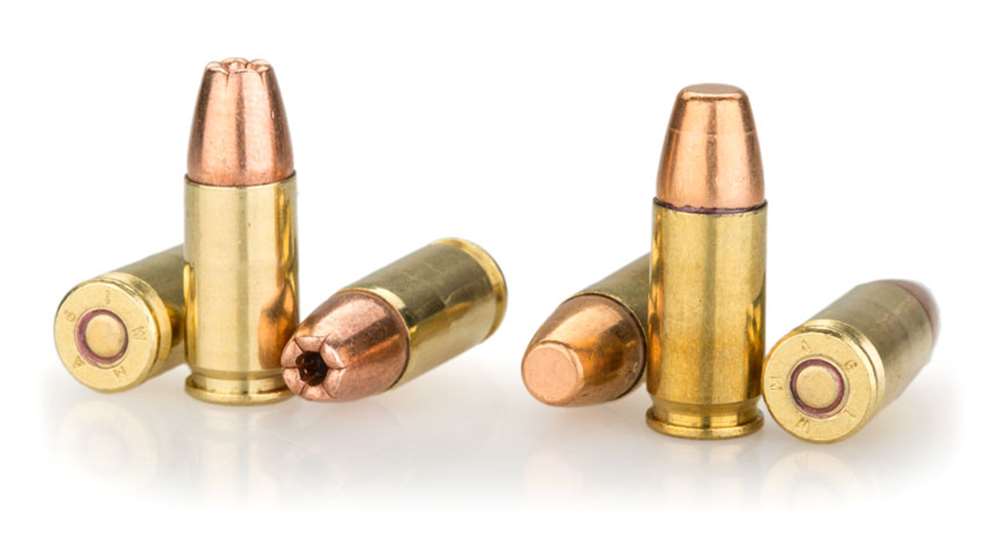
The Winchester loads adopted with the MHS system are the M1153 Special Purpose (l.), with a 147-gr. jacketed-hollow-point bullet, and the M1152 Ball (r.) with a 115-gr. full-metal-jacket projectile.
While much ink has been spilled on the “kinetic platform” (what most of us would call a “pistol”), when it comes to the adoption of the M17 MHS, there is one aspect that has not received much attention—the ammunition. While the original Request For Proposal (RFP) did not specify a chambering—which led to speculation that the .357 SIG, .40 S&W or, heaven be praised, the .45 ACP, might have been adopted—the Army opted to stick with 9x19 mm NATO. One of the RFP requirements was “increased lethality” relative to the existing platform without changing the chambering or increasing barrel length. What the Army was looking for, among other things, was a 9 mm load whose projectile would penetrate 14" of ballistic gelatin at 50 meters.
SIG Sauer, the lead contractor on the winning MHS bid, selected Olin Corp. (Winchester Ammunition) for the ammunition—a solid decision as Winchester has been the prime contractor of the U.S. M882 9x19 mm NATO cartridge since the adoption of the Beretta M9 in 1985.
SIG Sauer makes its own ammunition, but at the start of the trials in 2015, it was nowhere near ready for a big military contract. If you want to go to the winner’s circle, partner with someone who has been there before. And that someone was Winchester, which runs huge quantities of 9x19 mm NATO, 5.56x45 mm NATO, 7.62x51 mm NATO and .50 BMG for the U.S. government in its Oxford, Miss., plant.
“This is a significant opportunity for Winchester to continue its steadfast support of the U.S. military, just as we have for decades,” said Brett Flaugher, president of Winchester Ammunition, when the announcement came in January 2017.
“We are honored to work with SIG Sauer as part of the MHS contract,” Ron Cohen, president and CEO of SIG Sauer, Inc., said, “Winchester has a long history of supporting our service members, and we are honored to collaborate with them on this project.”
The ammunition accompanying the M17 includes the M1152 FMJ and the M1153 Special Purpose loads. There are actually four, and they are described in part in government documents as: “Ball, Jacketed Hollow Point (JHP), Drilled Dummy Inert (DDI) and Blank.” While it is pretty obvious what the dummies and blanks are for—I’ll skip them—the uses for the M1152 and M1153 are given as “The Ball cartridge is intended for use against enemy personnel, for training, and for force protection. The JHP cartridge is required for use in situations where limited over-penetration of targets is necessary to reduce collateral damage.” In case you didn’t catch it, “Special Purpose” equals “jacketed hollow point.”
The Army’s lawyers determined that the use of hollow points by troops does not violate the Hague Convention of 1899. Army Col. Brian Stehle, who was the head of Project Manager Soldier Weapons, was quoted in a military.com article, “We have a law of war determination that stated that this type of ammunition is usable.” Other “Special Purpose” rounds, including open tip match (OTM) and .45 JHPs have already been used by Special Operations troops for some time.
There were reports of stoppages and double-feeds in XM17 testing, which were addressed by SIG. It was never an ammunition issue, as Winchester made no changes to M1152 or M1153. One of the differences between the military-issue M17 and the P320-M17 civilian version are the recoil springs. The U.S. M17 is designed to work with U.S.-issue ammunition only—the commercial guns have to run with everything.
The M1152 employs a 115-gr. full-metal-jacket, flat-nose (FMJ-FN) bullet. The M1153’s 147-gr. jacketed-hollow-point bullet bears a familial resemblance to the company’s law enforcement Ranger T-Series, but it was “designed to maximize performance based on the government specification set out in the RFP,” Glen Weeks, director of government contracts & specialty products for Winchester Ammunition, told me during an interview. The powder used is not a special propellant. Weeks said it is a “propellant we have experience with and use in other products.” The pressures for the M1152 and M1153 are 39,700 p.s.i.
In our tests in 1985, XM882 propelled a 124-gr. round-nose FMJ out of the 5" barrel of an M9 at an average of 1273 f.p.s., delivering 446 ft.-lbs. of energy at 15 ft. Using an Oehler Model 43 and firing the new ammunition out of a 4.7"-barreled P320-M17, M1152 with the 115-gr. bullet was at 1326 f.p.s. and 449 ft.-lbs. of energy, while the M1153 clocked 962 f.p.s. with 302 ft.-lbs., both at 15 ft.
Currently, large quantities of both M1152 and M1153 are rolling off the presses and into Winchester’s military “pack-and-ship” cell in Oxford, Miss. Reports from the Army indicate the ammunition is performing as designed, and it is being issued with M17s in operational areas, although no specific instances of its use were disclosed.
Of the M17 adoption process, Weeks said it was an “overall pleasant and positive experience for Winchester … and the warfighter has a superior weapon. We are very proud to have been a part of that. We look forward to the next 30 years of service to the U.S. military.”
Additional Reading:
In the Company of Soldiers: The U.S. M17 & M18 Modular Handgun Systems
Tested: SIG Sauer P320 M17 Pistol
Known But to God: The Unknown Soldier and the U.S.S. Olympia
Most Popular