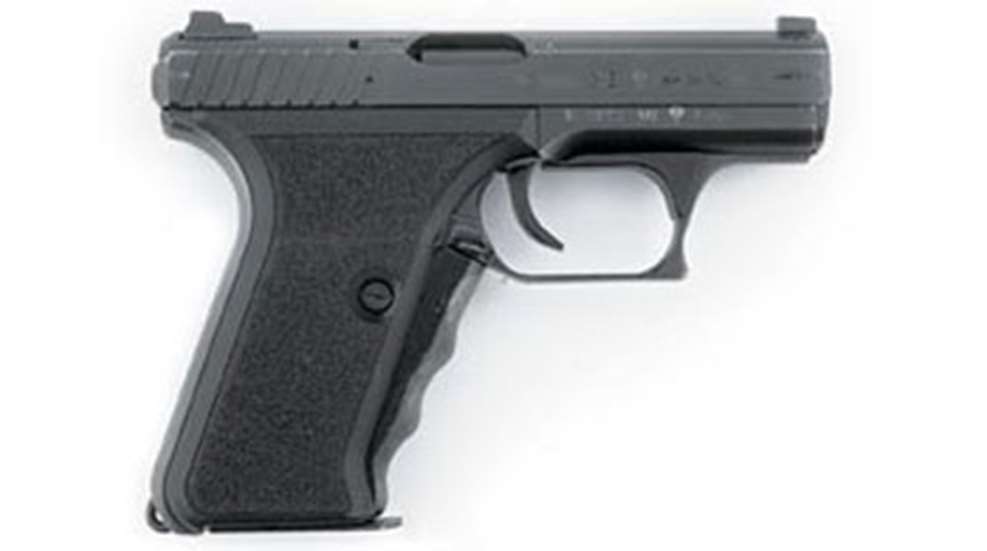
The H&K P7 pistol is famous for its innovative design and unique squeeze cocking system of operation. Originally designated "PSP," for Police Service Pistol, it was H&K's bid to replace the German federal police agency's aging stock of Walther P.38s. The German government wanted a single, universal, semi-automatic pistol compact and light enough for undercover officers yet capable of firing 9 mm Luger (9x19 mm) ammunition.
To meet the government's weight limit of 2 pounds, 3 ounces, H&K took an unusual route and opted for a gas-retarded, delayed blowback operating system. The violence of a blowback design usually limits its use to relatively low-power cartridges such as .32 ACP or .380 ACP and requires a heavy slide and recoil spring. But H&K designers delayed or retarded the gun's blowback action with a gas system. The PSP's barrel is ported just forward of the case mouth seat in the bottom of the fluted chamber. Gas pressure diverted to the cylinder impinges on a piston pinned to the slide, retarding normal blowback operation until chamber pressure drops to a point safe enough for extraction and ejection. This eliminates the need for a heavy slide and recoil spring. The unique operating system brought the PSP within the weight limit despite its all-steel construction.
The PSP was also among the first pistols to incorporate polygonal rifling, which at the time was thought to produce higher velocities than conventional rifling. Our "Dope Bag" testing of the gun in March of 1981 did not bear that out, however, that may have been because the pistol's 37⁄8-inch barrel was one of the shortest available in 9x19 mm.
Far beyond its small size and unusual delayed blowback design, the PSP is best known for its squeeze-cocking operation. In lieu of a fixed front strap the gun uses a finger-grooved cocking bar/lever that initially requires 13 pounds of pressure to make the gun ready to fire. While that might seem overly stiff, it is actually rather easy to apply because three fingers are at work. Also, once the squeeze cocker's spring is compressed, only 1 1⁄2-pounds. of pressure is required to keep the gun ready to fire. Aside from this cocking lever/grip safety, there are no other external safeties.
After emerging as the clear winner of the German government tests, the PSP was adopted as the standard pistol for its federal police force in 1978 and designated the P7. The German police contract was so large that there were no commercial sales until 1981. Once available for the civilian market, the P7 was offered in a variety of models, including the P7 M13. This gun has a double-column, 13-round magazine in place of the original's single-column, eight-round type. Alternate chamberings included .40 S&W in the P7 M10 with a 10-round, double-column magazine and the straight-blowback P7 K3 in .32 ACP, .380 ACP and .22 LR.
The P7 does not require the shooter to master two distinct trigger pulls. It also requires no manual manipulation of a separate safety lever as in a single-action design. The cocking lever cocks the hammer and acts as a decocker, grip safety and slide release. The only other external controls are a slide stop, a magazine release and a take-down latch.
The P7 appeared at a time when most U.S. law enforcement officers were equipped with revolvers, because semi-automatics were deemed too complex and unreliable for use by officers on the street. Despite its high price and sporadic availability, the P7 was adopted by a number of U.S. police departments. The gun's ease of operation, slim profile and light weight changed the way police and licensed individuals look at carry guns.
Most Popular