A lightweight .44 Magnum revolver is handy and easy to carry. Recoil is brutal, though, when shooting full-power loads in sub-2-lb. guns such as the Smith & Wesson 329PD. Using a 240-gr. bullet loaded to a mild 1000 f.p.s. may prove much easier to handle.
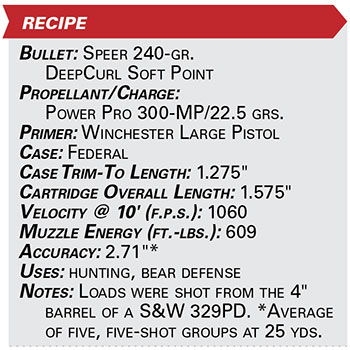
A mid-weight charge of 22.5 grs. of Alliant Power Pro 300-MP fired Speer 240-gr. DeepCurl bullets at a velocity of 1060 f.p.s. That relatively slow velocity significantly reduced muzzle flip and removed some of the recoil sting when shooting the 329PD.
 “Bullet pull” can result from the hard recoil of a lightweight revolver, and refers to a bullet jerking partially out of its case when other cartridges in the cylinder are fired. Excessive bullet pull can bind up cylinder rotation and change ballistic performance. A standard roll crimp may fail to hold bullets in place when shooting hard-recoiling cartridges such as the .44 Mag.
Speer DeepCurl revolver bullets—and others, such as Hornady’s 225-gr. FTX and 240-gr. XTP, Swift’s 240-gr. A-Frame and Cutting Edge’s 240-gr. Handgun Solid—are made with an extra-wide crimping cannelure that allows a handloader to apply a stronger neck-down crimp, ironing a step in the case mouth that nearly fills the cannelure. Such strong crimps can be applied with RCBS seating dies (rcbs.com) made since 1984, which can be adjusted to incrementally increase the crimp. For this recipe, a neck-down crimp applied to DeepCurl bullets resulted in the sixth cartridge’s length remaining unchanged after firing the five preceding cartridges in the 329PD. The neck-down crimp also contributed uniform ballistics with an extreme spread of velocity of 27 f.p.s. over 15 shots.
Most Popular