Way back in the day, the three Rs of learning were colloquially known as "Readin’, Rightin’ and Rithmatic." Fast-forward to modern performance shooting and the three Rs become Rise, Return and Realignment, the core mechanics of recoil control.
The operative word here is control. How well you control each phase determines how well you control recoil. Either you control the firing recovery process, or it will control you.
All three components—Rise, Return and Realignment—work as a single connected sequence resulting in preparation for the next shot as an integral part of the current shot. Each phase is a separate but integrated action that affects the others.
Let’s take a closer look at each one.
Rise
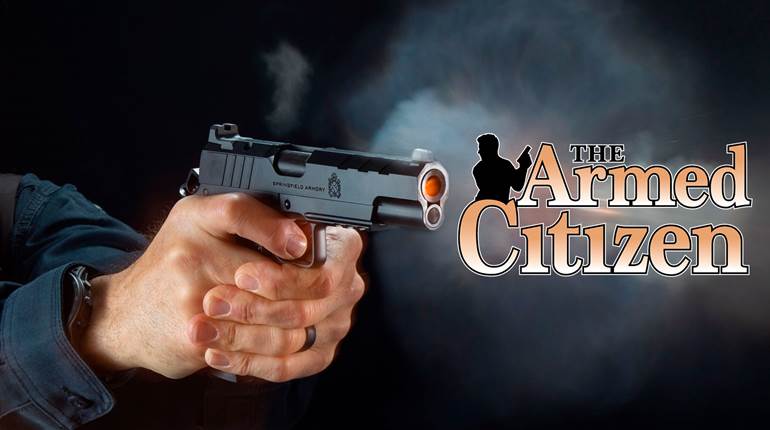
The first R, rise, occurs immediately after the first round is launched downrange. It doesn’t matter what firing platform or non-suppressed system you're using. When there’s a boom, there is muzzle rise.
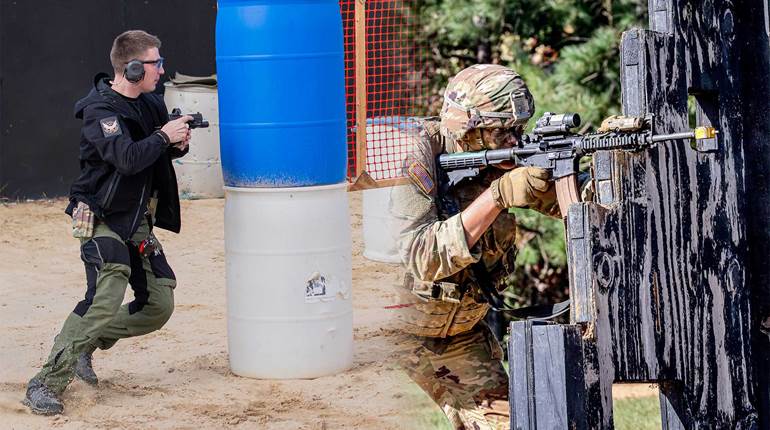
Most rifle systems allow for five points of contact and even grounding to stabilize the long gun muzzle. A pistol has only two: your left and right hands. Even less stable is using either hand unsupported.
For a deeper study, we’ll review the example of shooting a handgun with both hands providing optimal support and muzzle stabilization.
Rise begins immediately after ignition as bore confinement ends and expanding gases begin influencing muzzle movement.
Mechanically, the remedy is simple: limit how high the muzzle is allowed to climb. When split times matter, the amount of time it takes to rise adds to the amount of time it takes to return. Reduce the rise time, and you reduce your return time.
One of many techniques used to reduce rise is a durable grip to avoid unwanted movement, well-trained post-ignition control (what Rob Leatham refers to as a ‘perfect flinch’) to “counter the kick,” as they say, or engaging a rigid enough firing platform—your body in structural support.
Visually, you want to check your work by tracking precisely where your sights moved. Did it go straight up? Did it jog left? Or jog right? This matters immensely in diagnostics as you can’t fix something you can’t see.
Return
For every action, there is an opposite and equal reaction. In the case of return, what goes up must come down. Gravity and recoil spring tension drive the reciprocating slide back into battery and return the muzzle from recoil rise.
Here it’s critical that you don’t introduce any foreign input into the gun. Every unnecessary input creates a correction cycle, and correction cycles cost time.
Maintaining visual control via target-sight connectivity is equally as important as your mechanical control.
Asking yourself the right questions allows for the best diagnostics. Where did the sights go? What did they do? Did they stairstep on you? Did they drop out of your field of vision? Did your arc of wobble increase? These are all visual indicators of how you affect muzzle alignment during the return phase.
The combined visual tracking of Rise and Return is what tells the tale of how well you controlled each. This matters significantly in Realignment.
Realignment
The third and final R is basically the result of how well you controlled the first two. If there was any input on the way up or on the way down, then that input affected muzzle-target alignment, making realignment more work than it needs to be.
A common pistol shooter error is to add input into the muzzle return, which deliberately pushes the muzzle past the realignment point and either results in a low shot placement or forces you to make yet another corrective input which can cost even more time, further misalignment or both.
The goal is not to force the gun back on target. The goal is to manage Rise and Return efficiently enough so that the sights naturally realign with minimal correction required from the shooter. Multiple corrections result in longer split times whereas few or even no corrections result in shorter splits (causing great joy and happiness).
A durable grip, a well-timed post-ignition flinch and a stable but flexible firing platform all contribute to the realignment process. But one of the most difficult and counter-intuitive recoil control remedies is to simply let the gun do what it was precisely designed to do.
Allow it to rise, allow it to return and allow it to realign with the least amount of inputs. If you’re trying to muscle the muzzle to realign, you’re working way too hard and run the risk of foreign input.
The other side of that spinning coin is too much allowance. You can’t completely relax your grip or ease up on structural tension.
There’s a fine line between too much and not enough tension. Too little and the firing platform becomes unstable. Too much and you induce unnecessary inputs that require correction.
That’s the real balancing act. Finding that exact middle ground to set your grip, your structural support, your mechanical and visual control to effectively calibrate the three Rs for optimal performance.
Most Popular