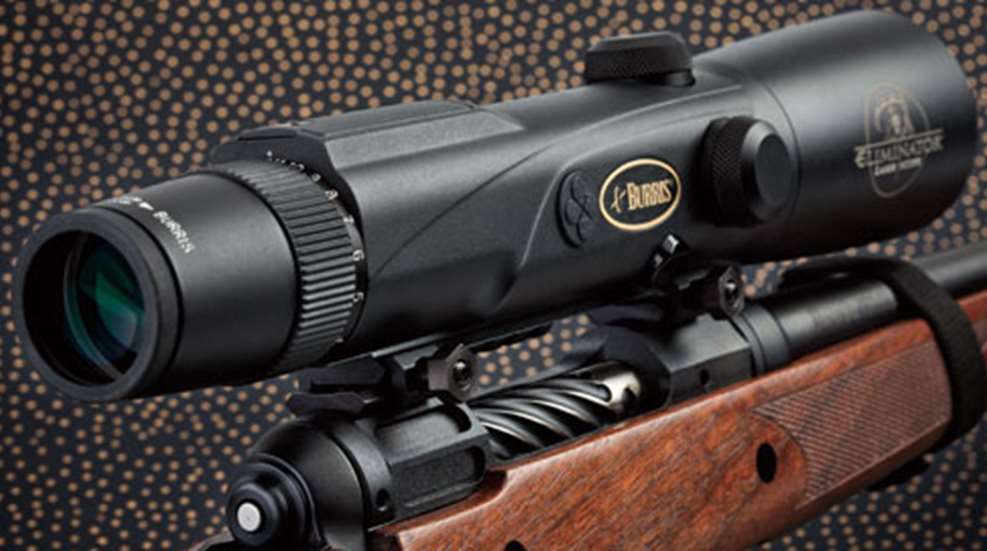
In the firearm, ammunition and accessory industries, “revolutionary” is likely the most overused descriptor; seldom is the product truly deserving of said recognition. But the “Eliminator LaserScope,” as it has been dubbed by Burris Optics of Greeley, Colo., has truly forever changed the optics category. The second-generation Eliminator, reviewed here, only enhances the original’s capabilities in that regard.
From its unconventional appearance to its amassed features, Burris’ Eliminator is undoubtedly different. It is the features, though, that more strongly break with tradition. Rangefinders, and even riflescopes with distance-reading capabilities, aren’t new technologies; however, the Eliminator determines and displays the actual horizontal distance to the target, regardless of angle, then illuminates the corresponding 0.04-mm dot—36 available—that subtends to 1/3 m.o.a. at 100 yards for a dead-on hold.
Both programming and operating the optic are surprisingly simple. After installing the included single CR2 battery, the user depresses the main switch, located about mid-length along the unit’s left side, to turn the unit on. A second push prepares it for programming, which further requires depressing the forward arrow button—right side, about mid-length—and the main switch simultaneously for six seconds. Once the display changes, the buttons can be released. It is then ready to receive user preferences and data.
Using the up and down buttons, the user first selects either yards (Y) or meters (M), with the choice confirmed by depressing the forward button. In a similar fashion, the zero distance is selected next: 0 represents 50 yards/meters, 1 for 100 yards/meters, and 2 for 200 yards/meters. With sight-in distance chosen, the final option is the “Bullet Drop Number” (BDN). Depending on the cartridge (and shotshell) and load, the BDN is determined by drop at 200 yards (50-yard zero) or 500 yards (100- and 200-yard sight-in). The first generation of Eliminators worked only with flat-shooting, center-fire rifle cartridges.
Burris provides a cartridge list with corresponding BDNs for most current rimfire, center-fire and shotgun slug loads; however, it is neither all-inclusive nor exact. Fortunately, determining the BDN requires knowing only the drop at 200 yards or 500 yards. Most ammunition packaging, company literature and websites provide this information, but we recommend going one step further to ensure the utmost accuracy.
Because of varying barrel lengths and tolerances, fluctuations in temperature and changes in altitude, published velocities are seldom achieved. Although less of a concern at shorter distances, such differences greatly influence bullet drop at longer ranges—especially beyond 500 yards. Because an accurate BDN ultimately determines downrange performance, it is advisable to chronograph the load to be used; then using a ballistics program, such as Hornady’s Ballistics Calculator, one should insert the actual velocity, the bullet’s ballistic coefficient, outside temperature and rifle sight-in distance for a more accurate drop. Burris recommends adjusting for 1/2-inch less drop per 1,000-feet increase in elevation. That said, range verification is prudent. It must be noted that although the scope offers 4-12X magnification, it needs to be on 12X for the Eliminator’s trajectory compensation feature to work.
With the Eliminator programmed and the crosshair on-target, the shooter depresses the main switch once to power the unit and a second time range the target. The included wireless remote switch, attachable to the rifle via its elastic band, accomplishes the same task. At the top of the display the target’s horizontal distance is revealed, and the proper aiming dot is illuminated on the bottom leg of the crosshair—simple and effective. The company lists 1,100 cycles as the useful battery life, and accuracy is within plus-or-minus 1 yard.
As for the scope’s other features, the lenses are index-matched and multi-coated, and elevation and windage adjustments are valued at 1/4 inch at 100 yards, with positive “clicks” throughout the range. Protecting the turrets are knurled aluminum caps, and an adjustable eyepiece focus ring ensures clarity.
The Eliminator’s body is from cast magnesium, no doubt contributing to its 1-pound, 10-ounce weight (with mount and battery), and it has a 5.7-inch-long integral rail that attaches to Picatinny and Weaver-style bases. Burris’ own Xtreme Tactical Bases (TXB) were created for the Eliminator, thus offering additional mounting options. Two mounting clamps and a wrench for tightening the clamps’ hex nuts are included.
Range work verified the scope’s adjustment values as accurate and movements repeatable, while three hours in a freezer, followed by submersion in water, proved the unit will resist internal fogging and remain waterproof. The Eliminator was also subjected to two separate range sessions and a hunt. During the first outing—and hunt—last fall the optic was mounted atop an E.R. Shaw Mark VII chambered in 6.5-.284 Norma using handloaded 130-grain Swift Scirocco IIs, and after a quick sight-in at 100 yards, first-round hits were accomplished on targets at distances ranging from 200 yards to in excess of 500 yards. The next day the combination accounted for a representative Wyoming antelope buck at 426 yards.
More recently, the same editor mounted an Eliminator on Savage’s new Model 11 Lightweight rifle, the sample chambered in 6.5 Creedmoor, and shot from a Caldwell Matrix rest. After sighting in at 100 yards, literally removing the bullseye with Hornady Superformance 129-grain SST ammunition, he backed up to the range’s maximum shooting distance: 372 yards. According to Burris’ literature, the load had a BDN of 44 (representing 44 inches of drop at 500 yards), but after inserting the bullet’s BC, the day’s anticipated temperature (90 degrees F), zero distance, and velocity (using factory published velocity of 2,950 fps) into Hornady’s Ballistics Calculator, 46 inches of drop was determined for 500 yards.
Because of the rifle’s abbreviated barrel, as opposed to that used in attaining the factory numbers, the first three-shot group predictably impacted low, with the average about 23⁄16 inches below the point of aim. Changing the BDN to 47 brought the average very close, but the shooter was happier with the results produced by a BDN of 48. With the latter, the group averaged about 1½-inches high, and only a tad left (slight right-to-left wind). None of the groups, however, would have proved ineffective in striking the vitals of an average-size game animal or a reactive target of reasonable size.
Of course, to attain the full potential of the Eliminator one must: have an accurate ammunition/rifle combination; be experienced in judging the wind; and be a proficient marksman. When the aforementioned are combined with the Eliminator’s trajectory compensation feature, long-distance hits are surprisingly easy. The Eliminator represents a real advancement in sporting optics capability and appears to be a well-made, rugged piece of hunting equipment.
Manufacturer: Burris Optics; (970) 356-1670; www.burrisoptics.com
Model: 4-12X 42 mm Eliminator
Finish: matte black
Field of View (@ 100 yds.): 25 ft. (4X); 9 ft. (12X)
Eye Relief: 3-3½"
Exit Pupil: 10.5 mm (4X); 3.5 mm (12X)
Length: 13"
Weight: 1 lb., 10 ozs.
Features: trajectory compensation, integral Picatinny/Weaver-style rail, index-matched, multi-coated lenses
Accessories: remote-activation switch, 2" sunshade, lens covers, owner’s manual, cartridge list (BDNs), batteries
Suggested Retail Price: $899
Most Popular