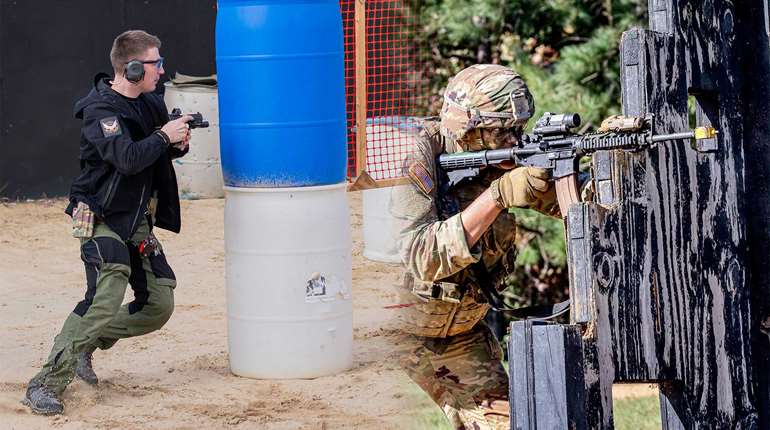
Movement is critically important to surviving a deadly attack. Shooters can use movement to get to protective cover and to force an attacker to alter his point of aim. In both cases, using the alternative shooting positions of kneeling or prone can be very beneficial. However, as in all defensive techniques, some thought and practice must go into making these moves efficient and effective.
To begin with, pistol presentation should be accomplished before the shooter begins to assume the alternative position that he or she has chosen. To do otherwise means that the shooter will very likely cover some part of the body with the handgun while moving into the position. As one can imagine, shooting yourself during a deadly encounter is something to be avoided.
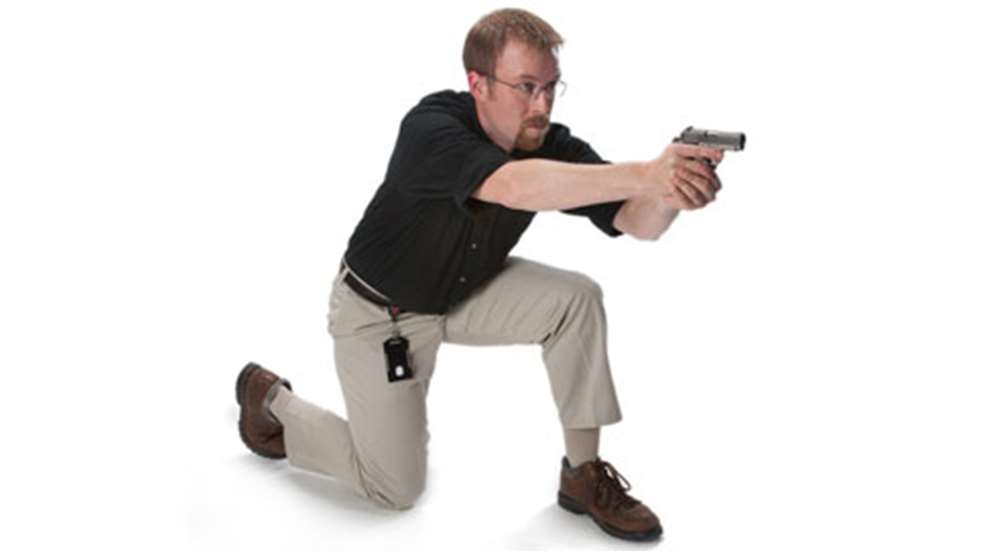
Once the pistol is drawn (keep your trigger finger straight and out of the trigger guard, please), a slight step forward is taken with the support foot. The shooter then lowers into a kneeling position with the strong-side knee on the ground and the support knee raised.
The Braced Kneeling position involves the shooter placing the support elbow on the support knee. The elbow itself should be slightly forward of the kneecap so that you don't have bone resting on bone. Using a good two-hand hold on the pistol, this is a very solid position and accurate shooting can result.
The Speed Kneeling position is acquired in the same manner, with the legs in the same position. In this case, however, the upper half of the body remains erect and uses the standard Weaver grip on the pistol. The Speed Kneeling position is very fast to get assume and fast to leave. In addition, it is almost as accurate a platform as the Braced Kneeling.
The Double Kneeling position has both knees on the ground and the shooter's body erect, using the traditional Weaver hold. In this case, however, the body is facing the threat and simply lowers oneself until the knees contact the ground. This is a fast position to assume and allows the shooter to alter height by sitting back on the heels or raising the body, the better to make use of available cover. The Double Kneeling position, however, does not allow a very fast recovery to the standing position. Also, care should be taken that the shooter doesn't drop into position too quickly, causing unnecessary and painful impact to the knees.
The Prone position is accomplished by dropping first to the Double Kneeling position and then easing the body forward until the shooter is flat on the ground. Whether the shooter chooses to lie flat, or roll slightly onto the side of the body, depends on shooter preference or what is necessary to make best use of available cover.
In using any of the Alternative Shooting positions, the pistol should be in the strong hand and pointed toward the threat. It is critical that the trigger finger remain straight along the gun's frame and out of the trigger guard. The thumb safety, if there is one, should be on. To do otherwise invites a negligent discharge.
It is also critical that the shooter's eyes remain on the threat while acquiring one of these shooting positions. The movements need to be practiced enough so that it is not necessary to look down while moving into these positions. The eyes must stay on the threat. However, it is advisable to place the support hand on the ground for support when getting into or out of the various positions. Thought must be given to being able to get out of these alternative positions quickly in cases where the threat has moved and the position is no longer secure.
When one is forced to engage a threat in the open, quickly dropping to a kneeling position might just confuse the attacker long enough to allow the defensive shooter to get the first center hit. However, in the open, the prone position is not a very good idea because it takes so long to get into and out of. The defensive shooter should stay as mobile as possible while a threat exists.
By practicing the various alternative shooting positions, the defensive shooter will be able to best make use of the available cover. For example, if the shooter takes a defensive position behind the front fender of a car, the criminal might expect him or her to raise up over the car hood to deliver shots. It might come as a complete surprise when the defensive shooter leans around the side to deliver shots, either from kneeling or prone. In short, by effectively using the alternative positions, the defensive shooter can keep the majority of the body concealed behind cover.
Obviously, using the alternative shooting positions requires a good deal of practice. One must be able to move into those positions smoothly and quickly. This only comes with practice. However, it is practice that can be acquired during dry-practice sessions in the home. One should work toward getting into position smoothly and finding the position that gives the most solid platform for launching the defensive shots. As with the initial pistol presentation, one should work for smoothness of movement. Speed comes when smoothness has been perfected.
Most Popular