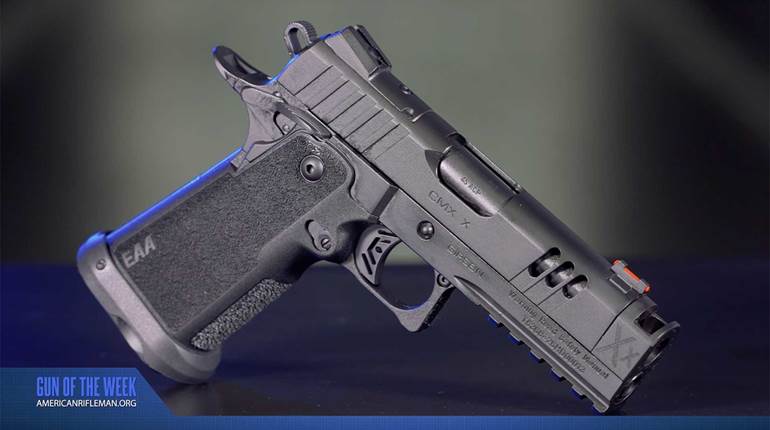
I clearly remember the press conference where Smith & Wesson’s Tommy Campbell announced the .40 S&W cartridge along with the Model 4006 pistol to fire it. The announcement created such a stir that almost anything “Forty” was a viable product. Like so many things, the .40 was a compromise, an effort to increase stopping power without increasing gun size or inadvisably reducing capacity. Most of those design criteria were pretty well met. But I want to make a couple of points here, and that means putting the situation in context.
The need for the .40 came as a result of perceived inadequate performance of the 9 mm cartridge, which dates to 1904 and the Luger pistol. It had scant history in America until after World War II, when it came back in the duffle bags of soldiers. In the 1960s and 70s, police agencies grew restless about the suitability of.38 Spl. revolvers for police work in the auto age. At the time, the order of the day was 9 mm semi-autos with DA/SA triggers, and the various makers competed vigorously. When 9 mm pistols—with the ammo of that day—began to fail, the search for something better began. The .40 was the result. The 9 mm pistols of that era usually had 15-shot magazines, while the .40 contained 11 or 12 rounds. Engineering changes and improvements have given today’s 9 mm magazines as many as 19 rounds, while the newest 40s are around 15 or so. In my book, this renders the capacity difference a very moot point.
It is also a good idea, however, to look at the ammunition. When those old “Wondernine Wars” got rolling in the early 1970s, we were using almost primitive ammo. Sure, it was accurate, clean-burning stuff, but the bullets were 115-grain JHPs of early design. Much effort went into getting the 9 mm to shoot bigger than it had before, even as more makes and models came along. The trend was toward heavier bullets, usually 147 grains or sometimes 124 grains. Today, most 9 mm ammo in service is one of these two weights, and the hollow-point cavities are engineered for reliable expansion. The point is simply that 9 mm ammunition today performs much better than it ever did. And most 9 mm pistols carry many more rounds than ever before.
However, the .40 S&W situation was not stagnate. Almost as soon as the first S&W and Glock pistols and ammunition came along, they started changing. The same improvements that were made to the 9 mm were made to the .40. While the majority of .40 loads featured 180-grain bullets at the start, lighter weights began to appear. The mean is probably around the 165-grain point today. It should also be obvious that neither caliber is frozen in time, and that great effort is underway to make all handgun ammunition perform better.
Handguns in 9 mm Luger and .40 S&W account for the greatest number of police service pistol sales and a big portion of civilian personal defense choices. In the latter category, there is an understandably large slice of the market going to snubby revolvers. Staying with the “Nine and Forty” comparison, it is interesting to note that in several ways, the two are growing closer, rather than farther away. In bullet weight, magazine capacity and bullet velocity, the two cartridges are closer than when they started. Bullet diameter cannot change, but it is established that the more popular round, as far as sales is concerned, is the 9 mm, even though the .40 seems to have a better stopping record.
I’d like to ask my readers to give me their input as to why this is happening. Let me know why you rate one over the other. Please stick to the 9 mm versus .40 S&W issue and not slide off into why you think the .41 Long Colt or .38 Super or whatever is better. I’ll compile them and let you know about the consensus.