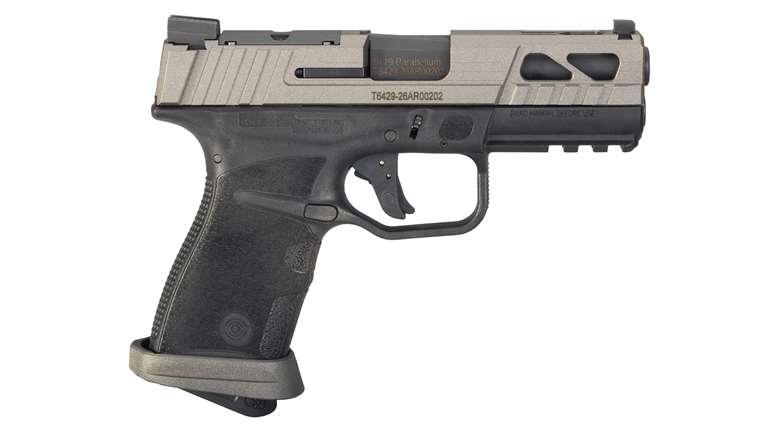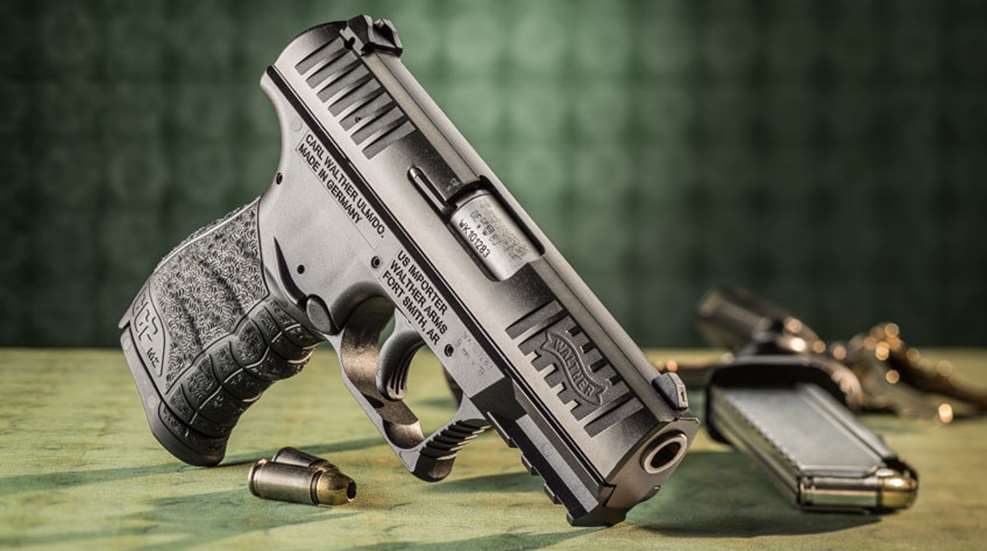
Walther created the modern, semi-automatic, concealed handgun market with the introduction of its model PP (Polizeipistole) in 1929, followed one year later by the classic PPK. In 2014, the company updated the concept with the introduction of its “Concealed Carry Pistol” or CCP. The result falls in size right between the smallest of single-stacks and the mid-size double-stack 9 mm Lugers, making it well-suited for inside-the-waistband or shoulder-holster carry.
Using the 9 mm Luger cartridge requires that the breech of the CCP be kept closed at the moment of firing. This is accomplished through a gas-delayed-blowback design to retard the opening of the action, a concept that got its start with the World War II-era Volkssturmgewehr. In the CCP’s case the system works as follows: When the action is closed, a piston attached to the front of the slide rests in a cylinder below the barrel. Upon firing, a small amount of gas is bled from a port in the front of the chamber to pressurize the cylinder, holding the piston forward to resist the rearward movement of the slide. When the bullet leaves the barrel the pressure drops, and the slide and piston are free to move rearward to extract and eject the spent case and load a fresh cartridge. The Walther gas-delayed- blowback system, dubbed Soft-Coil, allows for a lighter slide profile and recoil spring, which makes for an easier-to-rack slide and lighter overall weight.
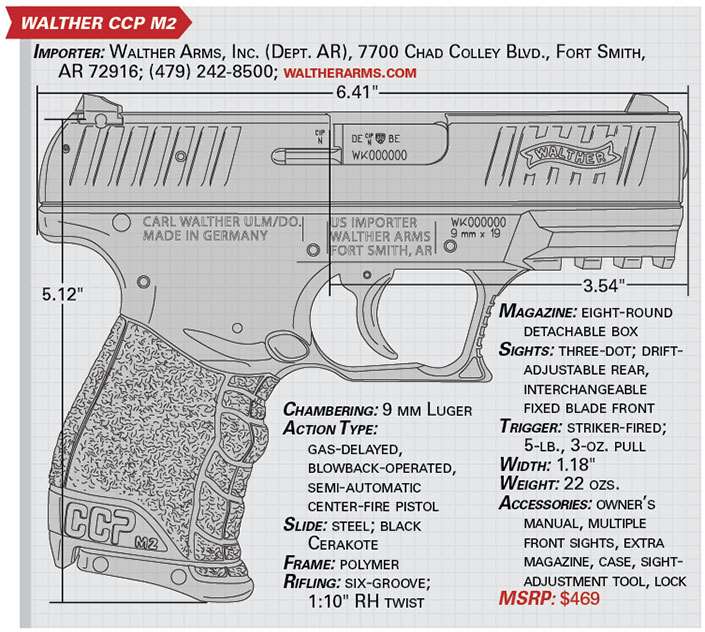
In 2018, Walther announced an update of the CCP based on customer feedback. The M2 version of the CCP has two important upgrades. First, the rear tip of the striker is colored red. When cocked, it is highly visible to the shooter at the rear of the slide to serve as an indicator that the pistol is ready to fire. The M2 retains the original CCP’s notch in the slide at the rear of the ejection port where the rim of a loaded cartridge can be visually observed.
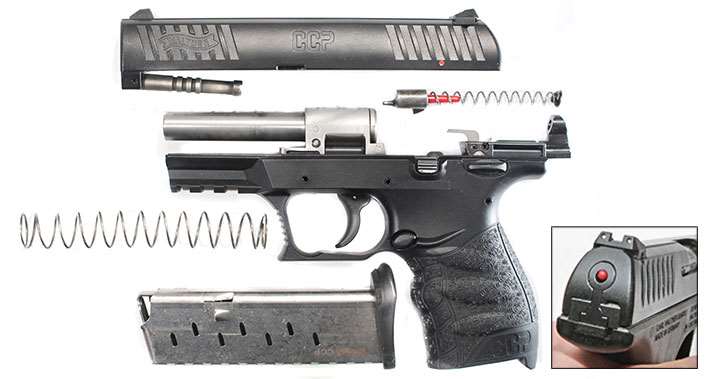
The second upgrade was a simplified, tool-less takedown method. On the original CCP, disassembly required a special tool and a spare hand; on the CCP M2, this process has been made far easier. First, make sure the handgun is unloaded. Point it in a safe direction and pull the trigger to release the striker. Push in on the locking block at the rear of the slide and move the locking block release, located below it, to the right. Moving the slide slightly to the rear and then upward separates it from the locking block and allows the whole assembly to be moved forward and off the barrel. Pointing the pistol muzzle up helps align the piston with the gas cylinder when putting it back together.
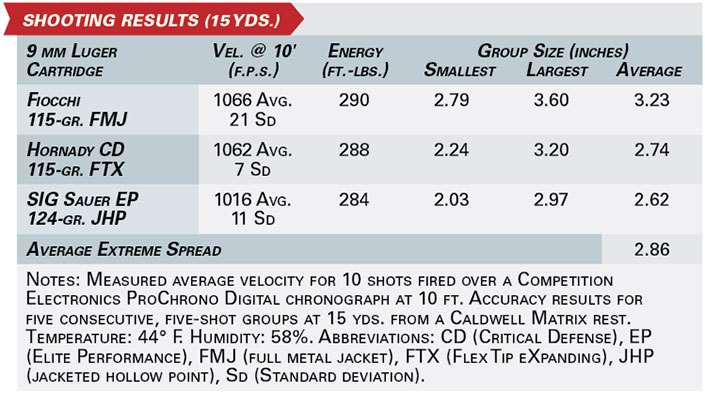
We tested the CCP M2 with a mixture of FMJ, standard-velocity self-defense loads and cartridges specifically designed for compact pistols. Accuracy at 15 yds. was adequate given the short barrel and abbreviated sight radius. Our sample pistol was brand new and had been cleaned and lubricated prior to testing. In the initial 20 rounds of firing with the 115 gr. FMJ there was one “stovepipe” failure to eject, and twice the pistol extracted a spent case and loaded the fresh cartridge, but failed to cock the striker.
In the pistol’s manual Walther warns that if the slide is not fully retracted to the rear during manual loading the pistol will fail to cock. During the initial testing, apparently the slide was not always moving fully rearward during firing. The issue cleared up as the pistol broke-in. As with all firearms intended for use in self-defense, a thorough break-in and testing with your carry ammunition of choice is recommended.
Another aspect of the CCP that may require break-in is the magazine release. With the pistol fieldstripped, the release button can be switched to either the right or left side. In our test pistol it functioned perfectly from the left side, but with the release set up on the right side for left-handed use it took several cycles of removing and inserting the magazines before they would push past the magazine catch and lock in place smoothly.
The pistol’s manual safety and slide release lever are left-side-only. The safety moves on and off easily straight out of the box. With a little practice it can be manipulated with the left-hand index finger, but it’s definitely a right-handed setup.
The CCP’s striker is fully cocked when the action cycles, and pulling the trigger performs two functions: disengaging a drop safety and releasing the striker to fire the handgun. It has no built-in trigger safety mechanism that releases during the initial press—think M1911 and High Power—carry the CCP with the safety on and swipe it off when the pistol is on target. Our test sample’s trigger broke at 5 lbs., 3 ozs.; it pulls through a short initial take-up, followed by a longer, consistent final stage, and needs to be almost fully released before it resets.
Externally, the M2 version is identical to the original CCP, meaning the ever-expanding aftermarket of sights, lasers and holsters will work for either model. The new CCP is not a complete overhaul, but a slight tweak. In its M2 version, Walther took the very good original CCP and made it just a little better by addressing its chief complaint: the onerous takedown procedure.
Most Popular