9/25/2012
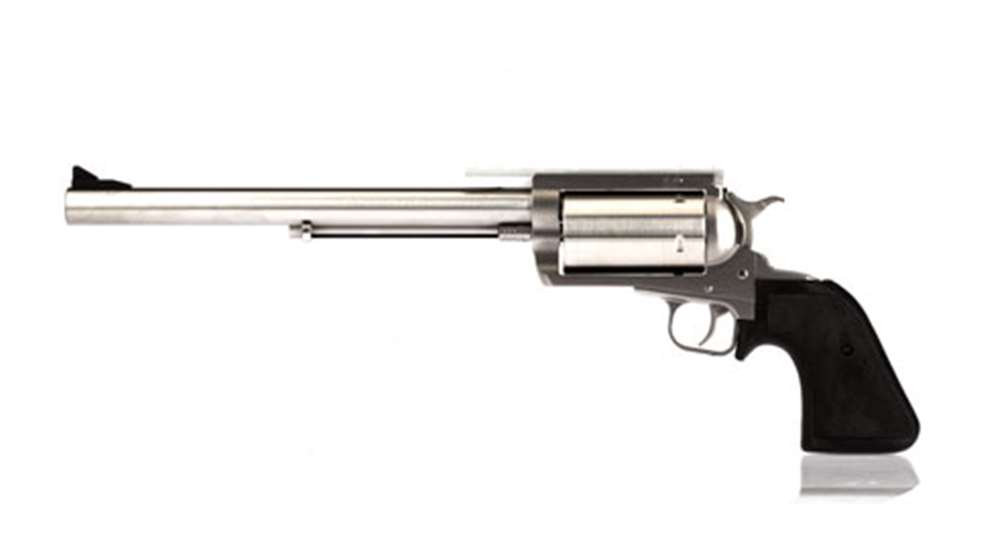
What is known today as the Magnum Research BFR, which stands for Big Frame Revolver, began as a concept gun developed in the 1990s by a small company called D-Max. Its plan was to use the Ruger Blackhawk as a template to build single-action revolvers with an extended frame and cylinder to chamber rifle cartridges and .410 shotgun shells. In 2000, Magnum Research purchased the rights to the D-Max revolver. Jim Tertin, director of manufacturing, redesigned the gun to resolve lingering problems with the original model to prepare it for production. In that same year, the first three models of the BFR were made available, including the .45 Colt/.410 model (with a removable choke), .45-70 Gov’t and .454 Casull. By 2001, most of the diverse caliber options listed in the current catalog were available. Recently, a few new caliber options have been added, including the .460 S&W, .500 S&W, and the .500 JHR.
The BFR single-action revolver features a five-shot cylinder, rubber stocks, adjustable target sights and all-stainless steel construction. Five different stainless alloys are incorporated into the revolver to ensure the individual parts have the correct level of hardness to handle the pressures generated by potent calibers. Loading and unloading is conducted with the hammer in the fully-forward position. Opening the loading gate allows the cylinder to turn freely in either direction for easy loading. A transfer bar transmits the hammer’s blow to the frame-mounted firing pin, allowing the gun to be safely carried with all five chambers loaded.
It should be noted here that BFRs are factory-custom guns. The company offers its customers access to the in-house Precision Shop, which provides a variety of custom options. It employs a proprietary sizing process to ensure that the frames, grip frames and cylinders are all exact in their dimensions for proper fit. The barrel/cylinder alignment is held to under 0.002 inches of concentricity. Barrel lapping, parts fitting and product inspections are all conducted by hand. The rifling twist rate has been tested to ensure the best fit for each chambering. The height of the adjustable rear sight and the front sight blade are also matched to the caliber and barrel length.
With a brief examination of the calibers and barrel lengths listed, it shouldn’t be too much of a surprise to learn that BFRs are favored for handgun hunting. With that application in mind, a .30-30 Win.-chambered BFR with a 10-inch barrel was requested for testing. The revolver arrived with a factory Weaver-style scope rail which can be installed in place of the rear sight assembly. With the rail in place, the revolver was topped with a Leupold VX-3 2.5-8X 32 mm handgun scope and evaluated for accuracy at 50 yards. The crisp, no-creep, single-action trigger broke at 3 pounds, 7 ounces, but it felt lighter. The level of felt recoil was stout, but not punishing. Tertin mentioned that he has developed a .30-30 Win. handload for his BFR, loaded with 165-grain spitzer boattail bullets, that will produce 1.5-inch groups at 50 yards using his favorite Leupold scope. With the factory loads I fired producing groups around the 2.25-inch mark, I believe the right load could easily produce the same level of accuracy he described.
Model: BFR Revolver (BFR30/30)
Caliber: .30-30 Win.
Action Type: single-action, center-fire revolver
Frame: brushed finish stainless steel
Barrel: 10"
Rifling: six groove; 1:10" RH twist
Cylinder Capacity: five rounds
Sights: fixed blade front, windage and elevation adjustable rear
Trigger: single-action: 3-lb., 7-oz. pull
Overall Length: 17½"
Width: 1¾"
Height: 6"
Weight: 85 ozs.
Accessories: lock, manual
Suggested Retail Price: $1,050
Most Popular