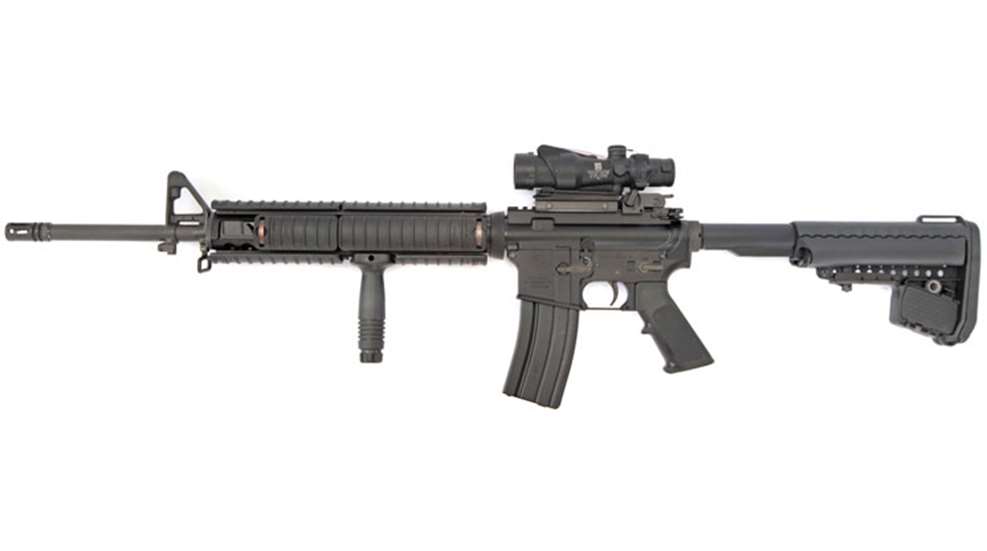
In the firearm world modularity is the name of the game, from interchangeable backstraps for handguns to caliber conversions for rifles. Nowhere is firearm modularity more important than the military. One “weapons system” has to adapt to a wide range of physical sizes, missions, climates and geography. It is in this arena that the M16 has excelled. As the ability to swap out parts quickly and easily has endeared the AR-15 to the civilian world, the flexibility of the M16 platform has led to its adoption around the world.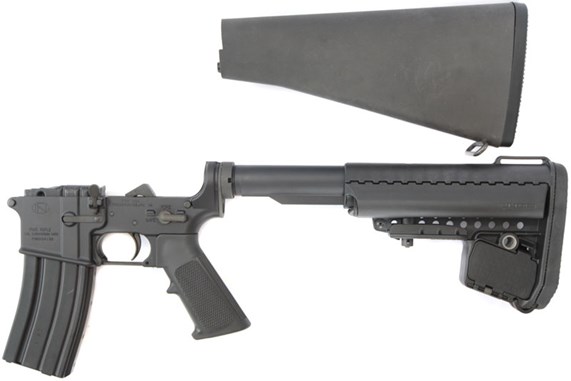
VLTOR’s A5 stock conversion (shown bottom installed), when extended to its furthest position, gives a length of pull longer than a standard A2 stock (top).
In the first decade of the 2000s, the U.S. Marine Corps was looking to hold on to its M16A4s, but was feeling the need for a little more flexibility in the platform. The rifle’s fixed stock had always been a little too long for smaller-statured troops. The trend for wearing body armor brought this problem to everyone. If you look at photos of soldiers and Marines firing the M16A4 when wearing body armor, you’ll notice they usually have the toe of the stock planted on the extreme edge of their shoulder or upper arm, with their body canted 45-degrees to their target to achieve a proper length-of-pull and eye relief. To address this problem, in 2009 the Marine Corps put out a Request For Information concerning the possibility of a collapsible stock system for the M16A4 that wouldn’t compromise the rifle’s reliability.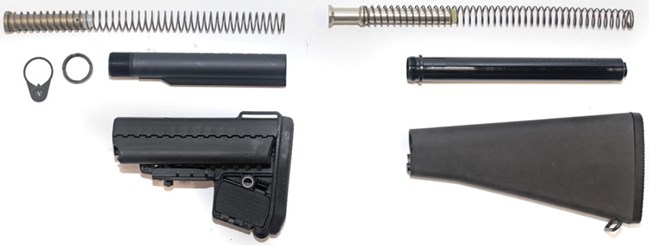
The components of VLTOR’s A5 stock conversion (left) compared to the standard A2 stock components (right). The VLTOR conversion uses an intermediate length receiver extension and buffer, paired with a standard rifle action spring. The VLTOR extension attaches to the lower receiver like a standard M4 extension with a receiver end plate and castle nut.
An answer came from VLTOR Weapons Systems, which introduced its A5 Conversion system (it was assumed that the A4 rifle modified with a collapsible stock would become the M16A5). Instead of using standard M4 carbine components, VLTOR designed a completely new receiver extension and buffer. The extension, while longer than those used on the M4, is shorter than the part used on a fixed-stock rifle. The buffer, which is likewise longer than an M4 buffer but shorter than a rifle buffer, is paired with a rifle-length action spring. The extension is attached in the lower receiver in the manner of a standard M4 stock setup with a receiver end plate and castle nut. The VLTOR kit ships with a 5.3 oz. buffer. The A5 buffers are available in five different weights, from 3.8 ozs. to 6.83 ozs., to fine tune a rifle’s performance. The kit is compatible with both direct-impingement and gas-piston AR systems, except those chambered in .308.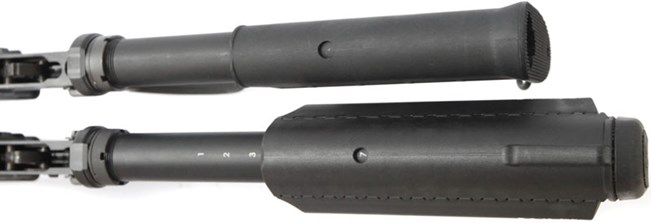
The VLTOR A5 stock conversion (bottom) provides a longer length of pull when fully extended than a standard M4 stock setup (top). The VLTOR extension has seven positions of adjustment and has marks that are visible through a witness hole on the supplied EMOD stock.
VLTOR pairs the new extension and buffer with its Enhanced Modular (EMOD) stock. The stock, available in black, tan or green, features a generous cheekpiece on each side, bilateral quick-detach sling swivel points, three battery compartments (two are waterproof) and a rubber recoil pad.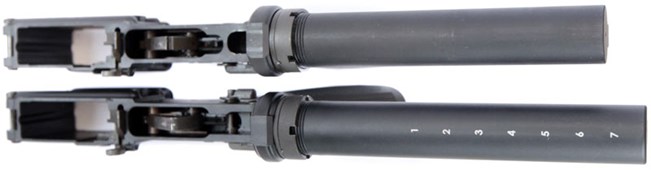
VLTOR’s A5 stock conversion uses an intermediate length receiver extension (bottom) that is longer than a standard M4 extension (top).
The A5 EMOD has seven positions of adjustability. Fully extended, the length of pull (LOP) is 15.25”—longer than an A2 stock for those who need it. Moving in to Position 5 (the receiver extension is marked with the number visible through a witness hole on the EMOD stock) yield about the same LOP of a standard A2 stock. Position 2 puts results in about the same length as an A1 fixed stock. All the way collapsed gives a LOP of 12.38” or about the same length as the third position out on a four-position M4 stock. The fully collapsed A5 stock setup takes the overall length of a rifle with a 20” barrel down to 37.25” or about 2.25” shorter than a fixed A2 stock rifle.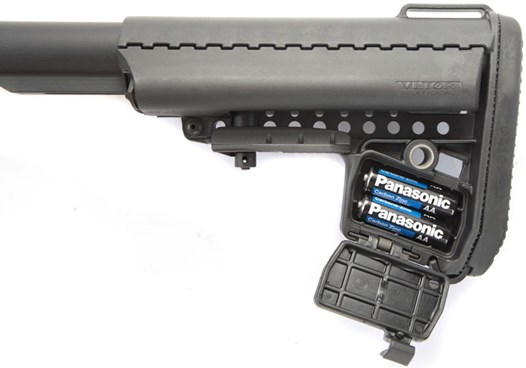
VLTOR’s A5 stock conversion is supplied with the company’s Enhanced Modified, or “EMOD” stock. Among the stock’s features are a battery compartment.
Besides LOP issues, another problem the VLTOR A5 system fixes is eye relief when using optics. When placing an ACOG far enough forward on a flat top receiver to put a backup sight behind it, it’s often hard to get the proper eye relief with a fixed A2 stock. Bringing the VLTOR in a few clicks on our FN 15 test rifle, fitted with the 4x32 ACOG and the MaTech backup iron sight, fixed this.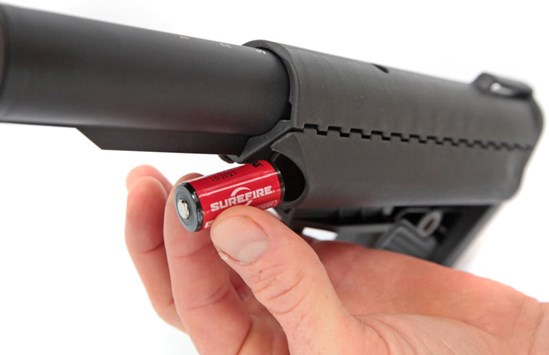
VLTOR’s A5 stock conversion is supplied with the company’s Enhanced Modified, or “EMOD” stock, which features two waterproof compartments for storing the CR123 batteries used in many electronic sights.
The price of modularity? All of the components for the A5 kit weigh just 3.4 ozs. heavier than an A2 stock, receiver extension, spring and buffer. The complete kit with stock retails for $215.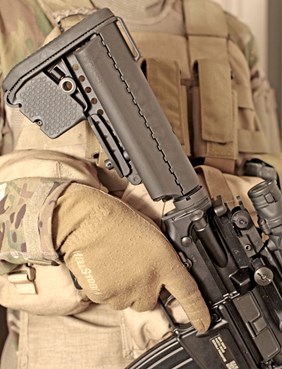 In Marine Corps testing, VLTOR’s A5 stock provided as reliable as a fixed stock M16A4. While some VLTOR A5-equipped M16s were used in the field, the M16A5 was not to be. The Marines decided to go with the M4 carbine to replace their M16.
The VLTOR A5 stock kit fixes the same problem in the civilian world that it did in the military. It gives the owner of a 20” barreled rifle an adjustable length of pull without sacrificing reliability. It is also an upgrade for shorter barreled M4-style carbines, where VLTOR claims it will slow down the cyclic rate and improve reliability. And for those who have to have a clone of every rifle in the U.S. arsenal, they can use the VLTOR kit to build the A5, the M16 that never was.