Within the pantheon of U.S. Marine Corps small arms, two rifles are indelibly linked with the Corps’ combat experience in the 20th century, and both were designed by Marines: the Model 1941 Johnson Rifle and the M16. Of the two guns, one is a footnote in military small arms history while the other remains one of the most widely used military rifles of all time.
The M1941 Johnson Rifle ended up in limited Marine Corps service through a roundabout procurement process. In the late 1930s, Melvin Johnson, a Boston attorney and Marine Corps Reserve captain, developed a recoil-operated mechanism he considered to be an improvement over the Garand’s gas-operated design. An informal test was held in June 1938, but as the Ordnance Dept. was already fully invested in the Garand, it showed no further interest.
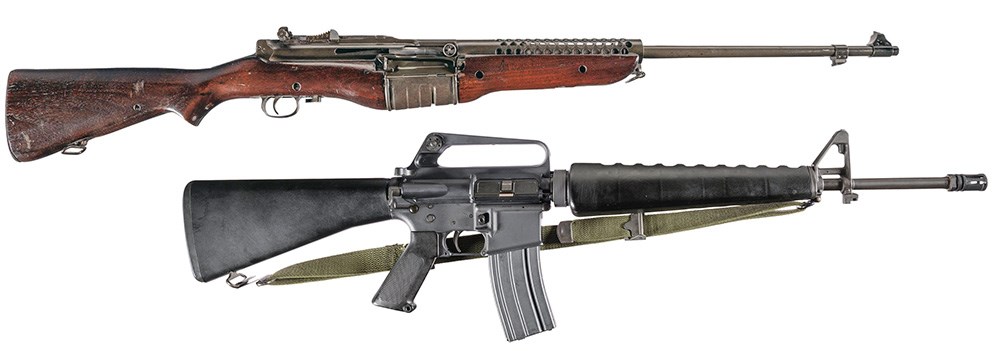
However, the Netherlands Purchasing Commission ordered more than 20,000 Johnson Rifles in 1940 to arm forces in the Dutch East Indies. Following the Japanese invasion of 1941, the U.S. government prevented most of these rifles from being shipped overseas. Ultimately, 750 of the guns were procured by the Marines, with 242 of them being officially issued to the Marine Corps 1st Parachute Regiment.
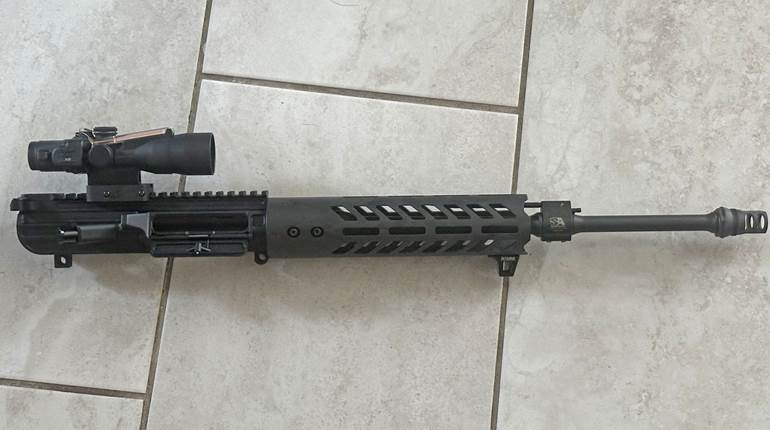
Conversely, the M16 developed by Eugene Stoner, who served in the Marine Corps during World War II as an armorer, ended up being one of the principal small arms of the Marine Corps in recent decades, but it, too, came into service through a roundabout procurement process. Stoner initially developed a .30-cal. semi-automatic, the Armalite AR-10, that was tested by the U.S. military and rejected in favor of the design that ultimately became the M14. In 1957, his design was scaled down to chamber the .223 Remington, a .22-cal. cartridge designed to meet the specifications of a U.S. Continental Army Command request for a rifle chambering a small-caliber, high-velocity cartridge. The “XAR-1501,” as it was first known, was demonstrated by Stoner himself, beginning a chain of events that, by 1969, ultimately led to widespread adoption of what became officially designated as the M16 by all branches of the U.S. military.
Of the many Marines who have served throughout 250 years of history (p. 48), Johnson and Stoner took a slightly different tack on that age-old creed: “Every Marine A Rifleman.”
Most Popular