When Thompson/Center looked into expanding its product line beyond muzzleloaders and single-shot Contenders and Encores, it wanted to do it right, and that meant building rifles with features that hunters and shooters would want such as an adjustable trigger and 5R rifling. Out of those requirements came the Thompson/Center ICON.
Introduced in 2007, the bolt-action ICON quickly earned a reputation for accuracy and reliability as a big-game hunting rifle. Now, T/C is expanding into the varmint and long-range shooting markets with the ICON Precision Hunter.
The ICON Precision Hunter features the Interlock bedding system and a heavy, 22-inch, fluted match-grade barrel with 5R rifling and a crowned muzzle for consistent accuracy. The stock is bench-rest styled with a beavertail fore-end in laminated wood and a raised cheek piece to mold the shooter's face to the rifle in line with a scope.
Instead of being drilled and tapped for scope mounting, the Precision Hunter comes with an Integra base for Picatinny-style scope rings, which provides a stable platform and allows scopes to be quickly replaced if needed. The receiver is CNC machined, and the bolt is Black Nitride treated and roller burnished for a smooth reloading action from the detachable three-round magazine. The Precision Hunter also comes standard with BoltLock, which allows the rifle to be loaded and unloaded with the two-position safety in place, and SwitchBolt for swapping the tactical bolt handle to whatever style the shooter is more comfortable using.
The trigger is crisp and adjustable between 3.5 and 5 pounds with almost no creep, helping the accuracy of the Precision Hunter, which comes with a test target showing a MOA grouping of three shots under one inch at 100 yards.
However, the most interesting new feature on the Precision Hunter is the Cooling Enhancement System. Competition and varmint shooters send a lot of rounds downrange, considerably heating up the barrel. In addition to the fluted barrel, T/C's Precision Hunter uses their new system of ported channels in the forend to circulate air around the barrel to keep it cool, providing more consistent accuracy as shot count goes up.
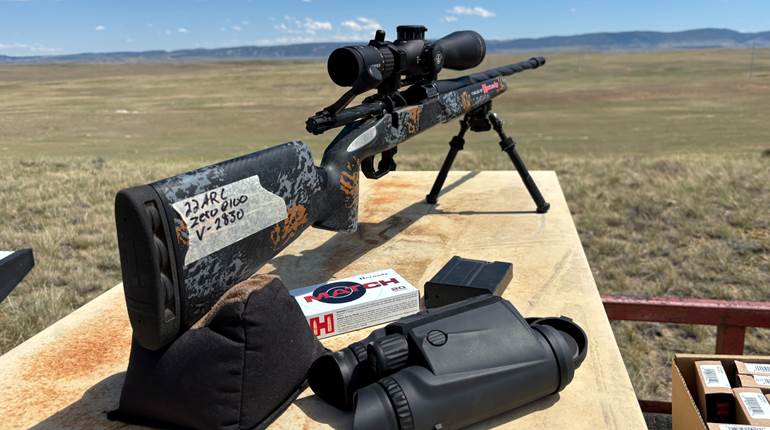
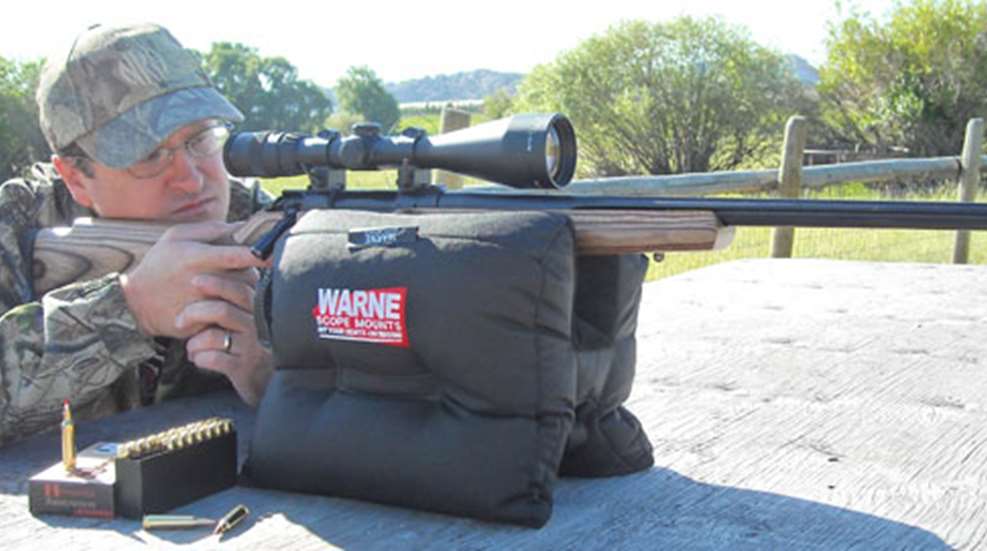
Testing on the Precision Hunter was conducted in a real-world situation at the Silver Spur Ranch in Encampment, Wyo. Before heading out for varmints, we matched the Precision Hunter with a Trijicon AccuPoint 5-20x50 mm scope with a Green Triangle Post reticle to become familiar with the rifles at the range.
The first thing I noticed about the Precision Hunter was the look of the laminated stock and blued barrel. There is a classic beauty you get with laminated wood and blued metal that just isn't the same with today's popular synthetic and stainless rifles. The next thing I noticed as I picked it up was its weight. Exactly opposite of a mountain rifle, this gun was designed to be carried a little and shot a lot.
While definitely heavy, the Precision Hunter points well, especially using Trijicon's Post reticle, which draws the eye quickly to the target. Its bench stock fit well into shooting sticks, bags and everything else we used as rests when reaching out for the long shots this rifle was designed to take.
When needing follow-up shots, which happened more than I would like to admit, the Nitride-treated bolt allowed smooth, fast reloads from a variety of shooting positions. The crisp, light trigger allowed me to make shots outside of 300 yards on some very small targets. Even as the barrel heated up with multiple shots, accuracy stayed pretty true with most of my misses being attributed to my shooting skills rather than the rifle.
Overall, the Precision Hunter conducted its job well on prairie dogs and my first Western coyote, which folded when a .22-250 Rem. Hornady V-Max 40 gr. bullet hit it at 209 yards. I'm now curious to try out a larger caliber on bigger game. Maybe the .308?
Manufacturer: Thompson/Center; (603) 330-5659; Tcarms.com
Caliber: .22-250 (tested), .204, .223, .243, .308
Capacity: 3+1
Action: Fat bolt with tactical handle (replaceable)
Receiver: 4140 Steel
Barrel: Blued 22-inch fluted with crowned muzzle
Rifling: 5R, 1:12 RH twist (.22-250)
Magazine: 3-round Detachable with single-shot adaptor
Sights: None, Integra base for Picatinny scope mounts
Trigger Pull: Adjustable 3 to 6 pounds
Stock: Laminated wood
Overall Length: 42 inches
Weight: 8 pounds
Suggested Retail Price: $1,149
Most Popular