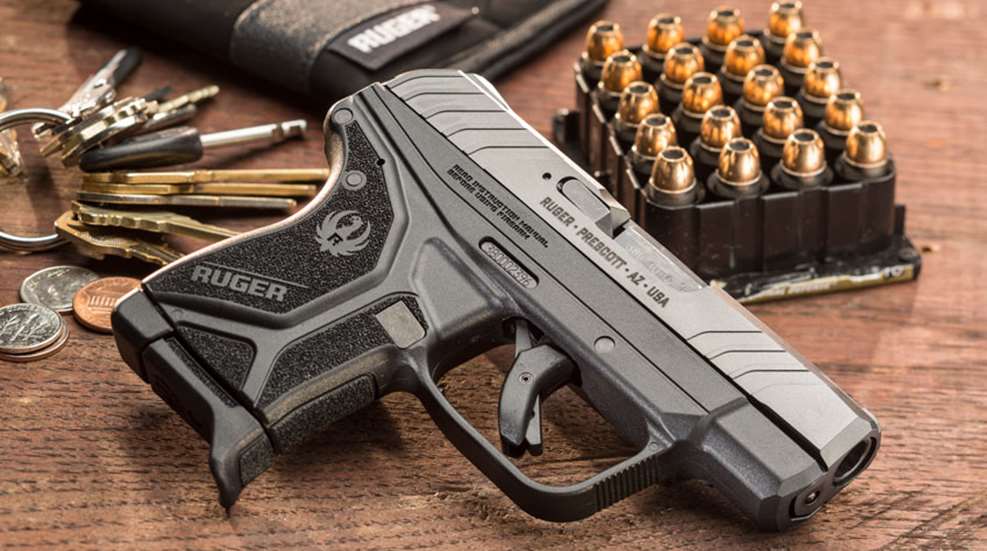
With its 2008 introduction of the Lightweight Compact Pistol (LCP), Ruger defined the modern pocket pistol. A locked-breech, hammer-fired, semi-automatic design chambered for .380 ACP, the pistol was slim, trim and snag-free—traits much desired in today’s concealed-carry firearms, and we have the LCP to thank for blazing the trail. Of course there are other handguns, old and new, that offer performance and portability on par with the LCP, but with more than 1.5 million units sold in less than nine years, Ruger’s pocket pistol has been a runaway commercial success and a crucial stepping stone in the evolution of personal-defense firepower.
In the concealed carry arena today, we talk a lot about compromise. Firearm manufacturers and armed citizens alike must balance characteristics such as power, capacity, weight and handling in order to meet specific requirements. Needless to say, despite the accolades and success garnered by the LCP, the pistol was a case study in compromise: it was snag-free to the point of being effectively sight-free; it was safe to carry thanks to its onerous double-action trigger; it was small and lightweight, but these, combined with relatively mild grip texturing, allowed even the .380 ACP cartridge to inflict noticeably snappy recoil. Ruger’s brand new LCP II aims to strike a better balance for consumers and evolve the platform that defined a class into a best-in-class proposition.
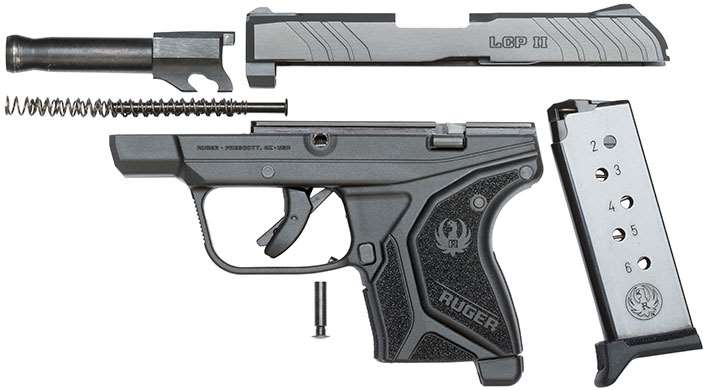
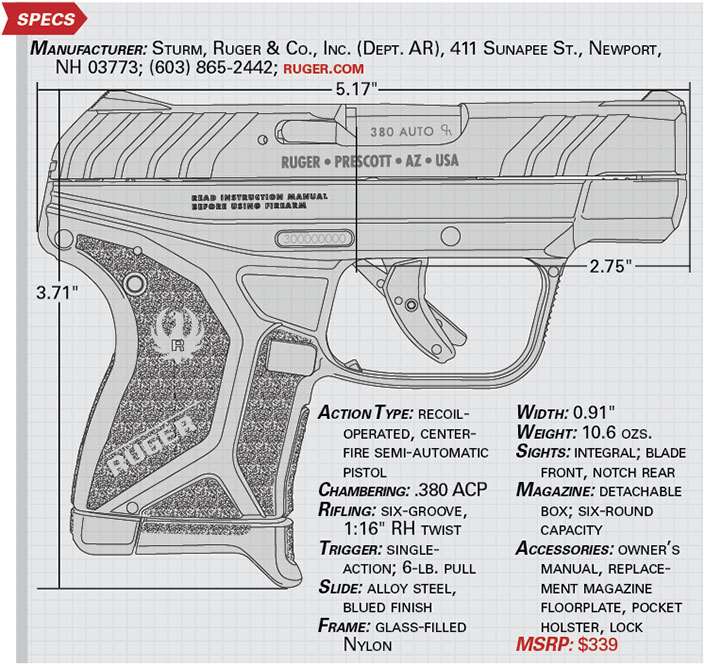
The LCP II is very nearly the same size as the original, but its exterior appearance is distinct. While all the edges remain contoured to prevent hang ups during the draw, the LCP II is decidedly more angular than the earlier model. From the slide’s cocking serrations, front and rear, to the textured portions of the polymer frame, the lines of the gun are unmistakably polygonal, though softened and beveled. It’s really a good-looking gun, but the aesthetic improvements are just a happy result of utility-driven enhancements. For example, the cocking serrations are not only stylish, they feel deep and are easy to grasp when manipulating the slide. Likewise, the geometry of the molded frame, including the beefed-up backstrap and the mapping of the textured portions—the pattern feels like relatively coarse skateboard tape—combine to enhance the user’s ability to handle the little gun, and control it under recoil. Regarding the features, the former swells the rear of the grip frame by about 0.2"—making it 0.91" wide—of hand-filling width within a crescent-shaped area that runs from beavertail to butt.
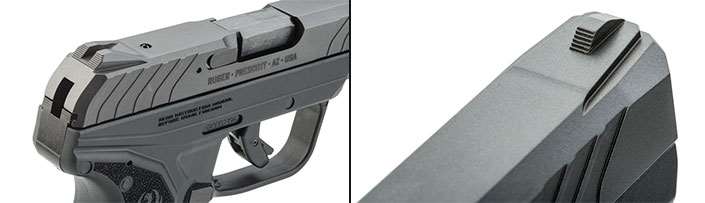
Beyond its new cocking serrations, the slide has also had an upgrade to its integral sights. The front post and rear notch are still small and black, but they are decidedly larger and more usable that those of the original LCP. They have glare-reducing horizontal serrations commonly seen on the fully adjustable rear sights of target pistols, and while I don’t expect the LCP II to show up to any bullseye competitions, the sights are very usable inside of 25 yds., even considering the gun’s short 4.5" sight radius.
Also aiding accuracy is the LCP II’s new trigger system. Where the original LCP’s 10-plus-lb. double-action trigger was undoubtedly safe, in the same sense as a double-action revolver, it was also a detriment when taking aimed shots at distances longer than arm’s reach. The LCP II utilizes a new single-action mechanism where the internal hammer is fully cocked by the rearward motion of the slide, resulting in a consistent and clean trigger pull of around 6 lbs. The new trigger also makes use of the familiar blade safety, as seen on many popular semi-automatic pistols today, so compared to the original LCP, the firing system is much improved without sacrificing safety.
The final change of note for the LCP II is the automatic slide hold-open function. The gun retains the manual slide lock lever from the original, but the LCP II’s slide will automatically lock open on an empty magazine. The LCP II ships with one six-round-capacity magazine featuring a textured floorplate with an extended finger shelf to accommodate a two-finger grip. A flush-fitting replacement floorplate is also included. Smartly, the LCP magazines of either generation are compatible with both firearms, however, the last-round hold-open function only works with LCP II magazines in an LCP II. Also included with a new LCP II is a black synthetic pocket holster that, while not fancy, is entirely serviceable and a nice added value.
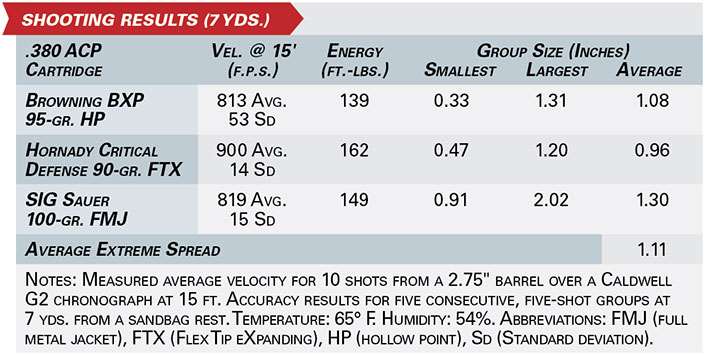
At the range, two things became quickly apparent. First, the LCP II is a big improvement over its predecessor in terms of shootability. I found the sights to be very easy to use and the trigger to be on par with production striker-fired pistols. So, while not intended for 25-yd. shooting, the LCP II’s combination of features allowed me to easily keep shots on a silhouette target at that range. Closer in, the gun was just plain accurate, as seen in the accompanying table. Due to its intended role, chambering and 2.75" barrel, the LCP II was formally evaluated for accuracy at 7 yds.
Still, it was equally clear that this is not a gun meant for extended range sessions. Even with the ergonomic improvements, this is a small, lightweight gun, and recoil, while manageable, is definitely noticeable. But in discussing this one apparent drawback, really the result of a compromise between size and power, we get to the crux of the matter: Like the original LCP, the LCP II is a purposefully designed pistol that compromises in terms of features and dimensions in order to best fulfill its intended role as a deep concealment, personal-protection firearm. It fulfills that role with aplomb, offers real improvements over its predecessor and leads in a class that Ruger, with its original LCP, really helped to define.
Most Popular