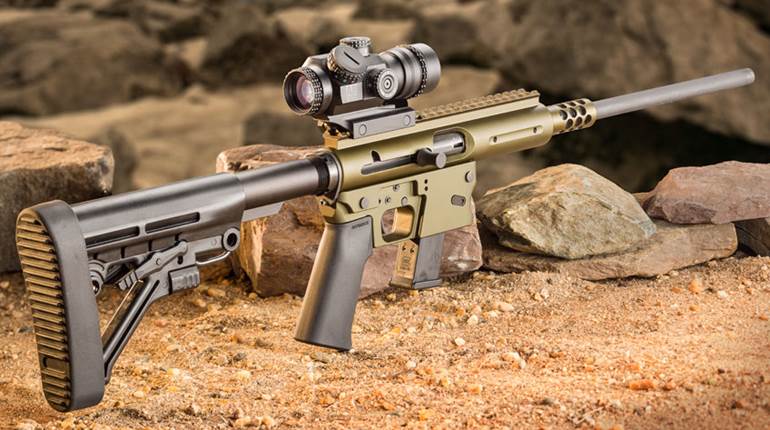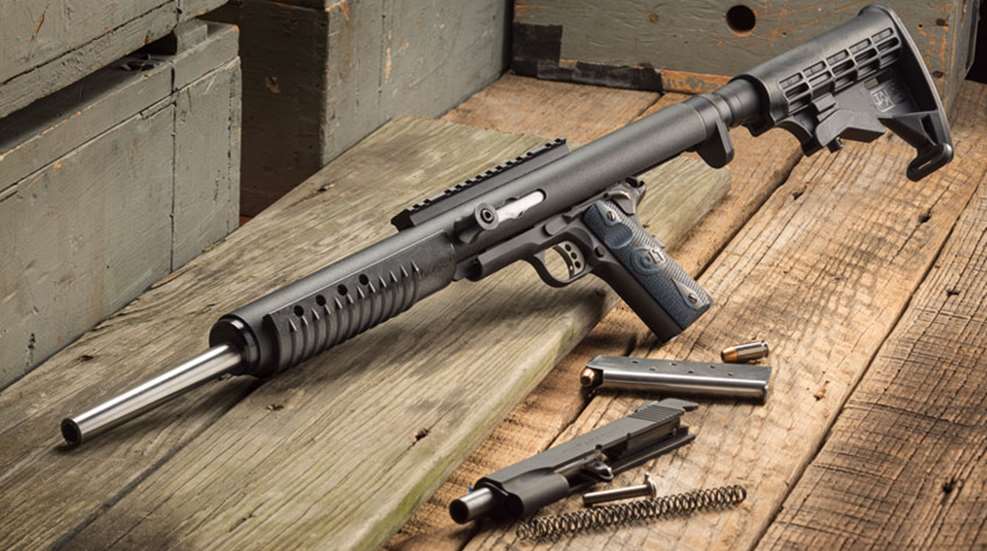
Installing without tools onto a full-size M1911 frame (not included), the Mech Tech Carbine Conversion Unit (CCU) legally coverts John Browning’s venerated pistol into a 16¼"-barreled carbine. Essentially functioning as an AR-style upper receiver once mounted in place, the non-serialized CCU (which is deemed by the ATF to be an accessory until installed atop an autoloading pistol) replaces the host gun’s slide and barrel assembly. The new configuration allows the carbine to retain the pistol’s superb single-action trigger and comfortable grip angle, as well as to utilize some of the host handgun’s operating controls—which will be seen as real boons to fans of old Slabsides—while increasing the firearm’s ballistic performance and accuracy potential.
Made of rolled steel with a powder-coated finish and a corrosion-resistant interior coating, the CCU’s cylindrical housing encases a simple blowback operating system that uses the energy exerted by expanding propellant gases on the cartridge case to cycle the action. An extractor located on the bolt draws the spent case from the chamber where it can be expelled from the upper by the lower’s ejector. The bolt’s rearward motion is then stopped upon contact with a thick rubber block, and the gun’s recoil springs (located along the top of the bolt assembly) drive the action closed again, stripping a fresh cartridge from the detachable box magazine and chambering it along the way. The CCU does not lock back on an empty magazine.
A reciprocating charging handle is found on the left side of the unit, and the bolt can be locked in the open position by retracting the handle and then pushing in on it until it engages a notch in the wall of the housing. Even after conversion to a rifle, the CCU still utilizes the host M1911’s grip and frame-mounted thumb safeties, as well as its magazine release button, which should make the carbine’s manual of arms familiar to handgunners.
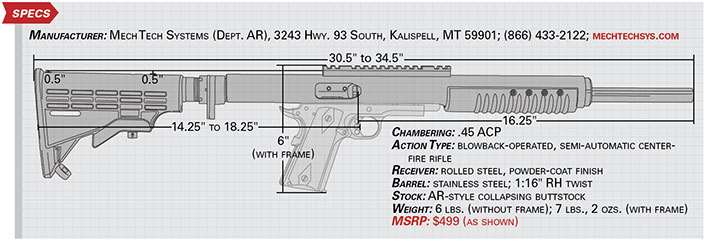
Mech Tech offers the CCU with four different buttstock options. The unit reviewed here includes an adjustable, M4-style stock that can be replaced in typical AR fashion; however, fixed and telescoping versions are also available. Base models all come with a 6" segment of Picatinny rail along the top of the receiver and a molded foregrip. Many optional accessories—such as additional rails, sights, lights and vertical foregrips—can either be factory-installed at the time of purchase or bought separately. While federally permissible, state and local laws in certain areas may prohibit some configurations of the CCU, so care should be exercised to ensure legality.
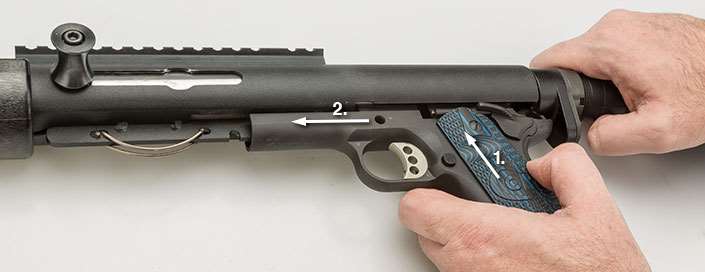
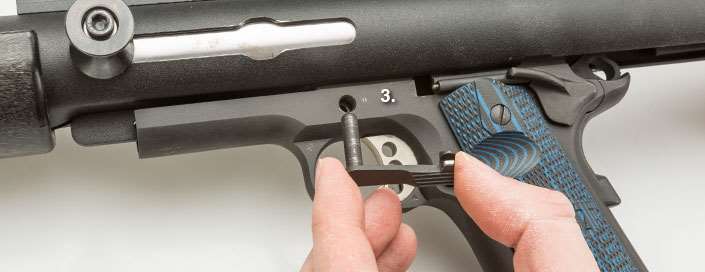
No permanent modification needs to be made to the host M1911 in order to install the CCU, and the process is easily reversible. First, separate the slide and barrel from the pistol’s frame, leaving the hammer cocked. Next, retract the unit’s bolt and lock it in the open position. Now, mate the rails inside the CCU with those located on the frame, pushing the frame forward as far as it will go. Finally, reinstall the M1911’s slide release to lock the components together.
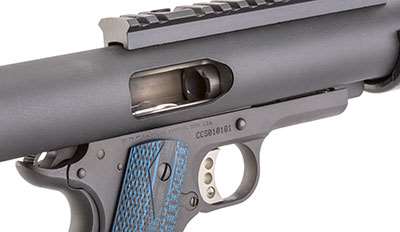
Our evaluation CCU was chambered in .45 ACP, with a 16¼" stainless steel barrel and 1:16" right-hand twist rifling. Mech Tech also offers 1911-compatible uppers in 10 mm Auto and .460 Rowland—with 9 mm Luger models likely coming in the future. According to Mech Tech, the CCU should be compatible with nearly all single- and double-stack 1911 frames, however, it would be prudent to check with the company regarding suitability with a specific model.
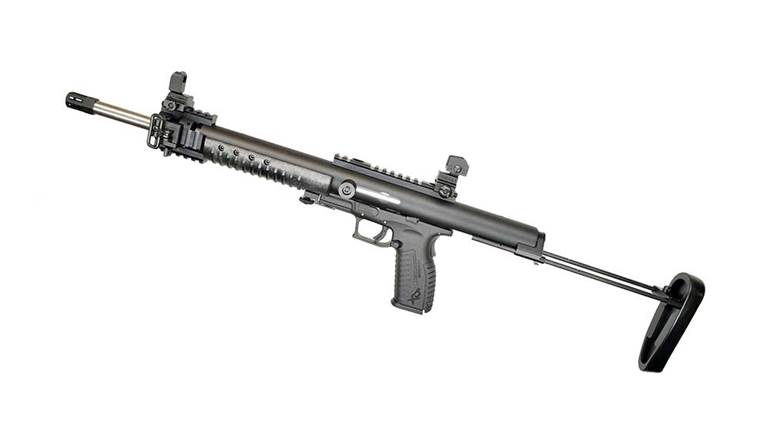
In addition to the M1911 unit tested here, Mech Tech produces CCUs that are compatible with both compact and full-size Glock models and most Springfield XD/XD(M) platforms. The Glock conversion kit is offered chambered in 9 mm Luger, .40 S&W, 10 mm Auto and .45 ACP, while the Springfield uppers are being produced in 9 mm Luger, .40 S&W and .45 ACP.
In order to function and accuracy test the Mech Tech CCU, we installed it atop a Colt Competition—the same serial number used in American Rifleman’s review of that model in August 2016 (p. 48). Through approximately 400 rounds, the CCU did not exhibit any failures to function. We elected to conduct accuracy testing using an ammunition load that had previously been shot through the gun during its prior evaluation—SIG’s V-Crown 230-gr. jacketed hollow point.
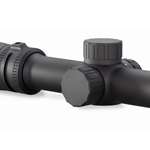
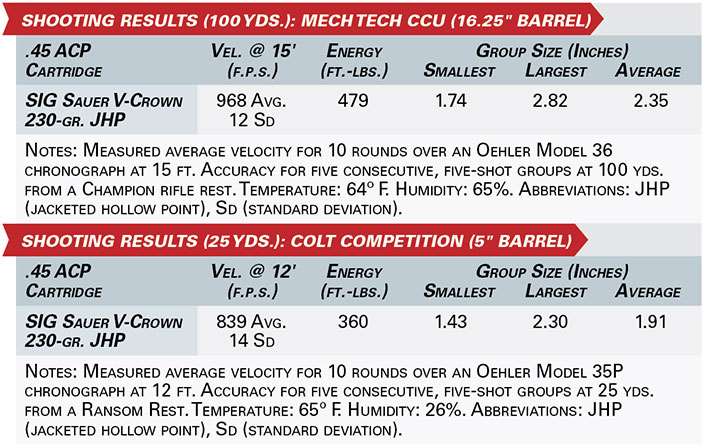
With help from a Bushnell AR Optics 1-4X 24 mm scope, we followed our protocol of firing five consecutive, five-shot groups through the unit. Taking advantage of the host gun’s 4-lb., 4-oz. trigger pull, the CCU managed a solid average group size of 2.35" at 100 yds.—not much worse than the Colt Competition had managed with that load at 25 yds. (1.91") while still configured as a handgun. We also chronographed SIG’s load through the CCU and found that the longer barrel of the rifle did manage to squeeze a little extra velocity out of the .45 ACP cartridge. Through the 16¼" barrel, the 230-gr. V-Crowns produced 968 f.p.s. and 479 ft.-lbs. of energy, up from the 839 f.p.s. and 360 ft.-lbs. exhibited by the same load from a 5" pistol barrel. The ballistic gains achieved through the CCU could be expected to be even more pronounced when chambered in higher-pressure cartridges.
For fans of the M1911, Mech Tech’s CCU represents a paperwork-free accessory that grants improved terminal ballistics in a platform that is familiar to, yet easier to shoot well, than their favorite pistol. Given the level of accuracy and reliability that we encountered during our testing of the CCU, it is easy to see why someone already in possession of a compatible host handgun would find such a product appealing.
Most Popular