New for 2026, Lipsey’s has teamed up with Smith & Wesson to revive a pair of short-lived, but highly sought after, Night Guard revolvers. The L-frame options include the Model 386, a seven-shot .357 Mag. and the Model 396, which is a five-shot .44 Spl. These re-introduced double-action revolvers incorporate up-to-date enhancements while sticking closely to the classic lightweight design. The wheelgun reviewed here is the Lipsey’s exclusive Model 386 Night Guard in .357 Mag.
Originally launched around 2008, the Night Guard series was developed with concealed carry in mind. The goal was to provide self-defenders with the capacity and performance potential of Smith & Wesson’s medium- and large-frame revolvers, while shaving down the gun’s weight, much like the aluminum J-frame models.
The desirable weight reduction was accomplished primarily through the use of Smith & Wesson’s proprietary scandium-aluminum alloy, which was introduced in 1999 with the launch of the AirLite Sc series. Scandium is a rare metallic element which is just one atomic number away from titanium. It has the unique property of imbuing a notable increase in strength and flexibility to other metals when a small amount is blended into an alloy. The result is a metal that is lighter than titanium with a level of strength comparable to steel.
This version of the Night Guard, like the original, sports a uniform matte-black finish throughout, except for the titanium frame pins. Visible from the left side, these have more of a burnt-bronze appearance. Its frame is made from the aforementioned scandium-aluminum alloy, as is its barrel sleeve. The outer barrel supports a .130-inch-wide, ringed XS Sights night sight, while the hollowed-out underlug shrouds the knurled ejector rod. The rear sight is fully adjustable with a .150-inch-wide square notch.
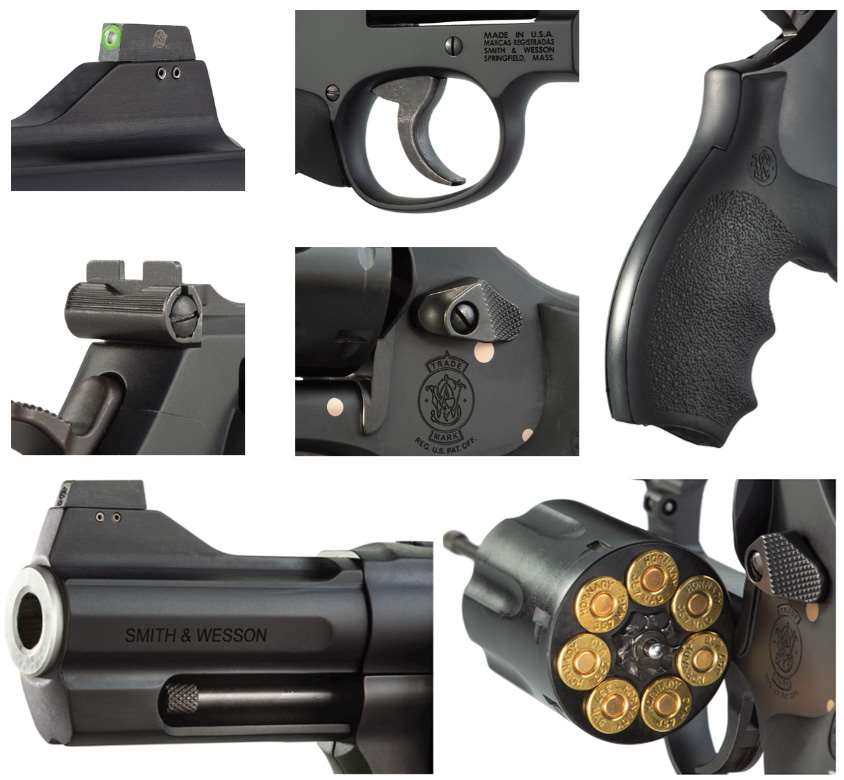
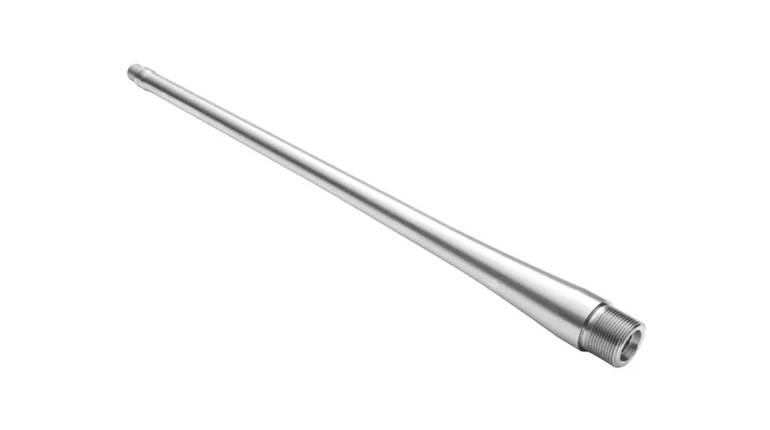
Made from stainless steel, the inner barrel has been stretched from 2.5 to 3 inches. The forcing cone is thicker than previous iterations for improved durability. The interior of the frame, just above the forcing cone, is fitted with a sheet-steel blast shield that serves to protect the alloy frame.
Like the bore, the seven-shot cylinder is also made from stainless steel. Chambers are chamfered for easier loading, while the cylinder edge has been beveled for smoother re-holstering. The cylinder yoke is supported by a modern ball detent for a secure lock-up, while the hammer’s exposed spur and the “pie-wedge” cylinder-release are both checkered for improved purchase.
Among the standout features of this particular revolver was the trigger pull. Double-action triggers can weigh in somewhere north of 12 pounds, but the Night Guard exhibited a clean, smooth trigger pull of 6 pounds, 15 ounces according to my Lyman digital trigger gauge. Manually cocking the hammer for single-action fire reduced the trigger pull to a short, crisp, 3-pound, 5-ounce pull. The revolver is capped off with Hogue’s pebbled rubber Bantam monogrip. Despite its trim dimensions, this grip is surprisingly hand-filling and provides plenty of purchase for managing recoil.
Unloaded, this Night Guard weighs 24.2 ounces, 11.6 ounces lighter than its stainless-steel compatriot, the 3-inch-barreled Model 686 Plus. Although the Night Guard is noticeably more comfortable to carry, recoil management will depend on ammunition selection. Obviously, heavy .357 Mag. loads will recoil differently than light .38 Spl. ones.
On the range, the Night Guard operated flawlessly throughout the course of testing using a variety of offerings provided by DoubleTap Ammunition. This gun can safely fire standard-pressure .38 Spl., defensive-grade .38 Spl. +P and a full range of .357 Mag. bullet weights from the fast-flying 110-grain hollowpoints up to the 200-grain hard-cast, deep-penetration loads intended for dangerous game. As expected, felt recoil ranged from moderate to intense, depending on the ammunition.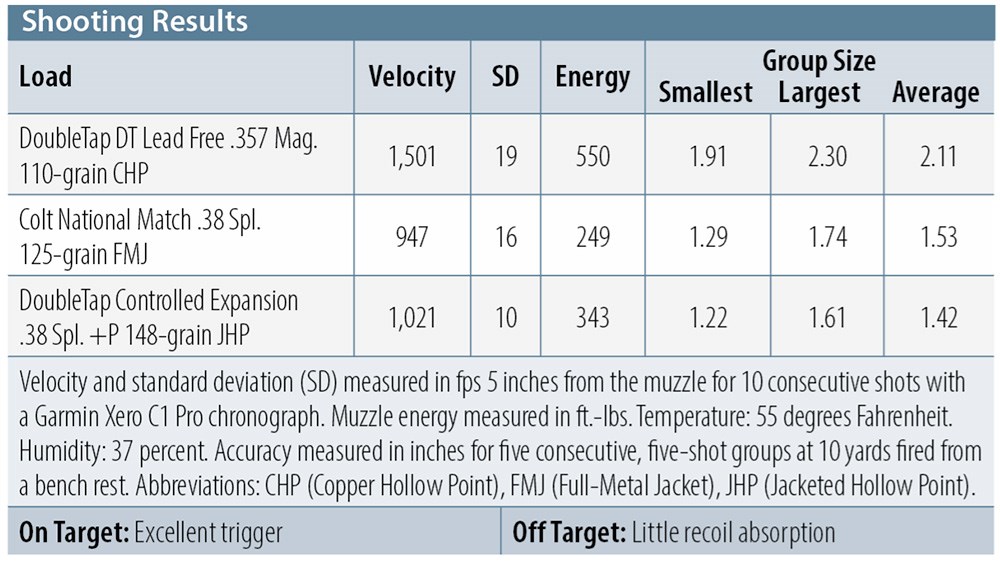
The original Smith & Wesson Night Guard series, like some other good designs, fell victim to the market trends of the day. Despite positive reviews and their obvious advantages, they often languished on dealers’ shelves. The late 2000s and early 2010s were a time when many self-defenders were downsizing their daily carry. Medium- and large-frame revolvers were competing against the now-ubiquitous compact, polymer-frame 9 mm pistols and pocketable semi-automatics chambered for .380 ACP. As a result, the Night Guards were discontinued in 2010.
Thankfully, Lipsey’s has kept the L-frame Night Guards from slipping into the annals of revolver history. The Model 386 is a particularly flexible and useful option. Thanks to its .357 Mag. chambering, it can be fired with an expansive selection of ammunition. Add to that its seven-shot capacity, 3-inch barrel and useful sights, and this version can comfortably straddle the roles of a home-defense revolver, a daily concealed-carry option or for defense against dangerous animals in the wilderness when loaded with the right ammunition.
Hopefully, this iteration of the Night Guard series will be better appreciated. It would be a boon to wheelgun fans for these lightweight models to sell well enough to keep them in the catalog. And, if we are extremely lucky, perhaps additional Night Guard models will be brought back from the archives to the present day.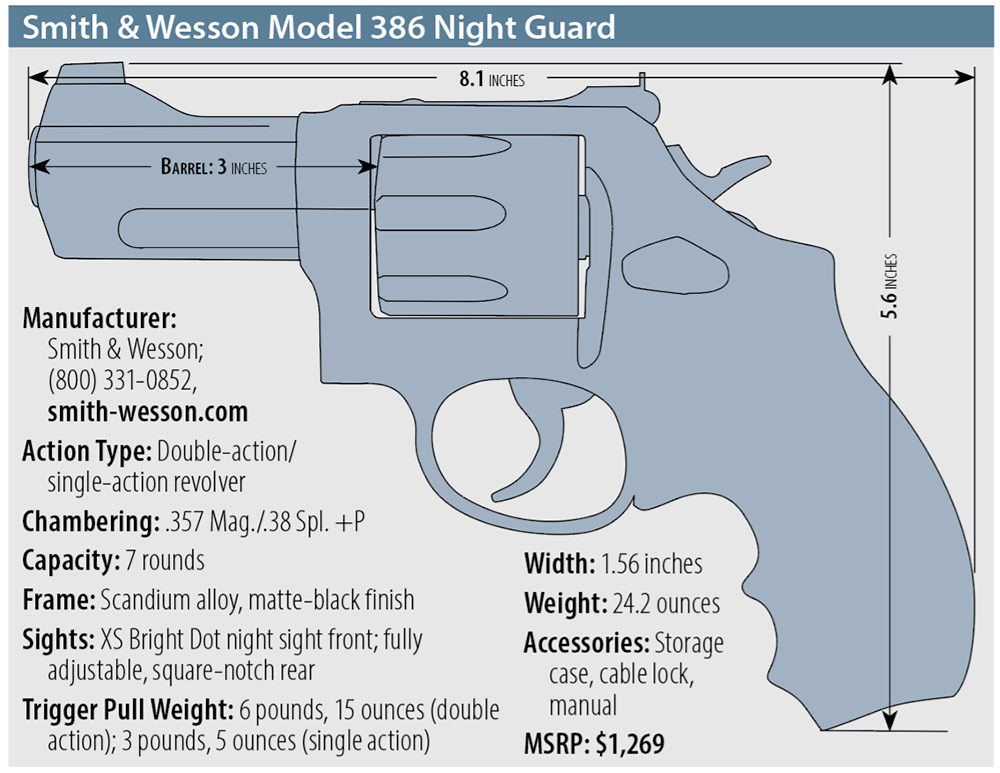
Most Popular