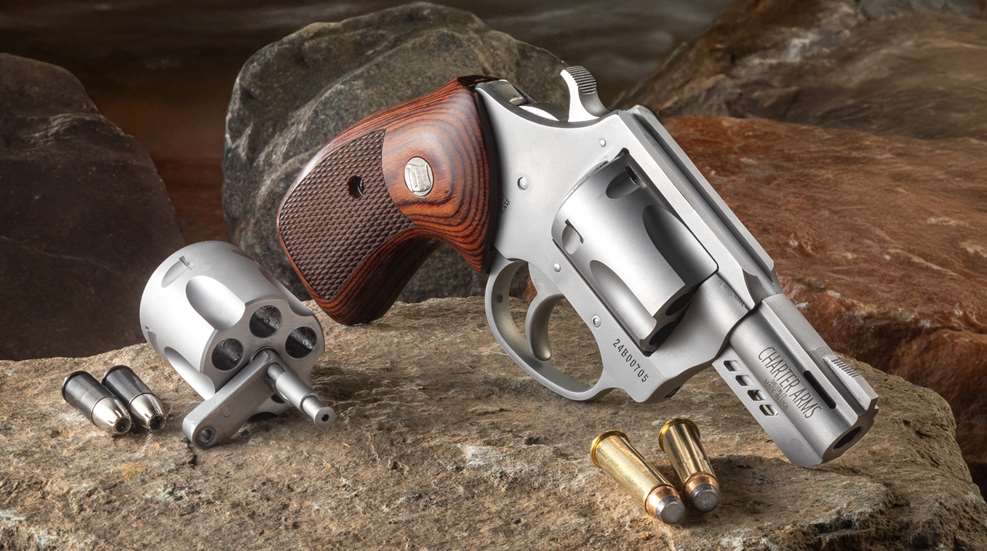
Charter Arms is an American gunmaker that has offered its own versions of compact, double-action revolvers at fair prices for more than 60 years. During that time, its catalog has included cartridge-convertible models that ship with a second cylinder assembly. Near the end of 2024, the company launched its latest series of convertibles, which, in keeping with Charter’s canine naming conventions, have been dubbed the Double Dogs.
Wholly constructed of stainless steel, these models are based on the company’s five-shot Mag Pug revolver chambered in .357 Mag. The series was launched with four configurations. Barrels are available in 2.2" or 4.2" lengths with either a satin-stainless or a matte black-nitride finish. The following evaluation takes a look at Model No. 73920 featuring a 2.2" barrel, a satin-stainless finish and a second cylinder for 9 mm Luger ammunition.
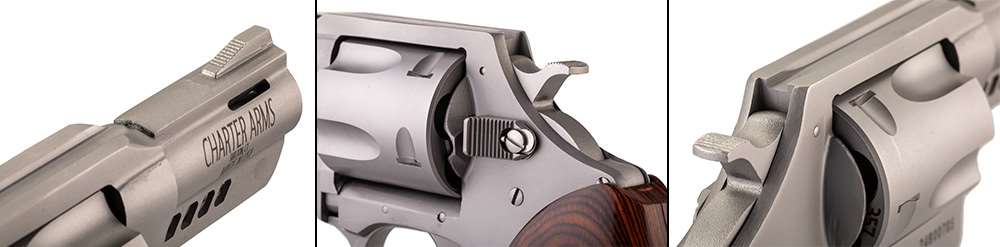
The Double Dog, like most other Charter offerings, is configured as a double-action/single-action revolver with an exposed hammer that has a serrated spur. Pulling the trigger in double-action mode, without cocking the hammer, results in a longer, heavier pull. In this case, the trigger cycled smoothly without stacking and broke at 9 lbs., 1 oz., of pressure. Manually cocking the hammer for single-action fire provides a notably shorter and lighter trigger pull of 2 lbs., 7 ozs.
The snub-nose 2.2" barrel is topped with an integral serrated front sight blade with an underlug that shrouds the ejector rod. The rear sight consists of a groove along the top of the frame ending in a square notch. Two notable alterations to the Double Dog’s barrel include four lightening ports, found on the right side of the underlug, and the barrel’s porting. Two 0.5" straight vents have been milled into the top of the barrel to either side of the front sight. When fired, the ports re-direct some of the gas produced by the cartridge ignition upward. This, in turn, generates downward pressure at the muzzle to mitigate rise and can work to reduce felt recoil.
Although the ports have been known to increase muzzle flash and noise, they can also contribute to quicker follow-up shots. In this case, the porting system proved to be effective in reducing muzzle flip and felt recoil when shooting full-power .357 Mag. and +P-rated ammunition. The benefits were less pronounced when firing standard-pressure .38 Spl. or 9 mm loads.
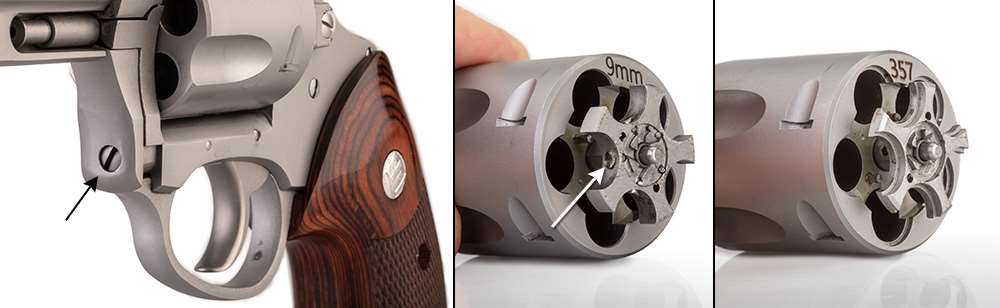
A serrated cylinder release, located on the left side of the frame, is pressed forward so that the fluted five-shot cylinder can swing out to the left side of the frame. The cylinder, which rotates clockwise when fired, is fitted with a two-piece ejector rod. The .357 cylinder’s extractor star is configured for use with rimmed revolver cartridges. Rounds can be loaded into the chambers one at a time or by using speed strips or speedloaders to accelerate the process. When actuated, the extractor star presses against the cartridge rims to expel spent cases from the chambers.
The 9 mm Luger cylinder’s ejector assembly uses a patented system for managing rimless semi-automatic pistol cartridges in a unique manner. For each of the five chambers, there is a spring-loaded detent mounted into the extractor star. When a 9 mm round is fully seated within the chamber, the detent locks into the extractor groove at the case’s base. When the ejector rod is pressed, the detents engage the cases so that they are pressed out and away from the chambers.
Charter’s rimless cartridge extractor system effectively replaces moon clips when firing semi-automatic cartridges, but the system does come with a trade-off. Due to the resistance exerted by the detents as rounds are inserted, speed strips and speedloaders are not the best fit. Rounds can be partially positioned but then each must be pressed down individually in order to lock them into place. A useful alternative to these revolver loading devices is a double-stack pistol magazine used as a dispenser to thumb rounds into the chambers.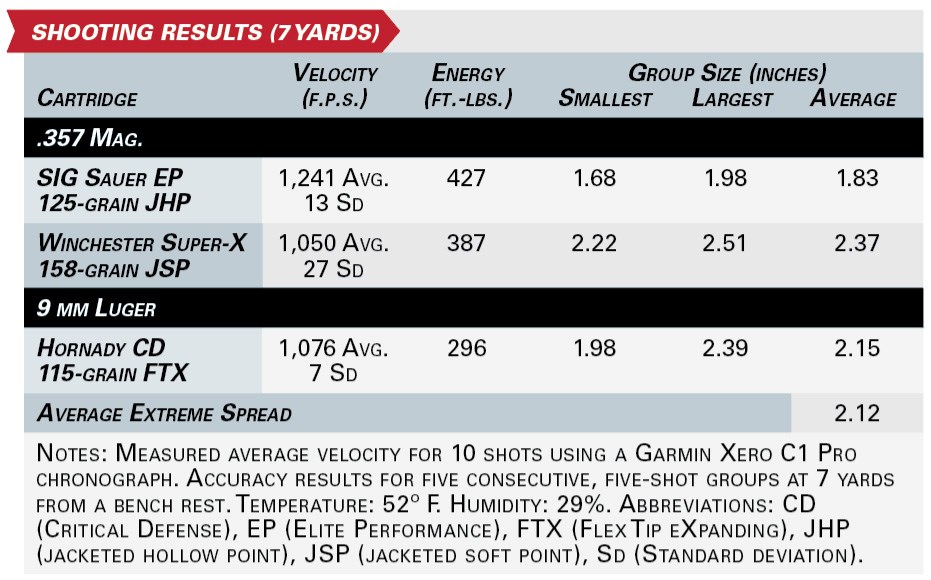
Trading out the Double Dog’s cylinders is a fairly straightforward process. With the action open and the revolver unloaded, remove the cylinder yoke screw located on the front of the frame just below the barrel lug. It should be noted that this screw is fitted with a small polymer bushing that fits between the yoke arm and frame to reduce wear. Knowing that the bushing can be easily misplaced and difficult to find, the company provides a packet of them in the storage case along with the owner’s manual and lock.
This model is completed with a classically styled and hand-filling checkered walnut grip with gold company logo medallions set into both panels. Although not as cosmetically refined as competing models, these guns are certainly durable and reliable, making them a good fit for their intended defensive roles.
At the shooting range, the revolver operated properly with all grades and cartridges of ammunition tested. While not a standout in our accuracy testing, the Charter Arms Double Dog nonetheless provides customers with a useful set of features and a flexible range of ammunition options at a very reasonable price.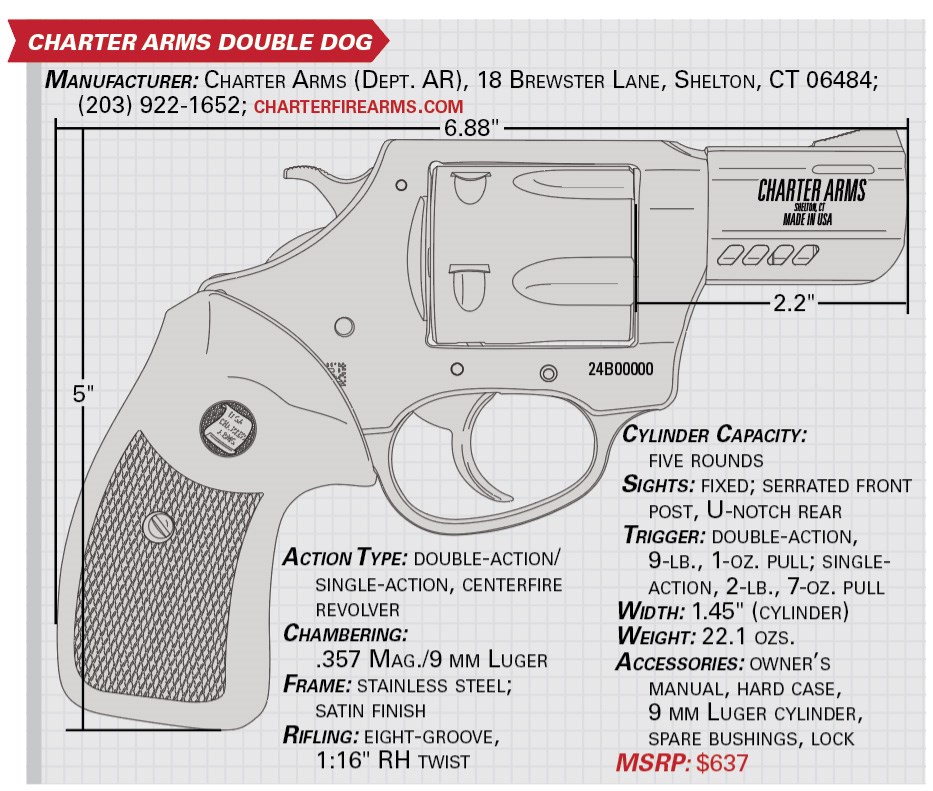
Most Popular