** When you buy products through the links on our site, we may earn a commission that supports NRA's mission to protect, preserve and defend the Second Amendment. **
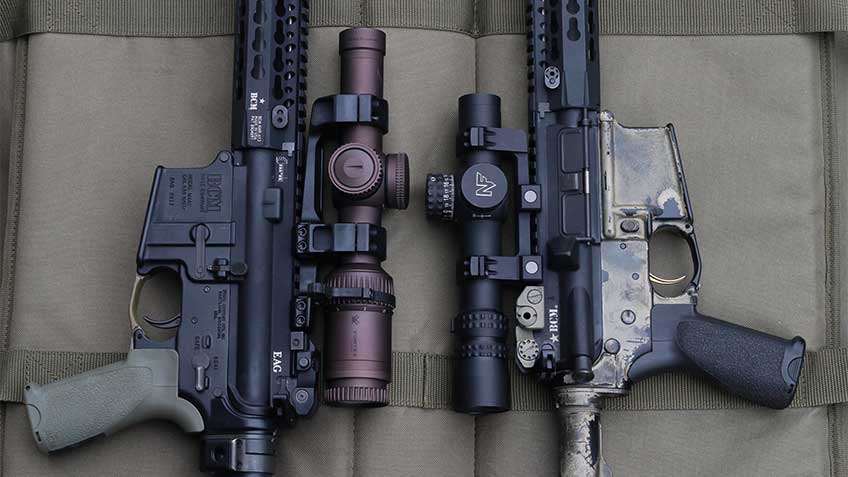
I have spent the last year switching back and forth between two optics on my primary teaching and training carbines, a Nightforce NX8 1-8X 24 mm first focal plane (FFP) and a Vortex Razor HD Gen II-E 1-6X 24 mm second focal plane (SFP). Both are leading choices in the Low-Power Variable Optic (LPVO) genre, both have been in use within USSOCOM, and I really like each. I am often asked which I recommend, and the answer is less about the individual optics and more about a shooter’s needs and the realities of the different strengths and weaknesses of each focal plane in general. So, let’s quickly throw out some ground rules.
Precision Rifles: First Focal Plane
The last decade has been an active one in optics. The state of the art has moved more or less continuously and, in some cases, dramatically. Nowhere is this more evident than on either end of the magnification scale. When looking at the higher-magnification optics designed for long range and precision rifles, there is little downside to an FFP optic.
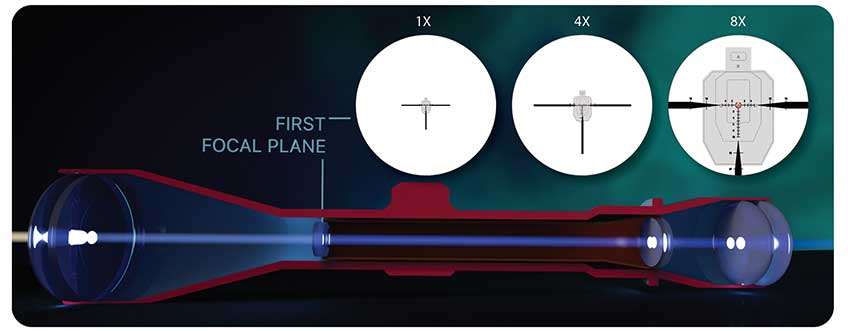
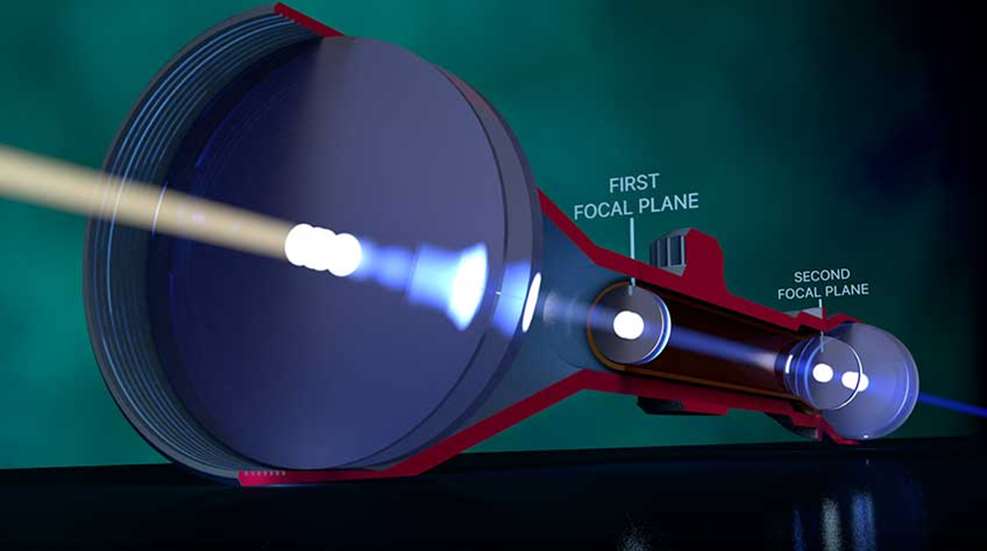
On an FFP the reticle expands or contracts in conjunction with the magnification, allowing the gradations of the reticle design, whether milliradian (mil), minute of angle (m.o.a.) or bullet drop compensating (BDC) to remain proportional. With the high range of magnification possible on today’s optics, it is a true luxury to crank the power to whatever is ideal for the level of support, the field of view desired and the precision of shot placement, then simply hold on the correct reticle gradation for the range and begin to press the trigger.
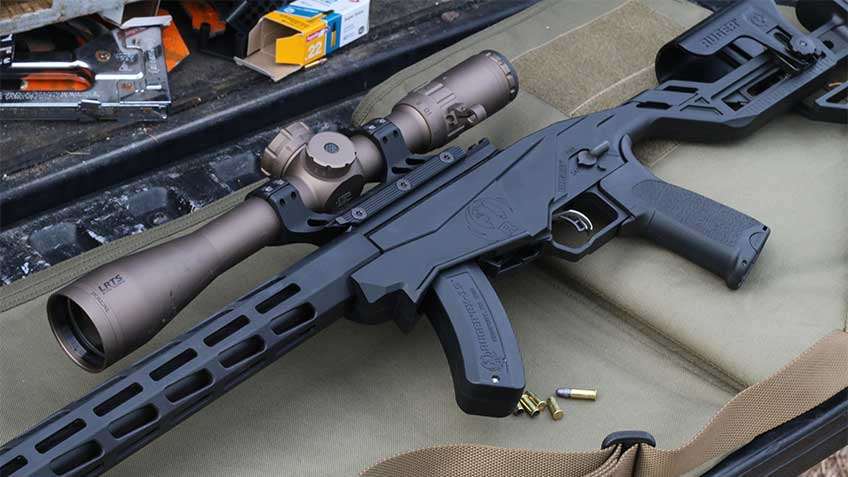
For example, I’ve been running a Bushnell Elite LRTS 4.5-18X 44 mm on some precision rifles and my Ruger Precision Rimfire. I recently had my youngest daughter out at the range trying her hand at a variety of steel targets from 50 out to 150 yds. with the Ruger .22. She was able to crank the magnification to where she was comfortable and simply hold the mil reticle at the number I called to hit each target. No complicated training, no sniper magic, just, “The round plate? Hold on 2.” Ting! “The top of that silhouette? Hold 3.7.” Tong! First focal plane reticles make life simple when the bullet is far enough to begin dropping fast.
Six Power And Less: Second Focal Plane
A decade ago there weren’t very many choices in the LPVO bracket, but today there is a wide selection from which to choose. One of the first decisions a shooter must make is how much power he or she needs. For many, 6X will be enough magnification and, at 6X and below, second focal plane is usually the way to go.
Most AR shooting, in whichever role—whether sporting, competition or duty/defense—is done within the “sweet spot” of the .223 Rem. trajectory where the shooter can simply hold on the intended target and get the hit. With the common 50-yd./200-yd. zero the bullet’s path is within the margin of error out to about 250 yds. This lets a shooter enjoy a consistent reticle image that remains the same, regardless of the magnification, and is still bold and visible at the low end.
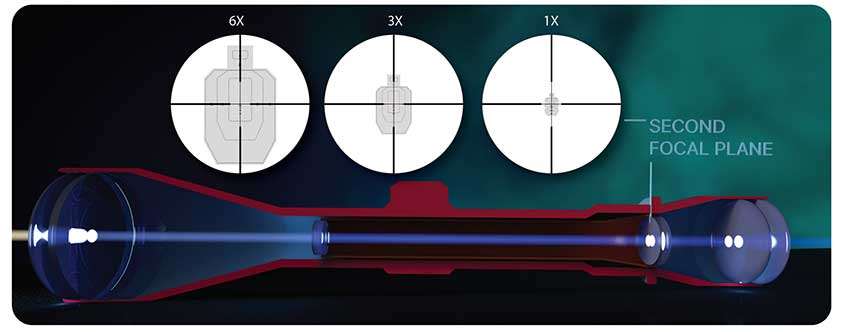
However, if the shooter has to hold over for the occasional long shot with the magnification topped off at the maximum, the reticle holds are “true.” Six power is a good compromise for visibility at distance but is still low enough that many shooters can use maximum power from an unsteady support without getting motion sick from the image and, thus, prone to snatching the shot off.
Six and eight power do not sound far apart, but there is a pronounced difference. Eight power is often too much magnification from other than very solid support. The carbine/LPVO combination is often fired from marginal support, and it would be a detriment to have to run all the way to 8X to get the mil holds or BDC to work at distance as one would with a second-focal-plane optic.
One observation for those looking at the 6X options on the market: Consider the BDC rather than the mil reticles. Six power is not a lot of magnification to resolve between milliradian marks quickly and precisely. It may be better to accept somewhat-diminished precision for your exact load with a BDC reticle in order to reduce visual clutter, and make it easier to pick up and place the correct hold. If you truly “need” exact mil holds routinely you may be better off upping the magnification to 8X or more and switching to an FFP optic.
First Focal Plane: Reticle Design And Red Dots
For an LPVO to have a reticle fine enough to be precise at 8X, it is often pretty well invisible at 1X. Optics manufacturers do their best to design reticles that compensate for this with bold duplexes that largely disappear at maximum settings, outer “donuts” that surround the actual center point and appear as hollow center dots at 1X, and the incorporation of illumination.
Illumination can turn the LPVO into a first cousin to the red-dot sights like the Aimpoint. Up until recently, many of the LPVOs, whether FFP or SFP, were illuminated mostly in name only, with a red dot visible indoors or on a cloudy day, but only produced a hint of red under bright, harsh light. They were visible, but not bold enough to matter. The latest offerings, such as the Razor and the NX8, have taken the dot to truly daylight bold. With the optic at 1X and the dot turned on, even a FFP like the NX8 can nearly match the speed and effectiveness of the non-magnified Aimpoint.
If a shooter is considering a FFP low-power variable, he should try to test the reticle at half-power increments across the zoom range. The reality is that the reticle will appear quite different at each half-power mark as it grows or shrinks, and on a patrol rifle or 3 Gun setup it is important that the shooter feel confident about how well that reticle works for him. I find it to be very personal—much more so than with an SFP optic, in which the reticle is the same throughout. I like the FC-MIL reticle on the NX8; it is still usable even with no illumination on low power and is effective at magnification with no excess clutter.
Precision Rifles: First Focal Plane
The last decade has been an active one in optics. The state of the art has moved more or less continuously and, in some cases, dramatically. Nowhere is this more evident than on either end of the magnification scale. When looking at the higher-magnification optics designed for long range and precision rifles, there is little downside to an FFP optic.
On an FFP the reticle expands or contracts in conjunction with the magnification, allowing the gradations of the reticle design, whether milliradian (mil), minute of angle (m.o.a.) or bullet drop compensating (BDC) to remain proportional. With the high range of magnification possible on today’s optics, it is a true luxury to crank the power to whatever is ideal for the level of support, the field of view desired and the precision of shot placement, then simply hold on the correct reticle gradation for the range and begin to press the trigger.
For example, I’ve been running a Bushnell Elite LRTS 4.5-18X 44 mm on some precision rifles and my Ruger Precision Rimfire. I recently had my youngest daughter out at the range trying her hand at a variety of steel targets from 50 out to 150 yds. with the Ruger .22. She was able to crank the magnification to where she was comfortable and simply hold the mil reticle at the number I called to hit each target. No complicated training, no sniper magic, just, “The round plate? Hold on 2.” Ting! “The top of that silhouette? Hold 3.7.” Tong! First focal plane reticles make life simple when the bullet is far enough to begin dropping fast.
Six Power And Less: Second Focal Plane
A decade ago there weren’t very many choices in the LPVO bracket, but today there is a wide selection from which to choose. One of the first decisions a shooter must make is how much power he or she needs. For many, 6X will be enough magnification and, at 6X and below, second focal plane is usually the way to go.
Most AR shooting, in whichever role—whether sporting, competition or duty/defense—is done within the “sweet spot” of the .223 Rem. trajectory where the shooter can simply hold on the intended target and get the hit. With the common 50-yd./200-yd. zero the bullet’s path is within the margin of error out to about 250 yds. This lets a shooter enjoy a consistent reticle image that remains the same, regardless of the magnification, and is still bold and visible at the low end.
However, if the shooter has to hold over for the occasional long shot with the magnification topped off at the maximum, the reticle holds are “true.” Six power is a good compromise for visibility at distance but is still low enough that many shooters can use maximum power from an unsteady support without getting motion sick from the image and, thus, prone to snatching the shot off.
Six and eight power do not sound far apart, but there is a pronounced difference. Eight power is often too much magnification from other than very solid support. The carbine/LPVO combination is often fired from marginal support, and it would be a detriment to have to run all the way to 8X to get the mil holds or BDC to work at distance as one would with a second-focal-plane optic.
One observation for those looking at the 6X options on the market: Consider the BDC rather than the mil reticles. Six power is not a lot of magnification to resolve between milliradian marks quickly and precisely. It may be better to accept somewhat-diminished precision for your exact load with a BDC reticle in order to reduce visual clutter, and make it easier to pick up and place the correct hold. If you truly “need” exact mil holds routinely you may be better off upping the magnification to 8X or more and switching to an FFP optic.
First Focal Plane: Reticle Design And Red Dots
For an LPVO to have a reticle fine enough to be precise at 8X, it is often pretty well invisible at 1X. Optics manufacturers do their best to design reticles that compensate for this with bold duplexes that largely disappear at maximum settings, outer “donuts” that surround the actual center point and appear as hollow center dots at 1X, and the incorporation of illumination.
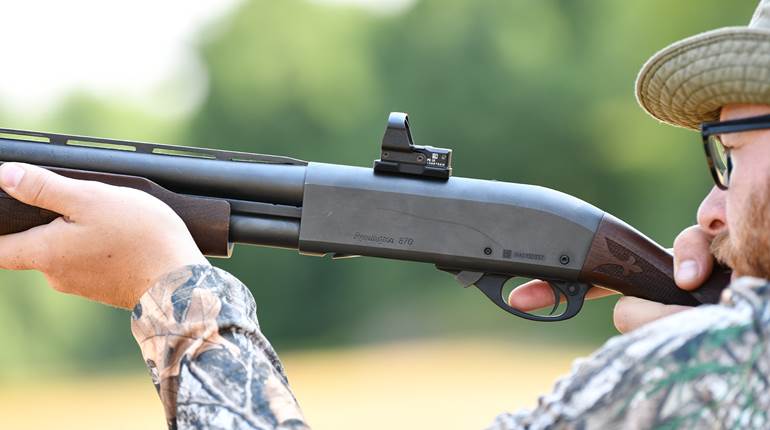
The author’s daughter used this .22 topped with a scope built with a first-focal-plane (FFP) reticle. The consistent values of the hold-over gradations make FFPs simple to use at extended range.
Illumination can turn the LPVO into a first cousin to the red-dot sights like the Aimpoint. Up until recently, many of the LPVOs, whether FFP or SFP, were illuminated mostly in name only, with a red dot visible indoors or on a cloudy day, but only produced a hint of red under bright, harsh light. They were visible, but not bold enough to matter. The latest offerings, such as the Razor and the NX8, have taken the dot to truly daylight bold. With the optic at 1X and the dot turned on, even a FFP like the NX8 can nearly match the speed and effectiveness of the non-magnified Aimpoint.
If a shooter is considering a FFP low-power variable, he should try to test the reticle at half-power increments across the zoom range. The reality is that the reticle will appear quite different at each half-power mark as it grows or shrinks, and on a patrol rifle or 3 Gun setup it is important that the shooter feel confident about how well that reticle works for him. I find it to be very personal—much more so than with an SFP optic, in which the reticle is the same throughout. I like the FC-MIL reticle on the NX8; it is still usable even with no illumination on low power and is effective at magnification with no excess clutter.
Most Popular