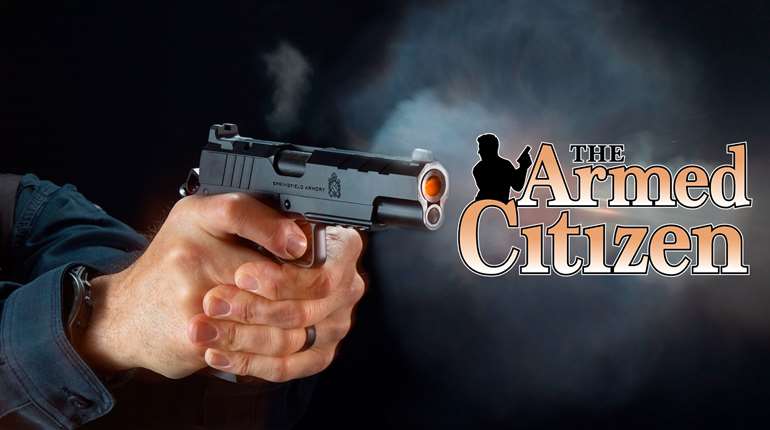
A while back, I stumbled across a witticism from author Robert A. Rinker (“Understanding Firearm Ballistics”) that anyone claiming their firearm has no muzzle flash should try keeping their eyes open while shooting. While there are exceptions, his point that some amount of flash can be expected from centerfire rifle-caliber firearms remains valid.
The primary muzzle flash we see in low light is caused by still-burning powder and super-heated gases exiting the muzzle together. Primary flash is fairly uniform from shot to shot when using the same ammunition. Typical ways to manage it include lower-powered loads, reduced-flash powders, ammo tailored for specific barrel lengths and flash-suppressing muzzle devices—including suppressors.
Secondary muzzle flash is an entirely different animal in both cause and severity. When a ball of fire that would make an artilleryman jealous suddenly appears in front of your muzzle, it can be unsettling. I’m not smart enough to come up with my own explanation for the roots of secondary flash, but Rinker put it in terms that even I understand.
According to the engineer-author, trace amounts of hydrogen are among the gaseous byproducts produced as smokeless powder combusts. When a charge burns efficiently in a barrel, there’s a balance of elements that helps to fully consume the flammable hydrogen. But, when there isn’t enough oxygen present in the bore, excess hydrogen can easily “flash over” once it exits the muzzle and slams into the oxygen-rich atmosphere.
Secondary flash in small arms is often sporadic, without warning or discernible pattern. As is the case with primary flash, shorter barrels and rapid firing tend to increase secondary muzzle flash’s frequency and intensity. That doesn’t mean every short-barrel centerfire rifle or large-format pistol will be a flamethrower. Atmospheric conditions, ammo and what’s attached to the muzzle matter.
Cheap, steel-case foreign ammunition is notorious for its dragon-like tendency to render flash hiders useless. While suppressors have been increasingly relied upon to tame muzzle flash, internal configuration has a lot to say about effectiveness. Traditional designs, which redirect hot gases and particles into multiple baffle chambers, generally do a good job of cooling things down enough to reduce flash.
But, over the past year, I’ve heard from several people (and seen for myself) that a handful of suppressors being marketed as “low back pressure” (LBP) are far less effective at flash management than conventional models. Because I’m two parts user, one part tester and zero parts suppressor designer, I consulted a former co-worker and all-around suppressor genius for help decoding this issue.
Since retiring from a distinguished Special Operations career a couple of decades ago, Jamie Wiedeman has been an integral part of SureFire’s efforts to arm our nation’s most elite warriors with critically important sound suppressors, lights and firearms. He points out that achieving low back pressure and good flash/sound suppression in a single design is difficult.
Wiedeman’s view is that poorly performing “flow-through” suppressor designs are the result of companies that rushed to bring inexpensive LBP suppressors to market. He explained that most of these designs allow everything to move through the suppressor unimpeded. The result is that sound and flash reductions suffer, worsening as suppressors quickly heat up.
I asked if the trend toward shorter suppressors is another contributing factor to excess flash. Wiedeman confirmed that decreased suppressor volume (the size, not the sound), especially when combined with shorter barrels, allows un-burnt powder to build up, eventually leading to secondary flash (and boom) before the cycle repeats.
SureFire has put significant time and effort into developing LBP suppressors that maintain the delicate balance between performance and size. My own use of its RC3 over the past couple of years indicates those labors have paid off. The RC4, released in 2025 and purportedly a major leap forward, is in use by multiple Federal agencies.
Wiedeman further explained that the chief mechanism for reducing flash is through the use of proprietary channels that twist and turn inside SureFire’s LBP suppressors. He also mentioned that to date, Huxwrx is the only other company he knows of that tests and employs similarly effective LBP designs.
I’m a proponent of using a larger suppressor-bore size to cover multiple calibers with the same or smaller bores. But, the benefits of this approach may be offset by decreased performance when using a super-short suppressor or a poorly executed LBP design. It’s logical if you reduce the surface area of the components that dampen sound, blast and flash, you’re going to get more sound, blast and flash.
At the end of the day, it falls into the give-and-take side of life. Lighter guns move more during recoil, subsonic ammo reduces effective range and going all-in on one performance factor comes at a cost to most others.
Most Popular