For more than seven decades, the name Sierra has been synonymous with match-grade bullets. Like so many of the historic brand names in the sporting world, it seems Sierra’s legacy was not born so much from corporate ambition, but from the simple desire of a few guys to make more accurate bullets for riflemen to handload in a post-World War II America, when factory-made, match-grade ammunition wasn’t commonplace. While there are some newer bullets that now compete with Sierra, the company’s reputation for accuracy both in the military sniping realm and the highest levels of competitive shooting remains at the top.
Back in 1947, in the post-war boom of Whittier, Calif., a trio of aircraft machinists—Frank Snow, Jim Spivey and Loren Harbor—saw a market starved for high-quality rifle bullets and set out to fill the void. Snow, a competitive shooter, knew what a match bullet had to do. It wasn’t enough for one bullet to fly straight. Many bullets had to fly straight consistently, shot after shot. The answer wasn’t so much a secret formula or a technically mind-blowing process, but rather a dogged commitment to precision and quality control, starting with the raw materials. This philosophy, one that’s easy to communicate but difficult to execute, is what led to the birth of Sierra’s most famous creation: the MatchKing (SMK) bullet. The company first sold its .224-caliber, 53-grain MatchKing to the Hollywood Gun Shop in Burbank, Calif. Not only is Sierra still making that same bullet to this day, but the company was a pioneer of the trend of moving out of California when it relocated its factory to Sedalia, Mo., in 1990.
The MatchKing isn’t just a bullet, but an icon; a hollow-point, boattail, tangent-ogive projectile that has won more matches and set more records than any other bullet in history. The results of Sierra’s traditional craftsmanship are quantifiable in the repeatable accuracy I routinely see on paper in the form of sub-MOA groups.
The MatchKing manufacturing process begins with obtaining raw materials free from anomalies that could make them inconsistent from bullet to bullet and batch to batch. For its jacket material, Sierra chose gilding metal, a specific copper alloy composed of 95-percent copper and 5-percent zinc. That gilding metal is then stamped and drawn into a cup that is then “reverse drawn” into a full-length jacket. By making the bullet in this manner, engineers can precisely control the exact thickness of the jacket. It is overdrawn, so then it must be trimmed, which is done to within a thousandth of an inch of its specified length. Elsewhere in the factory, the lead-alloy core material (made from 90- to 98.5-percent lead, depending on the bullet’s caliber) is extruded into wire from an 80-pound billet, cut and then stuffed into the prepared jacket by a press, in a process called swaging. In one final, critical stroke of the press, the hollow point and iconic boattail are formed. The result is the MatchKing bullet that has a weight tolerance of ± .3 grains, a maximum concentricity variation of .0003 inch and a maximum length disparity between bullets of ± .001 inch. Finally, the bullets are washed and polished to as close of a mirror finish as possible.
To pull all this off, each step of production is monitored to a level of obsessive scrutiny, with roving inspectors who pull batches off the line to test in Sierra’s 300-meter underground test range, the longest of its kind, where the finished bullets are fired from machine rests. This is not to see if they’re “good enough,” but to prove they are as close to flawless as bullets can be made by humans and mechanical machinery.
For seven decades, the SMK only had one downside, to which Sierra will readily confess. Although times have now changed—something we’ll get into later—this target bullet was never intended to be used as a hunting bullet. Because it was intended for paper, the round can come apart too easily if it strikes a close-range target at high velocity. At the other end of the spectrum, its hard-lead core is unlikely to expand properly at long range where impact velocities would be low. I commend Sierra for admitting this, as I suspect there are plenty of other manufacturers who would not if it meant their product might lose a portion of sales today.
In the last decade, however, a new niche has emerged, prompting the bullet market to expand—if not transform itself—to take advantage of the new trend of long-range hunting, where accuracy remains king, but the terminal performance of a bullet can’t be overlooked. While I’m not an advocate of shooting at animals at longer ranges for a host of reasons, some valid use cases exist, and in this new market space, target-style “hybrid” hunting bullets like those from Hornady and Berger have dominated.
Designing such a bullet is tricky, because it must be designed to expand within a range of optimal impact velocities; if the animal is close and the impact velocity is too high, the bullet might come apart or even explode. If the animal is too far away and the bullet too slow on impact, it might not expand at all, thereby failing to create an adequate wound channel for a swift kill. Since the bullet maker cannot control the speed at which a hunter’s bullet might strike an animal, most manufacturers offer bullets made specifically for various impact ranges. These hybrid-style bullets tend to have all the features of pure target bullets—such as perfect concentricity, a longer ogive and an optimized meplat for high ballistic coefficients (BCs)—but their jackets tend to be optimized for controlled expansion. Most commonly, this means that the jacket material is thicker at the shank to keep the core intact before tapering to thinner jacket material near the tip to initiate expansion.
Because the MatchKing is Sierra’s most popular bullet—due to its undisputed reputation for accuracy—the company needed to launch a new MatchKing product that would not only perform exactly like the original in terms of accuracy, BC and bullet path, but also could be used for hunting at longer ranges. As a result, the MatchKing X, or MKX, was developed in 2025.
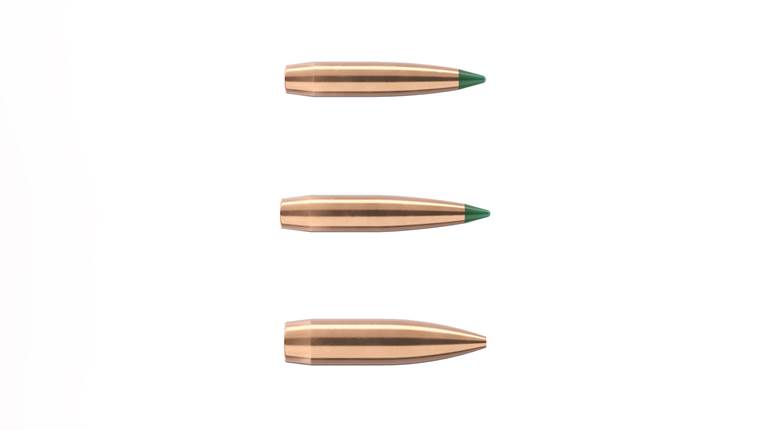
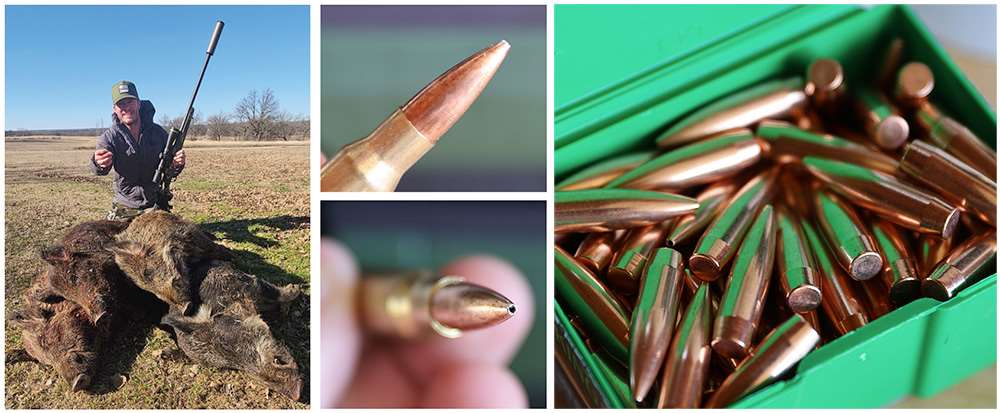
The MKX is, simply put, an evolution of the SMK. While it maintains the exact same exterior profile and BC as a MatchKing bullet of the same caliber and weight, its internal construction is slightly different. The jacket is thicker at the base for durability, but is specially tapered toward the tip, with light skives on the inside of the nose to ensure reliable expansion at various ranges. Frankly, I cannot see or detect these skives even when I dissected a bullet, so I’ll have to trust the company that they are there. As for the actual bullet-jacket thickness differences, a Sierra ballistician told me the mouth of the MKX’s jacket is approximately half as thick as the SMK. I verified this when I cross-cut an MKX bullet and could see that the jacket is indeed tapered.
The thicker jacket base provides stability and a very robust bulwark against over-expansion of the core and deformation during impact, while the thinning walls of the ogive and the very thin point reduce weight at the front, contributing to the bullet’s spin stability, superior flight characteristics and good expansion of the front half of the bullet when it strikes a game animal, even at longer ranges. Meanwhile, the MKX’s lead core is made with less antimony (a mere 1.5 percent), so it is softer and bulges, or mushrooms, more than the original at lower velocities. While none of this is new technology—hunting bullets have been made like this for years—the MKX’s appeal is, assuming all else remains the same, it can be substituted for the original MatchKing without changing the optic’s dope.
Some readers may ask why the MKX is now offered when Sierra has long offered its GameKing line that was touted to be just that—an accurate bullet more suited for hunting. The answer is that these two bullets also have subtle differences, since the MKX is meant to be a longer-range/hybrid hunting bullet that is expected to expand at all remotely realistic hunting velocities, even as low as 1,400 fps, which, in most 6.5 Creedmoor-chambered rifles, occurs past 1,100 yards. The GameKing—meant for more traditional hunting ranges—uses a harder lead core to resist deformation at high velocities. Similarly, the GameKing’s jacket is thicker and more robust because it was designed for use at shorter ranges. Neither bullet features a bonded jacket and core, and although the jacket and core are designed to lock together at impact, the GameKing isn’t particularly known for ultra-high weight retention in the face of extreme violence, nor do I suspect the MKX to be. The MKX is designed to expand to a reasonable degree at longer ranges, while being match-grade accurate and interchangeable with the original MatchKing bullets in terms of trajectory through a given rifle.
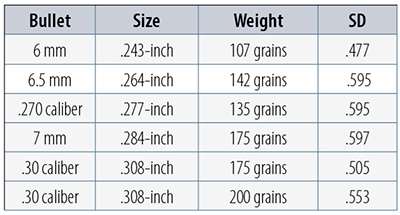
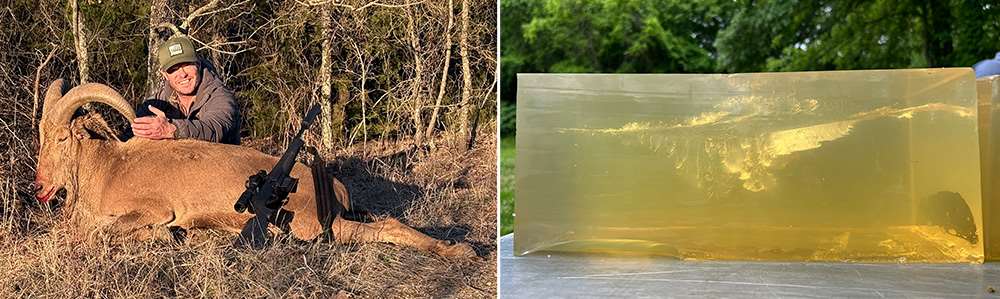
How does it do in the real world? On a recent excursion to a ranch in southeastern Oklahoma, I shot four wild hogs, ranging in size from 40 to 125 pounds, at distances ranging from 35 to 75 yards, using a custom-built Christensen Arms rifle chambered for the .300 Win. Mag. cartridge and loaded with the 200-grain MKX. Was I overpowered in this hunt? Probably, but because I’d seen the company’s admirable gel tests at long range, I wasn’t as concerned about the bullet’s long-range terminal performance as I was about whether this hybrid bullet would hold together under extreme velocities and the violence that bone, hair and flesh impart. Judging by the fact that all shots were complete pass-throughs (I could not collect the bullets for study), I can infer that the MKXs neither exploded or came apart in the animals, nor did they fail to expand, as judged by the massive wound cavities left in their wake. All hogs died within 30 yards of where they were shot, with two of them succumbing where they stood.
After verifying that bullet was up for the task, I hunted and then shot a 200-pound aoudad—a notoriously tough animal for its size—with the 175-grain MKX loaded for my .308 Win. The bullet performed in the exact same way. I shot the heavy-horned goat at 75 yards, from a quartering-away angle. The bullet entered high behind the left shoulder, passed through the offside shoulder and was not recovered. The goat died instantly, falling where it stood. I’m an advocate of pass-throughs, so for me, this was perfect projectile performance. The postmortem revealed why the aoudad died instantly: from devastating damage and hemorrhaging caused by the bullet traveling through the thoracic cavity.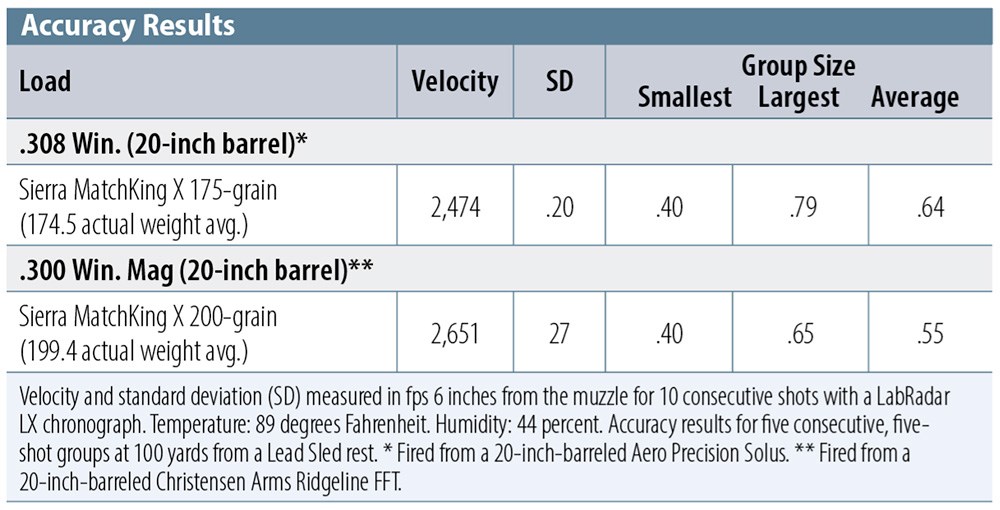
Days later, I shot the same loads for accuracy on a target range. While accuracy, of course, is not just indicative of the bullet, but of the complete rifle system including the shooter’s skill, my test rifles are known quantities in terms of accuracy, which, in the case of my aforementioned .300 Win. Mag., is .75 inch at 100 yards. Handloaded with the 200-grain MatchKing Xs, my groups were slightly better, on average, than with other hunting bullet loads I tested it against. I did test a Barnes TSX load (my pet load for this rifle) that slightly outperformed the MKX in terms of accuracy, but of course, this is just one anecdote that is dependent on my particular rifle’s preference.
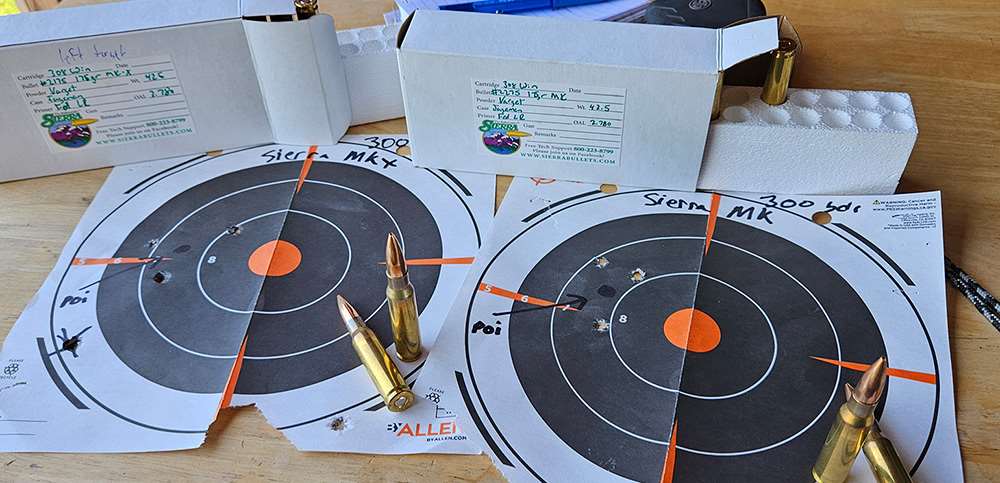
For the real apples-to-apples test—the definitive experiment to see whether the MatchKing X is actually interchangeable with the original MatchKing, I fired two boxes of .308 Win. ammo handloaded to the exact specifications, except one box was tipped with the 175-grain MKX while the other was tipped with the 175-grain SMK. I chronographed each and shot groups at 100 and 300 yards. The chrono numbers were statistically identical at 2,474 fps (MKX) and 2,478 fps (SMK).
I had no idea what would happen, and in fact, I was a little nervous, because if the two bullets from the same load and rifle did not print to the same point of impact, then this entire story—based on one of Sierra’s stated premises for producing the new bullet—could be viewed as a waste of time.
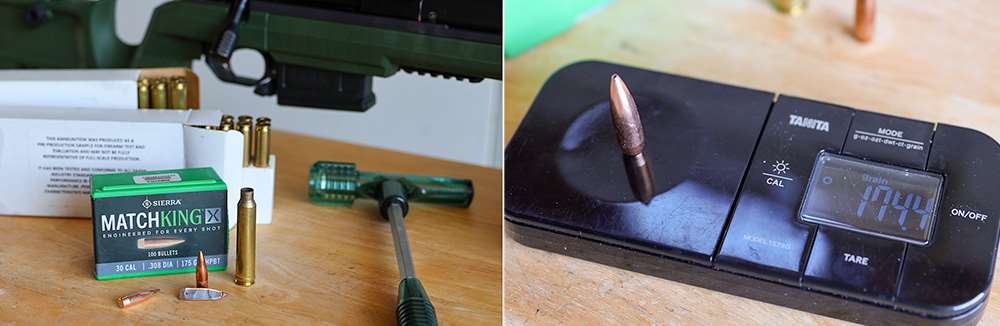
I was pleasantly surprised, however, when the point of impact (the center of each group) was nearly identical, so much so that, even at 300 yards, I would not adjust my scope even one click in any direction if I wished to shoot one load and then the other. For target shooting, I’ll use the SMK, but for big game, I’ll use the MKX without having to make any adjustments. Note that since Sierra is not a producer of loaded ammunition, hunters and shooters are advised to handload to achieve same point-of-impact with the two bullets.
American sportsmen are among the most discriminating in the world when it comes to rifle and bullet selection, but based on my admittedly limited trial using only two rifles in two different chamberings, I believe Sierra now has a very high-quality product in its new MatchKing X, especially for those who already shoot the proven MatchKing bullet and wish to use the same setup for long-range hunting.
Most Popular