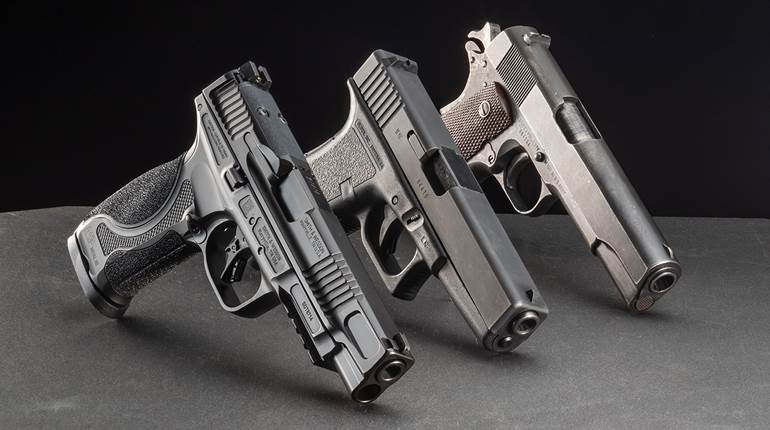
When I started shooting pistols the early 1980s polymer-framed handguns were an anomaly. As a matter fact, there was really only one, and that was the somewhat large and heavy Heckler & Koch VP70z. Today, we take polymer-frame handguns for granted. But there was a controversy that developed with the introduction of the Glock 17. The frame of the gun was made of revolutionary new material called polymer. Polymers are simply more than one simple compound joined together with other simple compounds. What compounds are employed and how they are joined give the final material its characteristics. Okay, it wasn’t revolutionary, it wasn't new, but the specific-high strength formulation (Gaston Glock received a patent for it) was new to firearms use, at least widely used firearms. And the polymer used was not the same plastic used to make little green army men. It was a material engineered specifically for use in firearms and reinforced where necessary. Various forms of proprietary polymers are used today, which include Nylon 6 and Zytel, often with reinforcing materials, such as fiberglass. One of the big innovations was the joining of metal parts (such as guide rails) to the polymer frame.
You can melt down little green army men, put the material back into a mold for little green army men, and you can make more little green army men that perform exactly as little green army men should. Not so for your Glock, Ruger, Springfield XD, Smith & Wesson or Walther. Their frame’s characteristics are engineered to change under high heat and pressure. It is not reversible.
The Glock pistol was a trendsetter. While the H&K came first, it was an expensive handgun, had little commercial success and was truly ahead of its time. The Glock was designed specifically as a duty gun (it won the Austrian army pistol trials in 1982) and proved an excellent personal protection and law-enforcement pistol. And it was in an American Rifleman article (May 1986) that then Technical Editor Pete Dickey debunked the myth of the "plastic guns” being invisible to metal detectors or X-Ray machines so long as the machine was on and the operator awake.
The Glock was the right gun at the right time. It came as American law enforcement was transitioning away from the revolver. The constant action of the striker-fired Glock’s trigger eased training for police officers as they could be taught just one trigger pull, not two. And a 9 mm it could hold 17 rounds. Which, as you may guess, is more than six, which was typical in a revolver of the day. And it employed a wonder material called polymer. A material that was utilitarian and incapable of rusting.
But just because something is made out of plastic does not mean that it is cheap. A lot of the cost in making an aluminum- or steel-framed handgun is in machining the material. Another cost center is the price of the material itself. Oddly enough, ounce for ounce, the sophisticated polymers used in firearm receivers are typically more than raw firearms-grade steel or aluminum.
With a polymer-frame handgun, though, the cost isn’t necessarily in the raw material; it is in the mold. The word plastic comes from the Greek work plastikos meaning “to form” or “to mold.” In order to get the complex shape required to make a semi-automatic pistol’s frame you have to have a sophisticated and expensive mold. These can cost several hundred thousand dollars depending on complexity. But once the mold is complete, then the machine time (molding machines are very expensive and most companies rely on specialty vendors) is greatly reduced. Squirting high-strength, specially formulated melted polymer goo into a mold takes a lot less time than machining a frame out of bar stock. Once the polymer cools and hardens, it sets up in its final form and is ready for assembly. No bluing, no anodizing and no polishing.
With a polymer-frame handgun you can create things like frame stippling and checkering in the mold that do not require a lot of machine time during manufacture. But adding complex surfaces and shapes to the mold do cost money.
Thanks to that polymer technology, we now have guns that come with interchangeable back straps, in the case of H&K even interchangeable side panels-and all those back and side straps of various sized require their own molds. Or even a whole new frame, as with the SIG P250. The use of polymer gives engineers a lot of versatility in designing their frames. But that versatility does not come inexpensively, at least in the initial tooling cost to make the gun.
The first new polymer frame handgun off the line from a major manufacture can cost as much as a $1 million or more in tooling costs. The good news is, much like shoes, the unit cost goes down from there.
Most Popular