As an NRA instructor, I always enjoy teaching beginners. I typically get a lot of couples and families who sign up for beginners classes. Invariably, the question always comes up, “what is the best gun,” or “what is the best caliber?” Of course, the answer is “it depends.” That’s like asking, what is the best mode of transportation?
These first-time shooters are actually asking a very good question and with good reason. In the case of a couple or a family, the primary concern is most often personal protection inside the home. That is not difficult to address since the rule of thumb is generally to use the largest caliber gun you can comfortably handle.
When routine concealed carry is not a primary concern, then the size of the gun is less of an issue. Basic physics teaches us that force (the amount of energy a bullet carries when fired) is the result of the mass of an object (the weight of the bullet) multiplied by the acceleration (speed in feet per second of the bullet). Here is an easy-to-use online kinetic energy calculator that provides the ft.-lbs. of energy for a particular cartridge as long as you know the weight of the bullet and its velocity.
The more force a bullet has, the harder it hits, the more it penetrates and the more it transfers force—all good and necessary for personal protection. However, the second rule of Newtonian physics teaches us that for every action there is an equal and opposite reaction. In other words, the more force a bullet has going forward the more force the gun has going backward (recoil).
The more mass a gun has, the less acceleration (perceived recoil) a particular cartridge will produce. So, in home defense, a full-size gun helps recoil-sensitive shooters handle more powerful calibers with a higher level of comfort and accuracy.
The second concern is the catch, however. Guns constitute a significant expense for many people, and in these tough times, a family may not be able to or be interested in purchasing different guns for each family member. One gun in one caliber may often have to fit the needs of everyone in the household.
Focusing on just the most popular personal-protection calibers, presented here are some of their differences and their relative strengths.
Special Note: What about the .22 LR, +P ammunition and expanding bullets? The .22 Long Rifle, or .22 LR, cartridge is everywhere. It is super cheap, fun and easy to shoot with almost no recoil. However, while it is perfectly lethal, and any gun is better than no gun, it does not produce enough energy to reliably stop a threat in short order and is not considered suitable for self-defense. It is, however, excellent for target practice, and if more than one gun is in your budget, a .22 for training would make a good choice.
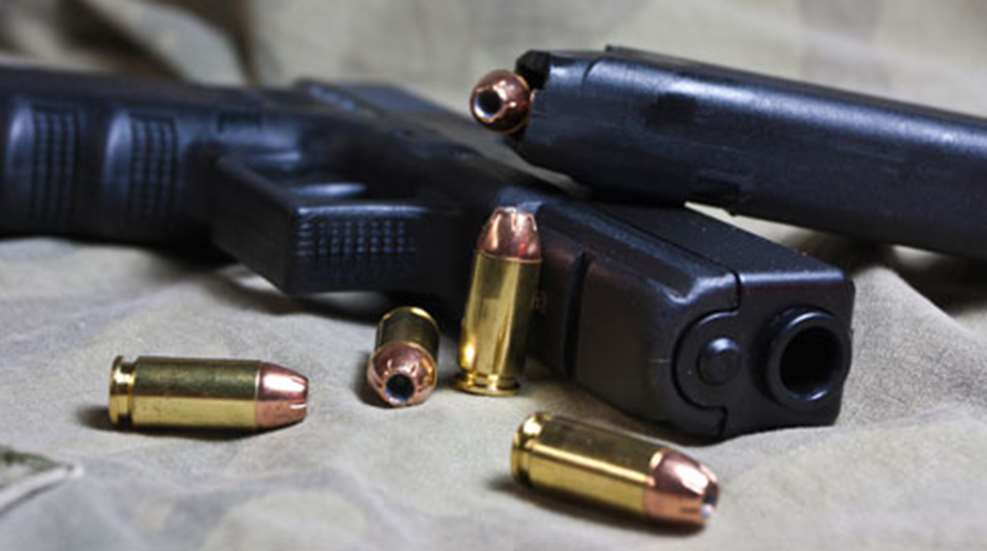
Most ammunition manufacturers sell cartridges in all calibers designed specifically for personal protection. These are intended to provide the maximum energy for a given cartridge and use bullets that will produce the most effective terminal performance. Ammunition can be found in standard pressure varieties as well as +P or +P+, which produce higher-than-standard pressure and velocity. This higher-pressure ammunition should only be used in guns rated to handle the extra forces, and it will produce more recoil.
Likewise, the shape and weight of the bullet affects both terminal energy and performance. A heavier bullet carries more force but is slower, and velocity has a much higher multiplier effect on force than does mass. Most self-defense ammunition is designed to expand on impact in order to have the maximum effect on the target. It is for this reason that different types of expanding ammunition are so popular with law enforcement, as well as those interested in personal protection.
.38 Spl.: This cartridge is considered by many experts to be the minimum necessary for adequate personal protection, along with the .380 ACP listed below. For decades, this was the standard round for law enforcement and it served well, even using the plain round-nose lead ammunition. Anyone who chooses this soft-kicking cartridge today will be even better served thanks to the availability of specialized self-defense ammunition.
.357 Mag.: As the name implies, this is a powerful cartridge with a reputation for producing one shot stops against two-legged predators. That power runs both ways and it can be tough to handle for some. One notable benefit here is that, since this is just a .38 Spl. with a slightly longer case and a lot more power, revolvers cambered for .357 Mag. can be loaded with .38 Spl. for recoil-sensitive family members. The reverse, however, does not apply.
.380 ACP: Long popular for small semi-auto pistols in Europe and countries where possession of military calibers is restricted, the .380 ACP (or 9 mm Short) cartridge has taken America by storm in the last few years. This is thanks to the increased popularity of concealed carry and the ability of this cartridge to fit very small guns. Much like the .38 Spl. above, it is considered a minimum self-defense cartridge, but was used for decades by European police officers and, most famously, by James Bond.
9 mm: Consider the perennial European cartridge, the 9 mm is fast, straight shooting, light kicking, easy to find and cheap to shoot. It is equally at home in full-size guns as in small concealed-carry ones. It is for these reasons that it is in such widespread use among modern law enforcement agencies and militaries (including ours) worldwide. It is more than sufficiently powerful enough for self-defense with proper ammunition and easy for beginners to master.
.40 S&W: Is it better to have big, powerful rounds or more of them? This is America, so why not both? The .40 S&W cartridge is a less-powerful version of the 10 mm, and it offers heavy bullets with a lot of velocity, while remaining comfortable for most to fire with magazine capacity thatis close to that of a similar-sized 9 mm pistol. The .40 S&W is a favorite among many law enforcement agencies and individuals focused on self-defense, and for good reason.
.45 ACP: This is the American cartridge: big, loud and powerful. Nearly half an inch in diameter, hollow-point ammunition resembles a flying ashtray as much as a bullet can. This heavy, slow-moving cartridge was the standard for the U.S. military for over 70 years and served on every battlefield (and still does) where Americans have fought. While it has stout recoil, it feels more like a push that a jab, and with practice, it is manageable by most and preferred by many.
In the end, the key is to get out to the range and try out a variety of guns and calibers to find the one you like best. Just like buying a car, if you are only getting one to share, it is always best to test drive it and make it a family decision.
Most Popular