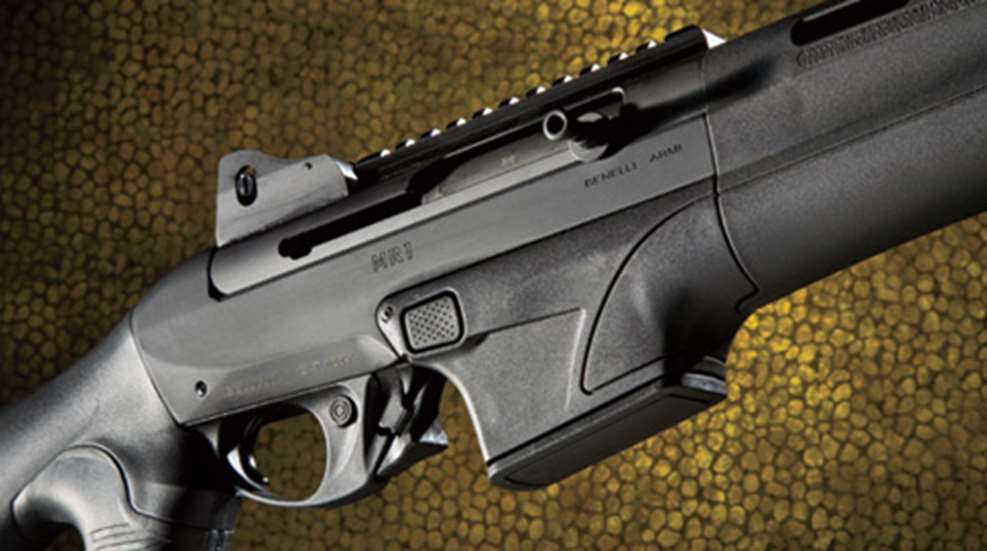
Benelli often takes unusual approaches to simplify firearm designs and enhance performance—take the Vinci semi-automatic shotgun, for example, with its distinctive modularity and In-Line Inertia Driven system. Even crossbreeding certain models isn’t off-limits to the Italian company, which since 1998 has been incorporating variants of its auto-regulating gas-operated (ARGO) system into both rifles and shotguns, starting with the Marine Corps-adopted M4 Super 90 shotgun, or M1014, and later the company’s first-ever rifle, aptly named the R1. Most recently Benelli built a version of the proven system into the MR1 Carbine, a 5.56x45 mm NATO/.223 Rem.-chambered rifle with shotgun-like ergonomics. It is reviewed here.
The MR1’s polymer magazine well assembly is separate from the black-phosphate, steel upper receiver and the hard-anodized, machined-aluminum lower receiver. It extends just beyond the end of the lower receiver underneath the fore-end and is pinned to the lower at the front and rear. It accepts standard M16 STANAG magazines and PMags, but Lancer L5, TangoDown and other after-market magazines may not fit.
The gun’s fixed polymer stock and neoprene pistol grip have the same basic profile, dual steel rear-sling attachments and rubber buttpad as those found on some of Benelli’s tactical M-series shotguns. The rear sight assembly is also similar and comes with two interchangeable apertures. The rear sight is adjustable for windage and elevation and is attached to the upper receiver with two hex screws. Four other hex screws firmly secure the 5-inch-long Picatinny rail to the upper receiver, and an optional tri-rail is available for mounting accessories on the left, right and underside of the polymer forearm by the front sight post and front sling-attachment slot.
For controls, the MR1 has a cross-bolt safety in the front of the trigger guard. The bolt catch on the front of the polymer trigger housing automatically locks the bolt to the rear after the last round is fired, and it releases the bolt when pressed downward. The steel charging handle extends from the bolt carrier and reciprocates during cycling, and it can be used as a forward assist in lieu of a separate control. Ambidextrous magazine-release buttons on the left- and right-hand side of the magazine well have stippling for grip and finger placement.
A hammer-forged steel barrel with a chrome-lined bore is threaded onto the upper receiver. The gas block doubles as a sleeve for the gas regulator/floating piston mounted by the baffles on the guide rod. Rings on the exterior of the regulator allow controlled bleed-off of excess gas, which is ultimately expelled through four elongated slots at the rear of the forearm. An aluminum tappet sits behind the regulator on the guide rod, impinging on captive rods mounted in the lower receiver that act directly on the bolt carrier during cycling.
The bolt resembles that of the R1: three large locking lugs, a recessed extractor flush with the bolt face and a plunger ejector. Like an AR-15, during cycling a cam pin in the bolt assembly acts on the black-phosphated bolt carrier and chrome-plated steel bolt, rotating the lugs out from the locking lug recesses at the rear of the breech. A link hinged to the back of the bolt carrier compresses a recoil spring in the buttstock, much like many semi-automatic shotguns.
The simple, four-moving-piece ARGO system provides consistent rearward force on the tappet and rods through gas regulation, helping to keep the MR1 functioning reliably, a trait confirmed by our shooting of nearly 200 rounds with no malfunctions.
As we expected, the MR1 handled like a tactical shotgun and had relatively mild perceived recoil compared with many other .223 Rem.-chambered semi-automatic rifles. It came naturally to the cheek and was easy to keep on target.
For close-range shooting and function testing we used both the iron sights and a 1.25-4 x 24 mm Trijicon AccuPoint TR21 on a quick-detachable BOBRO scope mount. For accuracy testing we mounted a Vortex Viper 3-9 x 40 mm riflescope. We did have to raise our heads slightly to find a good sight picture with the scopes; however, a firm, more comfortable cheek weld on the stock was achieved when using the iron sights.
Although a bit outside the box compared to typical semi-automatic rifle designs, the MR1’s natural and familiar grip, as well as its excellent reliability, is befitting its intended role as, in Benelli’s terms, the “centerpiece of an effective home defense plan.”
Specs:
Manufacturer: Benelli Armi, Urbino, Italy
Importer: Benelli USA; (301) 283-6981; www.benelliusa.com
Caliber: 5.56x45 mm NATO/.223 Rem.
Action: gas-operated, semi-automatic center-fire rifle
Receiver: black-phosphated, steel upper; hard-anodized, machined-aluminum lower
Barrel: 16", hammer-forged steel, chrome-lined bore
Rifling: six-groove, 1:9" RH twist
Magazine: five-round detachable box, accepts most standard AR-15 magazines
Sights: interchangeable military-style apertures; Picatinny rail
Trigger Pull: 5 lbs., 8 ozs.
Stock: polymer tactical stock, rubber buttpad and pistol grip; length of pull, 143⁄8"; drop at heel, 2¼"; drop at comb, 1½"
Overall Length: 37"
Weight: 7 lbs., 14 ozs.
Accessories: owner’s manual, extra peep sight
Suggested Retail Price: $1,299
Most Popular