The Colt Army Special, a popular workhorse of a revolver, has never received the collector recognition it deserves. Nonetheless, shooters have always appreciated its finely crafted action, which became the foundation for Colt’s most celebrated medium-frame revolvers, including the Python.
The Army Special began life in 1908 as an improvement over the New Army & Navy 1892-1903 models, which tended to bind up and get out of time due, in part, to their counterclockwise cylinder rotation. Taking inspiration from Colt’s rugged New Service revolver, the Army Special was given a stronger action, a revamped cylinder release latch, a “Positive Safety Lock” and clockwise cylinder rotation. Most guns were blued, but some were nickeled, and barrel lengths were 4", 4½", 5" and 6". Stocks were stylized black rubber until 1924, when they were changed to checkered walnut. Hoping for military acceptance, Colt dubbed its improved revolver the Army Special.
Although built on a .41-cal. frame, the Army Special was conceived as the perfect platform for the .38 Spl. cartridge, which, introduced in 1898, had quickly established itself as an accurate and effective man-stopper. The guns were also chambered in .32-20 Win., .38-200 and .41 Long Colt. (Additionally, in 1930 approximately 30,000 Army Specials were produced in .22 rimfire.)
But Colt soon realized that more Army Specials were being purchased by police departments than by the military. Thus, in 1927, the revolver’s name was strategically changed to the Official Police. It was a shrewd move, as—until the revolver’s discontinuance in 1969—countless thousands were sold to numerous law enforcement entities, including the railroad police.
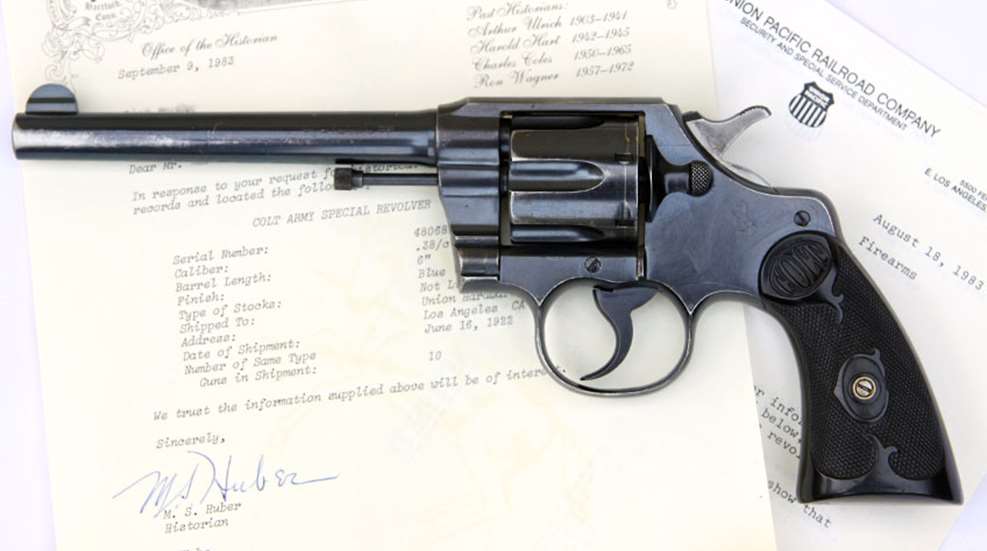
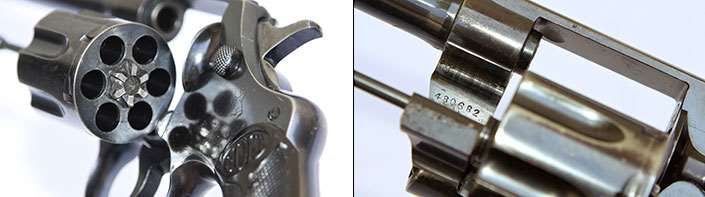
Such was the case with this Army Special, with its 6" barrel showing moderate holster wear but retaining a perfect bore. According to its Colt factory letter, on June 16, 1922, it was one of 10 guns shipped to the Union Hardware & Mfg. Co. in Los Angeles for the Union Pacific Railroad. A subsequent UPRR letter states these guns “… were in service with Union Pacific sometime prior to 1927.” This coincides with the fact that the Great Railroad Strike of 1922 resulted in the UPRR ordering a number of firearms during that brief but tumultuous period of rioting strikers. This gun would normally be valued at $450, but, with its supporting documentation, it could command a slight premium from a gun collector who also had a penchant for historical railroadiana.
Gun: Colt Army Special
Chambering: .38 Spl.
Serial No: 480XXX
Manufactured: 1922 (shipped June 16)
Condition: 60 percent—NRA Good (Modern Gun Standards)
Value: $450 (verified UPRR connection boosts the value to $550-$650)
Most Popular