by
Support NRA American Rifleman
DONATE
** When you buy products through the links on our site, we may earn a commission that supports NRA's mission to protect, preserve and defend the Second Amendment. **
As the United States was dealing with the hangover of World War II and the Korean Wars, the military-industrial juggernaut’s industries scrambled to acquire government contracts in order to keep their doors open. The Soviet Union sought to expand its brand of collectivism and establish buffers against the hated capitalists. On the other hand, the U.S. developed a plan to contain the Soviets. As a result, a lot of spying and posturing took place as each tried to improve its position.
The United States Air Force was spawned about the same time. Once the stepchild of the army, it came about as a result of the passing of the National Security Act of 1947. The Air Force sought to equip many of its planes with a compact survival weapon in the event of a crash or being shot down. One of the first designs submitted was the ArmaLite Rifle 5 (AR-5), a compact, takedown bolt-action rifle made from aluminum except for stress areas like to bolt and barrel along with a composite, then known as plastic, stock which the metal components could be stored.
When stowed in the stock, the AR-5 was weather tight and could float. Eugene M. Stoner, who would later design the AR-15 (M16) rifle was the lead designer for ArmaLite, an offshoot of the defense contractor Fairchild. The AR-5 replaced the M4 and M6 over-under survival combination gun. Like its predecessor, the AR-5 was chambered for the .22 Hornet. Stoner had hardly let the ink dry on the final drawings for the AR-5 when he began adapting the design into a .22 LR chambered semi-automatic rifle. In 1958 the AR-7 Explorer was introduced, and this humble little rifle has been produced ever since.
The AR-7 shares a very similar profile to its predecessor, and like the AR-5, the metal components can be stored in a composite stock that floats, as well. Operation is straight blow-back, and it is fed from a standard eight round detachable box magazine, though 10, 15 and 20 round magazines were also made. There is no provision to lock the bolt to the rear. Likewise to the AR-5, most of the metal components are made from aluminum, the bolt being the an exception. The first barrels were made from aluminum with a steel liner. Some experimental barrels were made of composites but are rarely seen outside the factory. Barrels are 16" long, and the rifle weighs 2 1/2 lbs. Overall length when assembled is 35". Sights consist of a rear aperture adjustable for elevation and a ramp-mounted blade front that adjusts for windage. Later in production the rear sight was made such that it could be removed and flipped to reveal a larger aperture.
For a rifle so relatively simple in design, the AR-7 had some reliability difficulties. Because the bolt is heavy for the otherwise lightweight rifle, it utilizes heavy-for-caliber dual recoil springs. Also, the feed ramp was susceptible to damage making feeding from the magazine problematic. Manufacturers from the original Armalite to the current Henry Repeating Arms, which calls it the U.S. Survival Rifle, recommend using only high-velocity ammunition with 40 grn. round-nose bullets. Other bullet profiles and sub-sonic ammo can be hand fed single-shot style into the chamber, but this limits the capability of the rifle as a survival tool. Another caveat is that the barrel nut must be checked often and kept tight to get maximum accuracy and reliability.
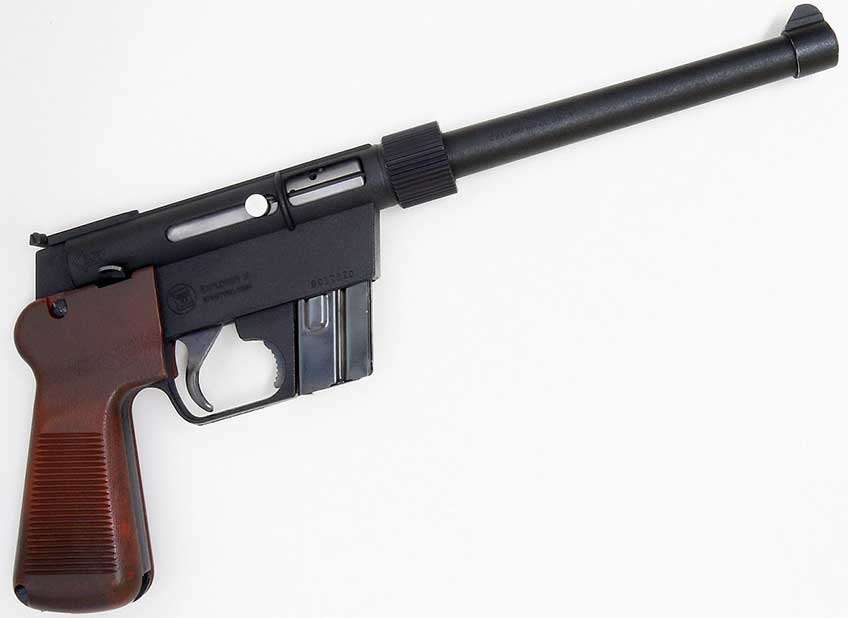
ArmaLite marketed the AR-7 Explorer from 1959 to 1973, when Charter Arms took over manufacturing. Charter Arms also introduced an AR-7 pistol featuring a 6", 8" or 10" barrel and a profile somewhat reminiscent of a C96 Mauser. Because of the risk of running afoul with the BATFE over the short-barrel-rifle issues, Charter Arms made the alignment lug and recess opposite on the pistol barrels preventing them from being installed on the rifle. Charter Arms manufactured the AR-7 from 1973 to 1990. Argentina built a licensed copy of the AR-7, Sistema de Armas .22 LR Fire de Brenta, some of which included additional features like telescopic sights, barrel shrouds and pistol grips.
Survival Arms of Cocoa, FL had a run at the AR-7 from 1990 to 1997. AR-7, LLC, built the rifle from 1997 through 2004, when it was bought by Armalite. Henry Repeating Arms has made the AR-7 since 1997, first in Brooklyn, NY and now in Bayonne, NJ. It is now known as the U.S. Survival AR-7 and features a choice of stock finishes.
One variant that garners interest from collectors is the Israeli Survival Rifle. This version has a telescoping stock, a pistol grip style from an FN-FAL rifle, and a barrel shortened to 13.5” with a sight design borrowed from the Mauser K98k. A few of these were imported to the U.S. for the civilian market, but they were required to have a 3" muzzle brake attached permanently in order to make the 16" minimum length for a rifle.
The AR-7 has found a niche with those who participate in backpacking, boating, and flying in which they could fall back on them in case of an emergency in remote places where a lightweight rimfire rifle might mean the difference between eating and starving. The latest iteration from Henry Repeating Arms even has a picatinny rail on top of the receiver so that an optic might be attached. Of course, such an accessory would not fit into the Spartan floating stock, but it could be stashed close to the stored rifle for such uses.
Prices for the AR-7 cover a wide range. New or slightly used samples can be bought for as little as $250. Original and mint ArmaLite AR-7s can fetch over $800.
The United States Air Force was spawned about the same time. Once the stepchild of the army, it came about as a result of the passing of the National Security Act of 1947. The Air Force sought to equip many of its planes with a compact survival weapon in the event of a crash or being shot down. One of the first designs submitted was the ArmaLite Rifle 5 (AR-5), a compact, takedown bolt-action rifle made from aluminum except for stress areas like to bolt and barrel along with a composite, then known as plastic, stock which the metal components could be stored.
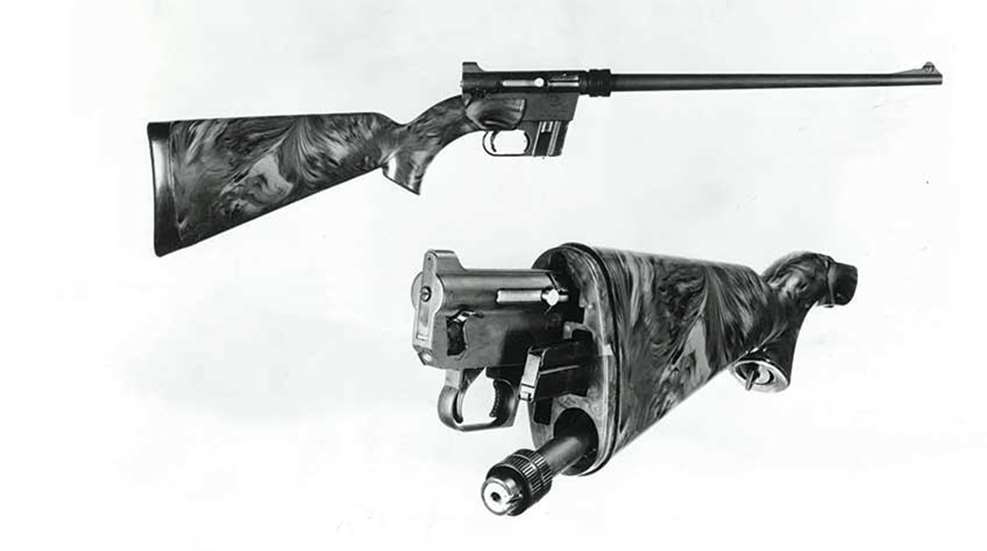
The ArmaLite AR-5 in assembled and stowage configurations.
When stowed in the stock, the AR-5 was weather tight and could float. Eugene M. Stoner, who would later design the AR-15 (M16) rifle was the lead designer for ArmaLite, an offshoot of the defense contractor Fairchild. The AR-5 replaced the M4 and M6 over-under survival combination gun. Like its predecessor, the AR-5 was chambered for the .22 Hornet. Stoner had hardly let the ink dry on the final drawings for the AR-5 when he began adapting the design into a .22 LR chambered semi-automatic rifle. In 1958 the AR-7 Explorer was introduced, and this humble little rifle has been produced ever since.
The AR-7 shares a very similar profile to its predecessor, and like the AR-5, the metal components can be stored in a composite stock that floats, as well. Operation is straight blow-back, and it is fed from a standard eight round detachable box magazine, though 10, 15 and 20 round magazines were also made. There is no provision to lock the bolt to the rear. Likewise to the AR-5, most of the metal components are made from aluminum, the bolt being the an exception. The first barrels were made from aluminum with a steel liner. Some experimental barrels were made of composites but are rarely seen outside the factory. Barrels are 16" long, and the rifle weighs 2 1/2 lbs. Overall length when assembled is 35". Sights consist of a rear aperture adjustable for elevation and a ramp-mounted blade front that adjusts for windage. Later in production the rear sight was made such that it could be removed and flipped to reveal a larger aperture.
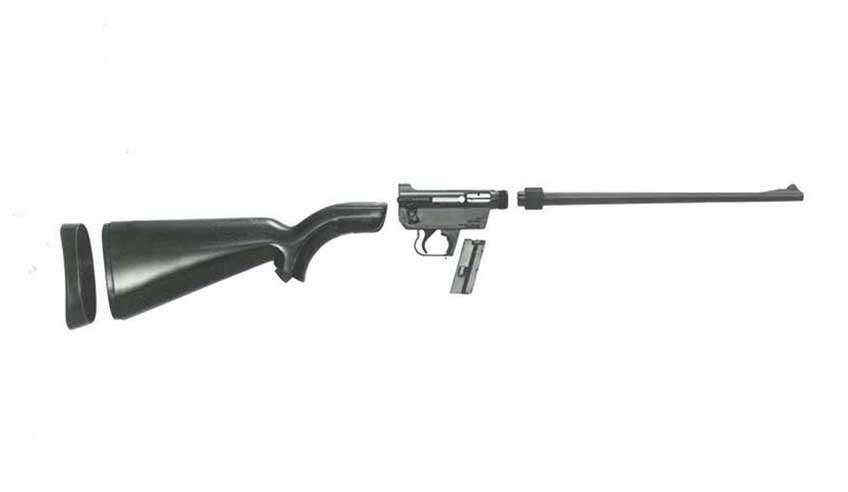
An exploded view of the ArmaLite AR-7.
For a rifle so relatively simple in design, the AR-7 had some reliability difficulties. Because the bolt is heavy for the otherwise lightweight rifle, it utilizes heavy-for-caliber dual recoil springs. Also, the feed ramp was susceptible to damage making feeding from the magazine problematic. Manufacturers from the original Armalite to the current Henry Repeating Arms, which calls it the U.S. Survival Rifle, recommend using only high-velocity ammunition with 40 grn. round-nose bullets. Other bullet profiles and sub-sonic ammo can be hand fed single-shot style into the chamber, but this limits the capability of the rifle as a survival tool. Another caveat is that the barrel nut must be checked often and kept tight to get maximum accuracy and reliability.
ArmaLite marketed the AR-7 Explorer from 1959 to 1973, when Charter Arms took over manufacturing. Charter Arms also introduced an AR-7 pistol featuring a 6", 8" or 10" barrel and a profile somewhat reminiscent of a C96 Mauser. Because of the risk of running afoul with the BATFE over the short-barrel-rifle issues, Charter Arms made the alignment lug and recess opposite on the pistol barrels preventing them from being installed on the rifle. Charter Arms manufactured the AR-7 from 1973 to 1990. Argentina built a licensed copy of the AR-7, Sistema de Armas .22 LR Fire de Brenta, some of which included additional features like telescopic sights, barrel shrouds and pistol grips.
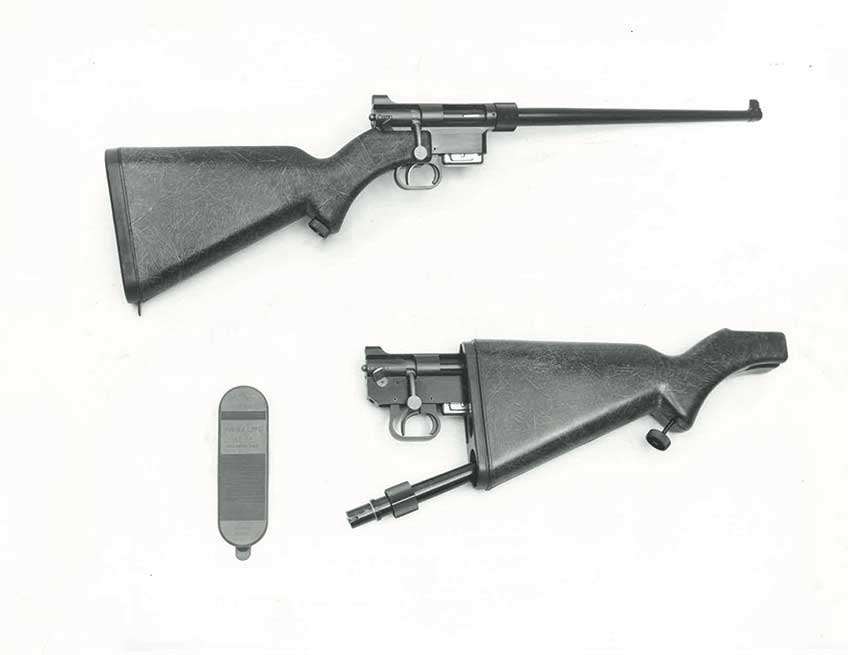
The pistol variation of the AR-7 that was produced by Charter Arms.
Survival Arms of Cocoa, FL had a run at the AR-7 from 1990 to 1997. AR-7, LLC, built the rifle from 1997 through 2004, when it was bought by Armalite. Henry Repeating Arms has made the AR-7 since 1997, first in Brooklyn, NY and now in Bayonne, NJ. It is now known as the U.S. Survival AR-7 and features a choice of stock finishes.
One variant that garners interest from collectors is the Israeli Survival Rifle. This version has a telescoping stock, a pistol grip style from an FN-FAL rifle, and a barrel shortened to 13.5” with a sight design borrowed from the Mauser K98k. A few of these were imported to the U.S. for the civilian market, but they were required to have a 3" muzzle brake attached permanently in order to make the 16" minimum length for a rifle.
The AR-7 has found a niche with those who participate in backpacking, boating, and flying in which they could fall back on them in case of an emergency in remote places where a lightweight rimfire rifle might mean the difference between eating and starving. The latest iteration from Henry Repeating Arms even has a picatinny rail on top of the receiver so that an optic might be attached. Of course, such an accessory would not fit into the Spartan floating stock, but it could be stashed close to the stored rifle for such uses.
Prices for the AR-7 cover a wide range. New or slightly used samples can be bought for as little as $250. Original and mint ArmaLite AR-7s can fetch over $800.