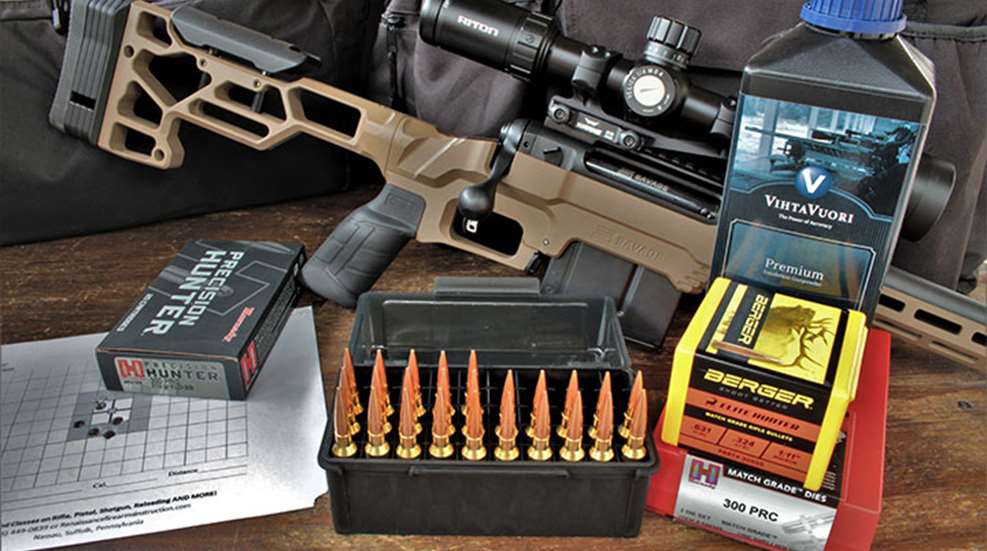
During the introduction of an NRA reloading course, I cover the reasons that an individual might choose to start handloading. Most shooters decided to start "rolling their own" to save money, increase accuracy or create what isn't available. Truth be told, most shooters are going to find a great deal of intersection between these three roads, as was the case when I and fellow NRA Reloading instructor Ron Ingram ventured into handloading the .300 Precision Rifle Cartridge.
You see, at the time there weren’t many hunting rounds on the market yet, and the one offering that we could get left us just outside of one m.o.a. accuracy. This would satisfy most hunters, but the .300 PRC is far more than just a hunting cartridge. Sure, that big .30-caliber bullet is going to put a hurtin’ on anything that walks this earth, but in the ergonomic Savage Precision Chassis Rifle, it is a sweet round to put on steel out to a mile and maybe even beyond.
When engaging targets at these sorts of distances, there are many variables that can affect a bullet, so you don’t want to have a lot of shot-to-shot spread in the mix. With that in mind, we set out to see how much better we could do than the big boys to bring this variance down as much as possible. We started our build around the bullet. We liked the light recoil that came with the Hornady 212-gr. ELD-X in its factory loading, but we weren’t quite sure that we could get our rounds to perform any better with the same projectile.
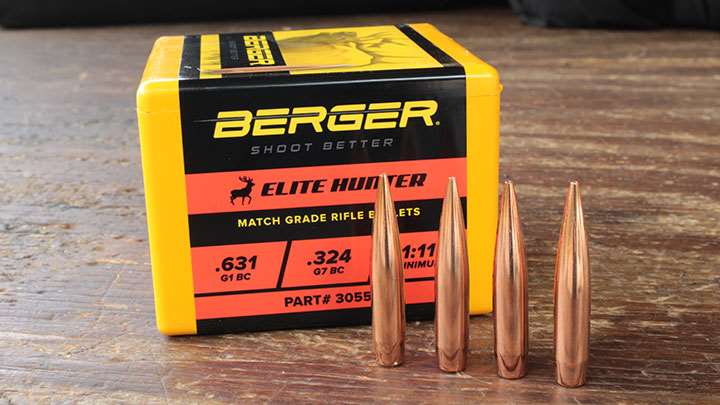
This must be read as a compatibility issue, not a quality issue. I’ve seen the best bullets money could buy lose a group test to mass-produced range fodder many times in my career. Guns like what they like, and it’s as simple as that. Turning our attention to Berger bullets, we selected the 205-gr. Elite Hunter.
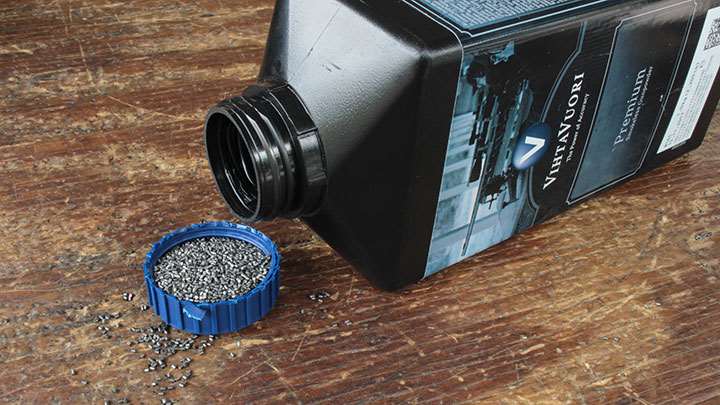
Its sleek profile gives it an excellent ballistic coefficient, and the skiving that encompasses the ogive ensures it will do its job when it reaches the target. The same folks that are responsible for getting Berger products to us also handle VihtaVuori powder. Be that as it may, they were not modest in their suggestion of N165 to push these rounds. Knowing better than to argue, we took their advice and accepted and appreciated the sample to get the work done.
At the time of load development, Hornady was pretty much the only game in town for brass. Most brass is ready to load right out of the box, but if you are looking for consistency, you are going to want to put in that extra effort. We didn’t go too crazy with brass prep, but we did resize it all to take care of any deformation that occurred during shipping.
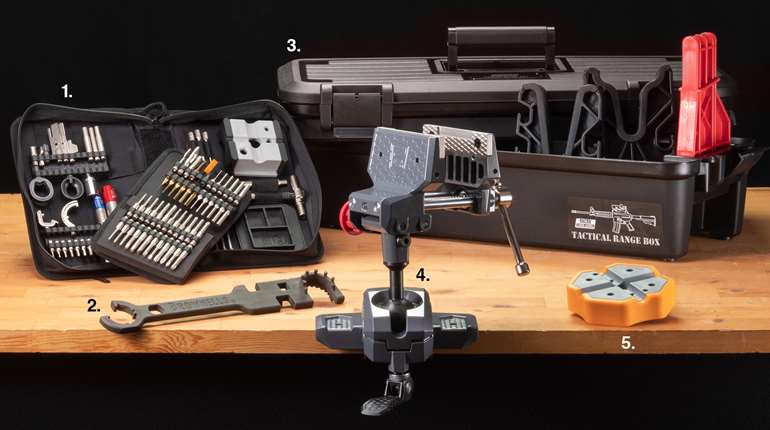
We accomplished this through the use of a Hornady Match Die set that utilizes a bushing system to set neck tension exactly where you want it. After sizing, we ran them all through a trimmer to make them identical to each other, and then they were ready for primers and powder. We weighed each charge with an RCBS Match Master scale and built five rounds of each half-grain increment of the powder spectrum.
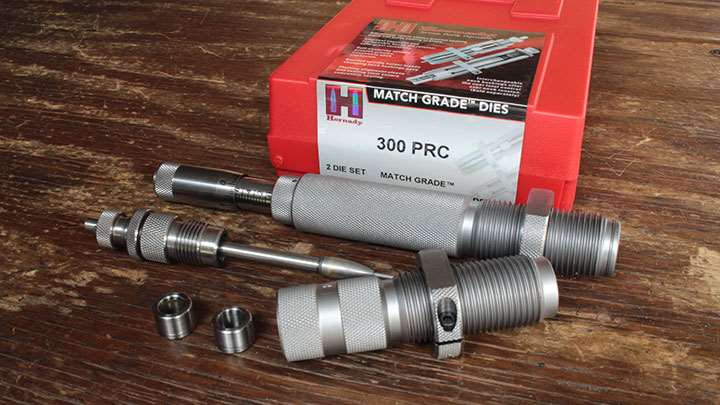
Half-grain steps are plenty precise, because this monster can take upwards of 73 grains of powder. We had an entire weekend to our disposal, so we decided to make it a multi-trip load development. On day one, we fired our initial groups and saw some good results; even those first groups starting to beat out the factory ammunition that we had shot before this test.
It looked like 72.5 grains of powder was the sweet spot, but we had a suspicious flyer that made us run home to make up a few more rounds with this charge. A retest confirmed our suspicion and proved it to be inconsistent, so further investigation and development were necessary. Whenever we find rounds that act like this, we turn our attention to seating depth.
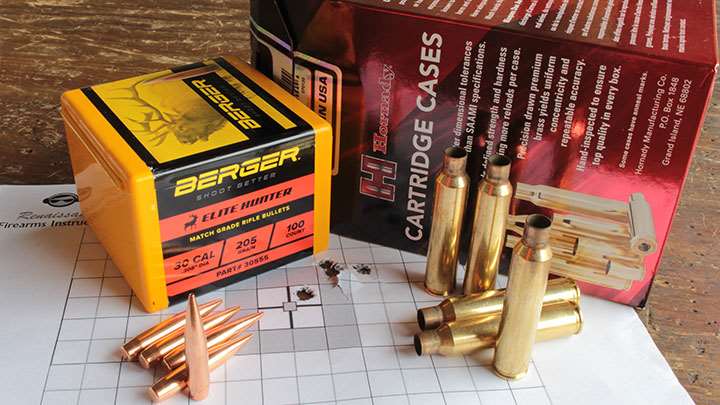
Through the use of a Hornady overall length gauge and a comparator, we found that simply matching our overall length to the factory round’s overall length left us a whopping 0.160” off the lands. We corrected this and elongated our retest rounds to sit just 20 thousandths off the lands. At this overall length, the rounds no longer fit into the detachable box magazine but they were so close that if things worked out we could try a deeper depth to get them to feed.
We ran off 20 of these to check groups and to get an idea if the results would be repeatable. Our second range day brought us soggy weather. Many folks would hold off under these conditions, however they would be missing a great day to shoot. Rain doesn’t affect a bullet's path much (some might even say not at all), so there is no reason to let a little moisture ruin your range day.
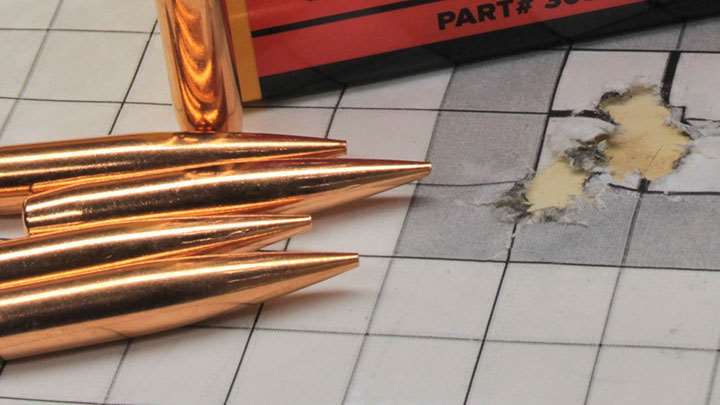
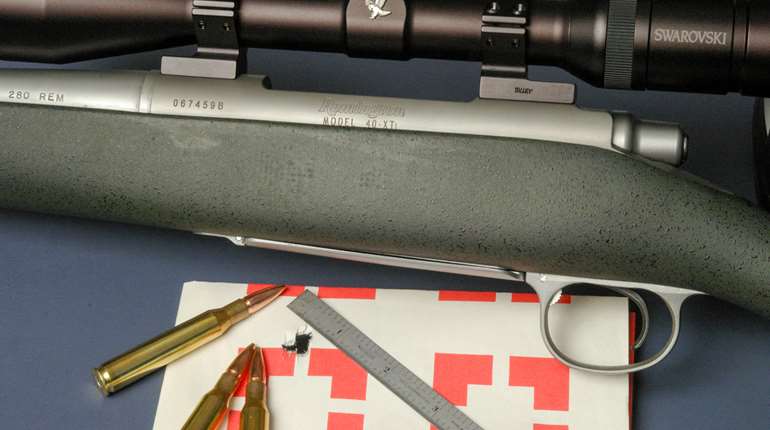
Although it was raining, we pressed on, and we are glad that we did. Group after group was well inside of m.o.a. Our best one of the day landed right inside of 0.75 m.o.a. Not bad for a “hunting” bullet. The lessons learned during our testing were plentiful. For starters, don’t ever settle for mediocre accuracy, even out of what might be considered a budget rifle.
When a manufacturer makes a round, they are likely not making it to perform best through your particular firearm, so you'll need to do some work before you call one or the other "inaccurate." Paramount to this is to never take a good group for face value. If we chalked up that flyer in our first decent group to shooter error, we would be scratching our heads at a later date as we missed even the largest of targets at extended range.
Our experiment left us with a round that performs better than what could be currently purchased, saves us a chunk of change and is relatively light on the shoulder for a hammer like the .300 PRC.