The gold ring of one of Leupold's more budget-oriented models shone atop my old Savage when I took my first deer. Though it lacked the colorful accenting, a Leupold was what I used the first time I reached out past 800 yards with a rifle. And though I’ve now laid hands on my fair share of riflescopes, my mind often returns to such milestones, and the important part Leupold precision has played in them. Far from a nostalgic attachment, the company continually reinforces its position with new innovations, stretching the bounds of the field both figuratively and literally. Such is the case with Leupold’s newest addition to its Mark 5HD series of riflescopes: a 7-35X 56 mm variant, which I had the pleasure of ringing out at Leupold’s own long-range school in Madras, Ore. 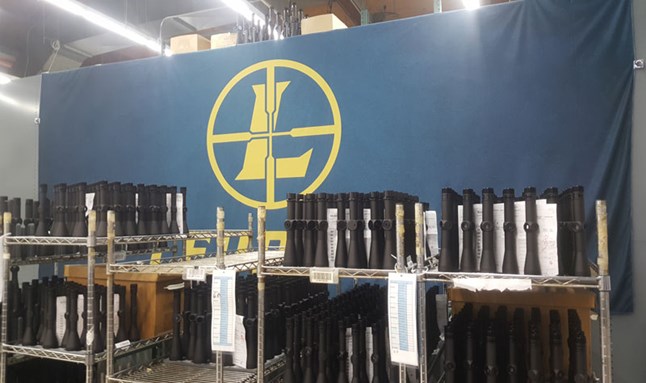
Essentially a magnified MRAD version of the Mark 5HD 5-25X 56 mm MOA that I took to a long-range course in Glengary, W. Va., the 7-35X 56 mm fills a niche often requested by the long-range community. Slapped atop bone-stock RPRs chambered in 6.5 Creedmoor, they helped us step the short-action cartridge out past 1,000 yards—and then some—with ease.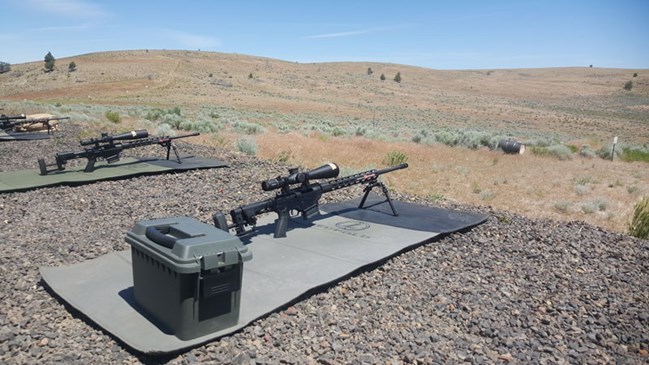
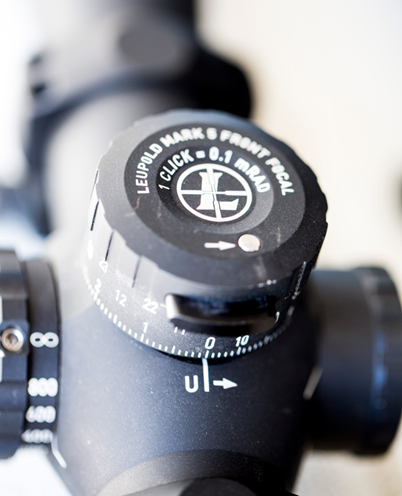 A first-focal plane (FFP) riflescope, meaning the reticle adjusts automatically when magnified, the Mark 5HD 7-35X 56 mm retains the same dimensions as its less-magnified predecessor, only adding an extra three ounces thanks to the weight of an additional piece of glass in the objective lens. In the right application, this is a small price to pay for 10X more magnification. For turrets, the 7-35X 56 mm maintains the M5C3 ZeroLock Adjustments Dial system, with 1/10th MRAD adjustments. These provide an audible and tactile “click,” adding to the confidence one can count on when quickly spinning through the turrets’ three rotations of adjustment (10.5 MRADs per rotation). Also helpful is the turrets’ rotation identification system. Throughout the first rotation, the lock button stays protruding from the turret, during the second, the button moves flush, while in the third, the button recedes into the housing and a silver pin pops up from the top. This is an incredibly useful indexing point when trying to adjust turrets without visual inspection. The parallax adjustment knob, meanwhile, sits on the left side. Several reticles are available—the simplified Front Focal TMR, graduated in .5 MRAD hashmarks (.2 MRAD on the edges), which we used, and the more complex options of the FFP CCH (Combat Competition Hunter) Reticle, the H-59 or the Tremor 3. The Tremor 3 and the TMR are also available in illuminated variants. While I did not have a chance to use any of the more complex reticles, I think one of them may possibly be a better choice for a scope of this caliber (though the TMR certainly has its own merits). More on this later.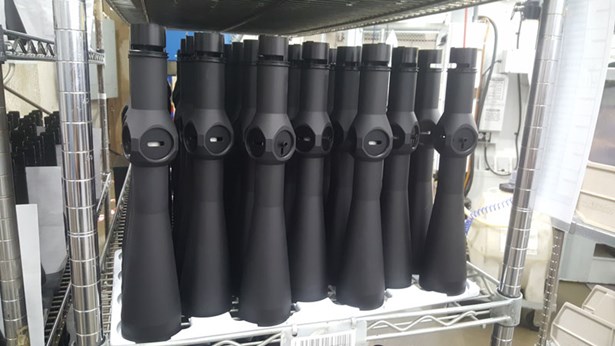
In terms of durability, the 35 mm maintube of the 7-35X 56 mm is constructed with 6061-T6 aluminum. This aerospace-grade material pairs with the rest of the scope’s premium construction, which emphasizes screwing rather than gluing components together, to allow it to survive 5,000 impacts on a machine Leupold terms the “Punisher.” This torture device for optics imparts recoil equivalent to three times that of a .308 each time it slams the scope down, making it quite a rigorous ordeal for any scope to pass. The scratch-resistant lenses are also both waterproof and fogproof, aided in the latter by the gas trapped within the scope. Finally, all these components combine into an incredibly lightweight design (33 ozs.), which, contrary to what seems obvious, actually contributes to the durability and longevity of a riflescope—it doesn’t have to absorb as much recoil before moving. 
 Out on the range, we flogged these optics for 3 days in high wind and blinding sun, the scopes proving more than adequate to the task. The turrets tracked incredibly well, moving our reticles seamlessly from distances of 100 yards out to around 1,900, with adjustments matching those suggested by our ballistic calculator almost exactly. Magnification was similarly excellent, with pristine clarity maintained from 7X all the way to 35X, easily adjusted via the oversized throw knob. The only hiccup we experienced was not the fault of the scope at all (and really could barely be categorized as a “hiccup,”—it occurred when we were pushing the RPRs far beyond their usual bounds). It could, nonetheless, have been somewhat alleviated by the more complex Leupold reticle, thus I feel I should address it.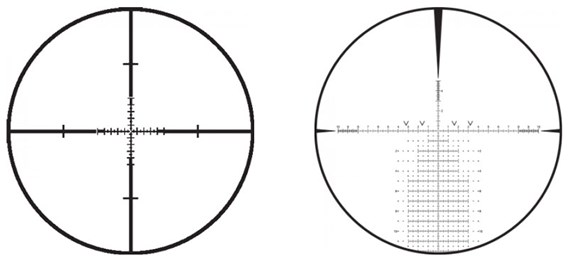
Left: TMR Reticle. Right: FFP CCH Reticle
As we put our Mark 5HDs atop unmodified RPRs, the scopes were seated on flat rails—we thus could not utilize all three rotations of adjustment (as our 100-yard zero point was roughly halfway through), and ran out of elevation travel somewhere around 1,700 yards. As such, given the intense wind and the distance, we were having to hold in the dead space of the scope for our longest shots (a method which proved surprisingly accurate nonetheless). While, yes, the easiest fix for this issue would be to mount the scope on a 20+-MOA rail (as I would imagine it most often will be anyway), one of the more detailed reticles would have helped greatly in our specific scenario, as they are better graduated for instances in which holdover and Kentucky windage must be combined. As such an asset will always allow one to push the bounds of the scope, as well as provide opportunities for quicker shots when time is a factor, I cannot help but think one of these reticles is the optimal choice for the Mark 5HD 7-35X 56 mm MIL. That said, the TMR did perform admirably, and provides more than enough utility for the vast majority of consumers.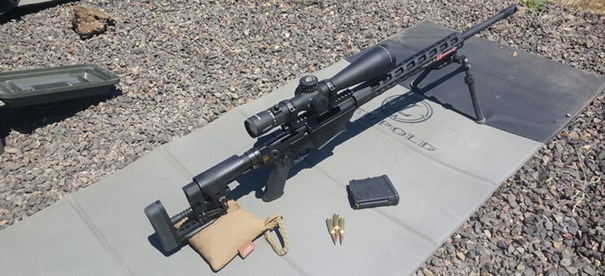
Finally, I must call out yet another standout feature of the Mark 5HD and Leupold glass in general—low-light performance. Our second day of shooting we rose early (think 3 a.m.), and got to the range before sun-up to test the scopes in extremely low light. The Leupolds by and large outperformed the field, their image quality and reticle clarity living up to their reputation. This is in large part due to the Twilight Max HD Light Management System, which also significantly cuts down on the sort of the glare that can become problematic at sun-up and sundown (non-HD models such as the VX-Freedom eliminate just 10 percent less).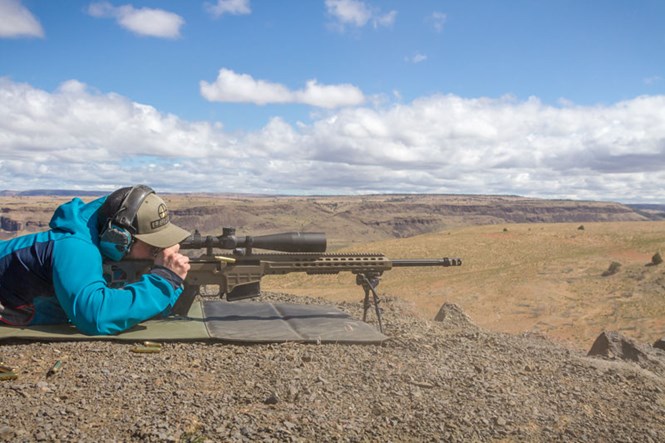
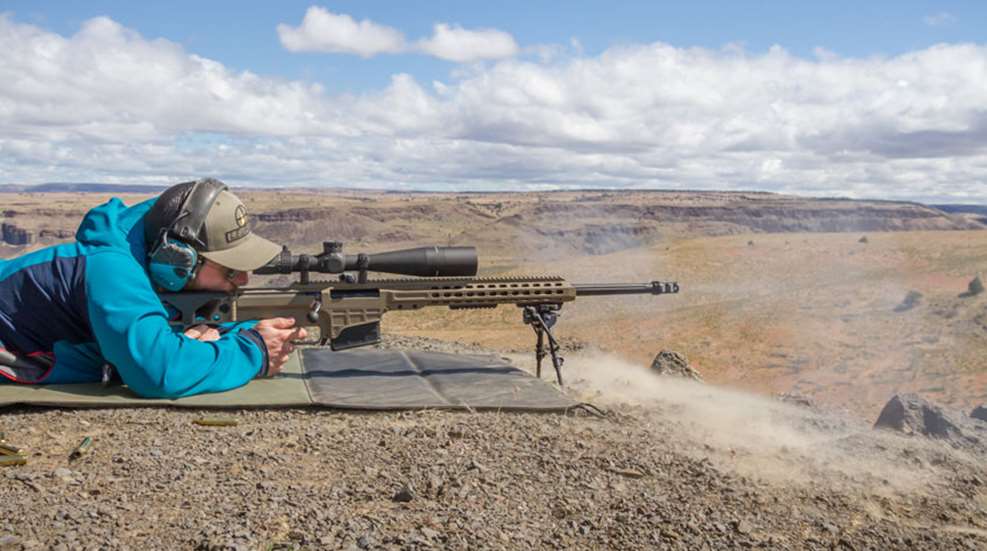
Playing around with the Leupold 7-35X 56 mm MIL atop a Barret MRAD on our final day.
The verdict? Even without its trademark gold ring, Leupold’s Mark 5HD 7-35X 56 mm MIL is another shining jewel in the company’s crown. Durable and consistent, this is a scope for those looking to push the bounds of their rifle with the confidence that, should they miss, it’s not the optic that is letting them down. For more information on this elite riflescope, which retails for $2,989.99, please visit leupold.com.
Additional Reading:
Tested: Leupold Mark 5HD 5-25X 56 mm MOA Riflescope
Tested: Leupold Mark 5HD 5-25X 56 mm Riflescope
Uncovering the Secrets to Long-Range Precision Shooting
Most Popular