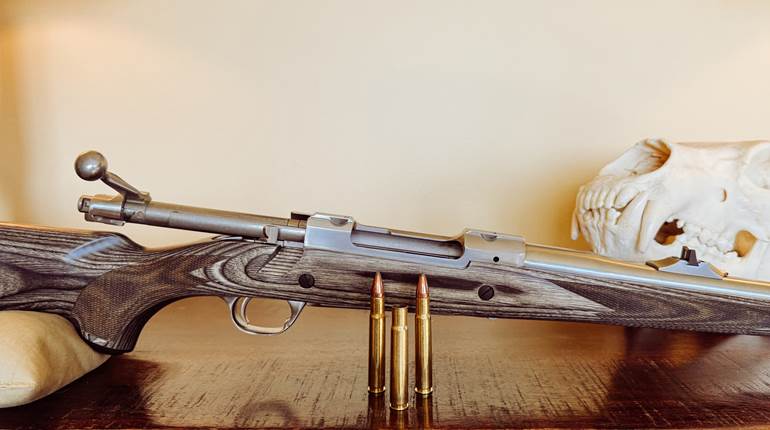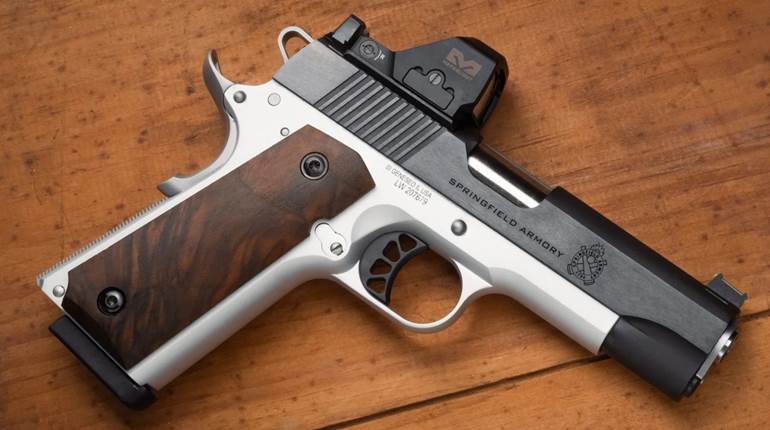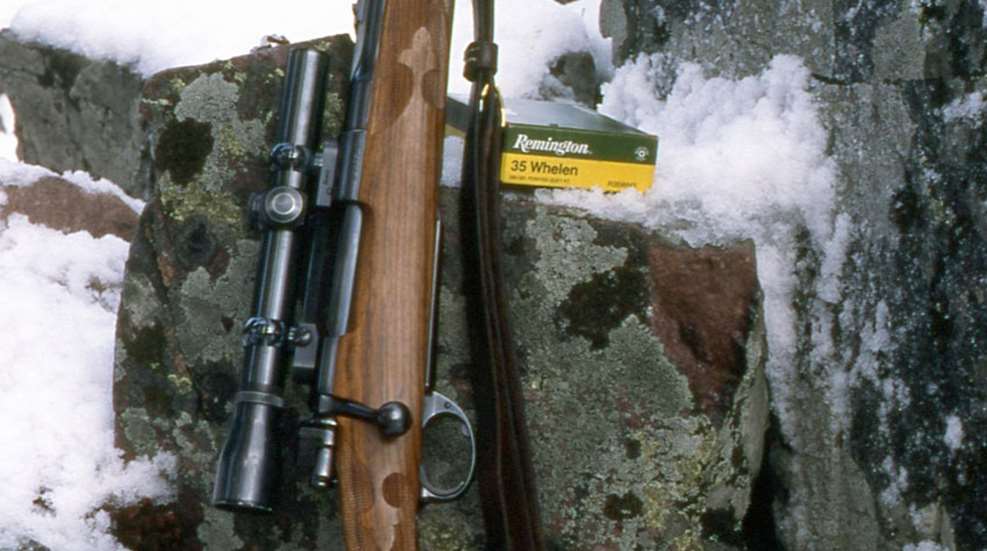
The .35 Whelen was developed as a wildcat in 1922 but was finally legitimized by Remington in 1988. The rifle shown is based on a re-worked Mauser Model 98 action, and possesses a finely figured walnut stock.
The .35 Whelen is all about relatively heavy bullets fired at a sufficient velocity to produce plenty of terminal energy and an adequate trajectory at typical hunting distances. This old-school view is waning, and so is the Whelen. That’s unfortunate, because the Whelen is an efficient and versatile hunting cartridge.
Bullets
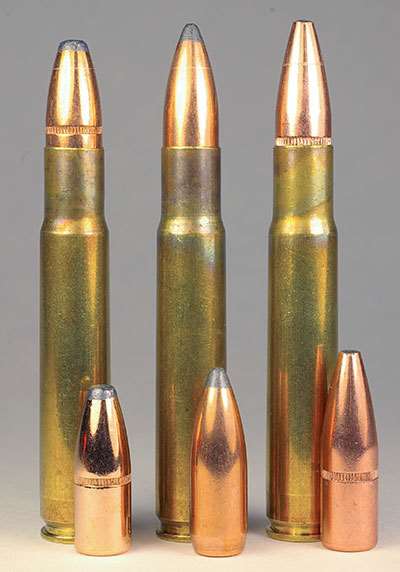
No .35-cal. bullets are constructed with an especially sleek form. One of the most aerodynamic is the Sierra 225-gr. Spitzer Boat Tail (SBT) with a G1 ballistic coefficient (BC) of 0.370. That is less than the 0.501 BC of the Sierra .30-cal. 180-gr. SBT. But start out both bullets at 2600 f.p.s. from the .35 Whelen and .30-’06 Sprg., respectively, and their trajectories are still within 2" of each other at 400 yds. The heavier bullet does carry more energy way out there, but not enough that even a mouse would notice.
The Whelen firing 250-gr. bullets places it above its parent cartridge, the .30-’06, and its kind. I’ve been shooting my Remington Model 700 in .35 Whelen since 1988, mostly with 250-gr. bullets of ordinary construction—Hornady Spire Point, Remington Pointed Soft Point and Speer Hot-Cor Spitzer Soft Points. Through the years, I’ve used the rifle mostly to hunt whitetails, elk and black bears in the forest. My farthest shot in the timber was about 90 yds. Fired at a mild muzzle velocity of 2400 to 2500 f.p.s., these bullets carry enough energy and retain enough weight to plow through game. The bullets punch through deer, leaving a neat exit wound with little bloodshot meat. Even with less-than-perfect broadside shots, the bullets sail completely through elk, and then usually hit a tree so hard snow falls off the branches.
All that stone’s-throw shooting must have ingrained in my brain that the Whelen was a short-range cartridge. The first time I hunted antelope with the Whelen, I stalked up on a buck. The distance looked long, and I held the crosshairs on the top of a buck to compensate for the bullet’s drop. The 250-gr. bullet hit right where I aimed—over the top of the buck. Seeing dirt kicked up by the bullet, I aimed right on and a second bullet killed the buck. Pacing off the distance, the buck stood a few steps past 175 yds.
Propellants
Thumbing through my records, I’ve handloaded the Whelen with a variety of propellants, from IMR 3031 on the fast side to IMR 4320 on the slow end. Maximum amounts of these propellants are required to fire 250-gr. bullets approaching 2500 f.p.s. from a 22" barrel. In the Speer Handloading Manual Number 15, however, a velocity of 2709 f.p.s. is listed for 250-gr. Hot-Cor bullets fired with 66.2 grs. of Alliant Power Pro 2000-MR propellant. That speed is nearly the same as the Speer manual lists for that bullet fired from the .358 Norma Mag. burning an additional 10 grs. of propellant.
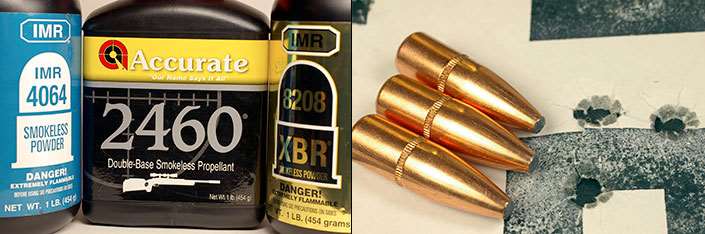
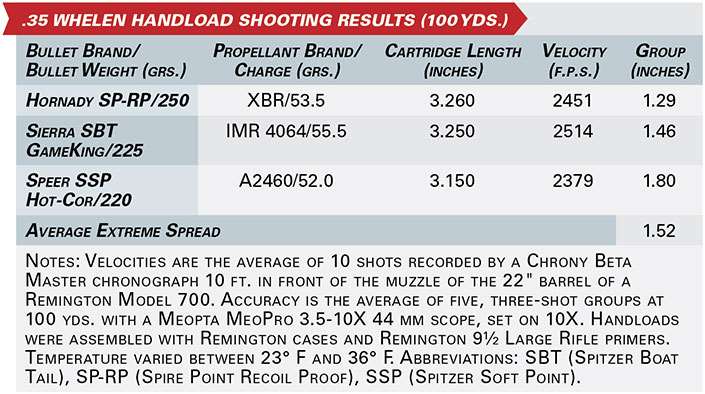
I have found IMR 4064 to be a first choice for accuracy and speed shooting 200- to 250-gr. bullets in the Whelen. Following close behind are IMR 3031 and 4320. I was quite pleased with IMR 8208 XBR firing Hornady 250-gr. bullets at 2451 f.p.s. with an average group size of 1.29" for five, three-shot groups delivered from my well-used Remington Model 700. Accurate 2460 paired with Speer 220-gr. Hot-Cor bullets, listed in the accompanying table, is a moderate-velocity load to tune up for hunting season.
A Case For Economy
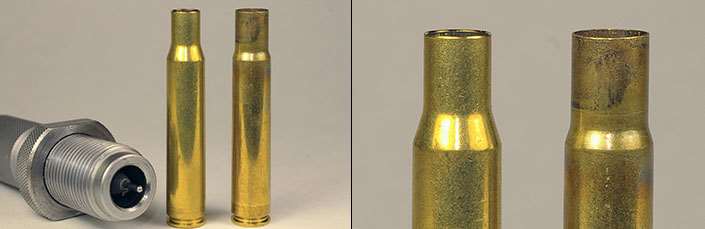
Hornady, Norma and Nosler sell .35 Whelen cases and, of course, brass remains after firing factory Whelen cartridges. However, forming Whelen cases from .30-’06 Sprg. cases is gratifyingly frugal, and I have a lot of ’06 brass. I recently converted a batch of once-fired Federal ’06 cases into Whelens with a down-and-up stroke of the handle on my reloading press.
Expanding the neck places a lot of force on a case and the spindle in a full-length sizing die. A case entering a die is unsupported and may drift this way or that with a spindle in its normal position with the expander button just above the bottom of the die. In that position, a spindle can also bend some from this force and cause necks to expand off center from the case body. Setting the expander button deeper into the die supports cases against the die walls so they remain straight when the expander button enters them. The shortened spindle is also not as prone to bend. Certainly, lubricating the inside of the case necks eases the stress of expanding them.
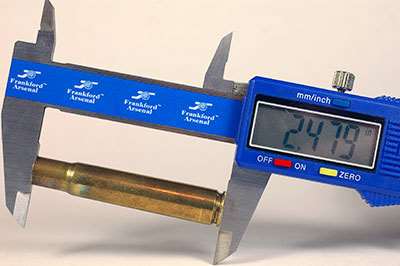
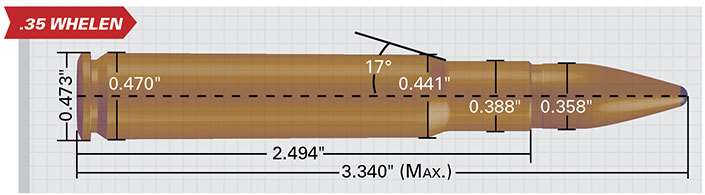
Neck runout was 0.002" at most on the expanded ’06 cases, and their wall thickness was the same as Remington Whelen cases. Case length measured approximately 0.012" short of the 2.484" trim length of Whelen cases. That length may not be long enough to apply a crimp on some bullets, depending on their seating depth. Velocities turned in by expanded ’06 and Whelen cases were within 20 f.p.s. of each other when both fired IMR 4064 and Sierra 225-gr. bullets listed in the accompanying table.
Hunting with my .35 Whelen several Novembers ago, snow fell during the night and left a clean slate at morning light for a day of old-school tracking. Two sets of large tracks meandered along the edge of an oxbow in the river. I looped ahead to intercept the whitetail bucks. Stepping around a juniper, I saw the bucks, and they saw me and ran. With my rifle up, I followed the bucks through my scope going in and out of sight between the trees. The crosshairs swung past the shoulder of the buck bringing up the rear and the rifle fired. The buck fell and slid on the snow with its momentum. Snow was still sifting down through the tree branches when I walked up to it.
Most Popular