When Walther introduced its svelte Polizeipistole (PP) and Polizeipistole Kriminalmodell (PPK) double-action pocket pistols in 1929 and 1930, Mauser realized that it might be a good idea to think about retiring its own serviceable, but increasingly hoary, line of 1910/1914/1934 6.35 mm (.25 ACP) and 7.65 mm (.32 ACP) repeaters.
Though the earlier Mauser pocket models were extremely well-made, cleverly designed and popular in their day, being single-action and a bit boxy they were perceived to be old-technology. In the face of stiff competition from Walther, sales were flagging. Mauser went to work and, by the mid-to-late ’30s, a handy 7.65 mm double-action pistol had been achieved by its designers.
Totally unlike Mauser’s earlier wares, the HSc, as it was called (“HS” standing for Hahn Selbstspanner—“self-cocking hammer,” and the “c” indicating the third and accepted design), was a streamlined, up-to-date double-action blowback. Reflecting the sleek Art Deco look of the period, in the manner of such things as the new Volkswagen automobile which appeared almost concurrently, this handy semi-automatic was definitely a product of its time.
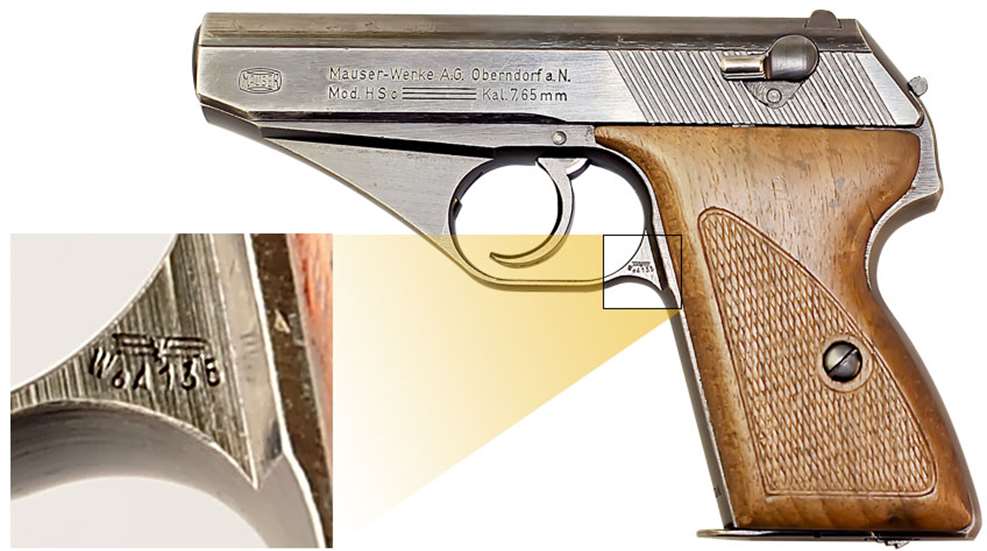
Measuring just 6" in length with a 3.4" barrel, the 25-oz. HSc featured a reduced exposed hammer, the spur of which—to allow for easier concealment—peeked out of the rear of the slide just far enough to allow a positive thumb-cock. A single-stack magazine held eight rounds and this, along with one round in the chamber gave the pistol an effective nine-shot capability. The magazine had a typical European heel-style catch, though a lip on the forward part of the magazine allowed it to be easily extracted when the catch was pushed to the rear.
As well, the gun had a slide-mounted safety which, when “on safe,” locked and lifted up the rear of the internal spring-loaded firing pin, preventing the hammer from striking it. Stocks were plain, simply checkered walnut panels. Standard finish was blue, and sights involved nothing more than a dovetailed rear round notch and a small square blade milled out of the slide.
Production on the HSc began in 1940 and, given what was going on in the world at that time, the gun was evaluated and accepted by the German army, navy and police in short order. Such examples were stamped with the appropriate waffenamt inspector’s marks. Civilian models were also available. As well as wartime examples, some were made under French auspices for a couple years following World War II and then by Mauser commercially until 1977. In 1970 the gun was also offered in 9 mm Kurz (.380 ACP). Additionally, copies were made in Italy by Renato Gamba. Ultimately about 350,000 HSc pistols were manufactured by Mauser.
While embellished HScs can be found, standard finishes are those most normally encountered. Generally speaking, from a collector’s standpoint, with the exception of very early “low grip-screw” models, the wartime, military-issue pieces hold the most interest and bring the best prices, early war variants having a slight edge. The pistol we’re looking at here, for example, has a “WaA135” waffenamt, indicating it was army-issue. Navy guns bring about double that of army specimens, as do World War II-vintage Swiss commercial models. All things being equal, late World War II police and postwar guns normally have the least value.
Gun: Mauser Model HSc
Manufacturer: Mauser–Werke A.G., Oberndorf am Nekar, Germany
Chambering: 7.65 mm (.32 ACP)
Manufactured: c. 1943
Condition: NRA Very Good (Modern Gun Standards)
Value: $500
Photos by Jill Marlow
Most Popular