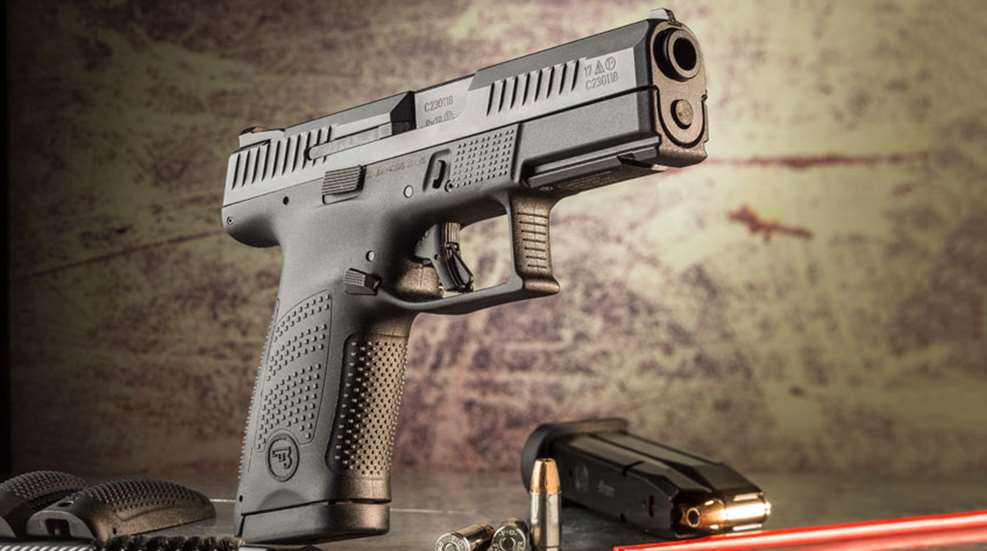
In the past half-decade, Czech Republic manufacturer Ceska zbrojovka a.s. Uhersky Brod (CZ) has unveiled a host of intriguing handguns and long arms, such as the Scorpion EVO S1- and 805 Bren S1-series pistols and carbines, all of which have appealed to American shooters. Continuing that trend, the company recently unveiled its first foray into polymer, striker-fired pistols—the P-10 C.
Since its inception in 1975, the hammer-fired, recoil-operated, semi-automatic CZ 75 pistol has not only been outstanding in its own right, but, with refinements, has also served well as the foundation for several other excellent CZ models. That includes the P-09 and P-07 pistols, which were first offered in 2013 and 2014, respectively. As a short-recoil-operated, striker-fired pistol, engineers of the P-10 C couldn’t utilize the existing operating system from the CZ 75; instead, they designed one from the ground up. There were benefits from doing so, one being a high-quality trigger.
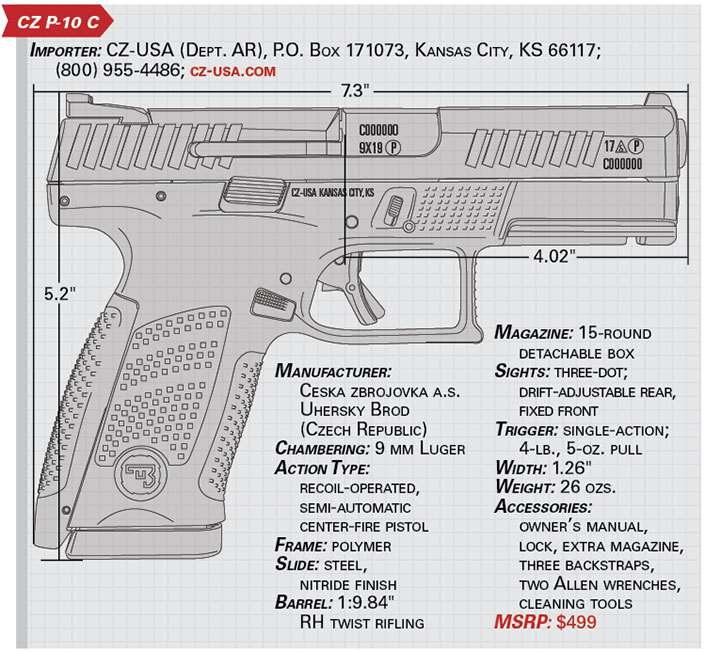
Triggers of striker-fired pistols often leave much to be desired. Not so with the P-10 C. With a break averaging 4 lbs., 5 ozs., of pull, the pre-cocked, single-action trigger—with a blade-in-trigger safety—displayed minimal creep and no overtravel. Equally important, the reset was remarkably smooth and notably short, enabling speedy follow-up shots. The firing pin is blocked by an internal passive safety. Other controls on the P-10 C include bilateral magazine-release buttons and slide releases. Fans of Glock’s takedown system will find familiarity in the slide removal on the P-10 C, as the processes are virtually identical.
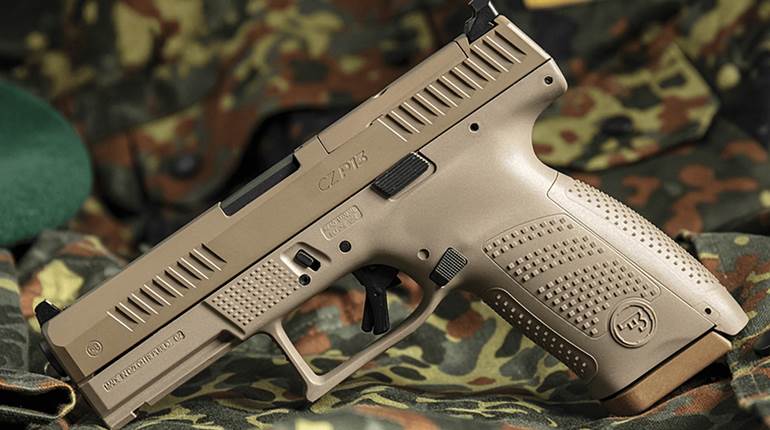
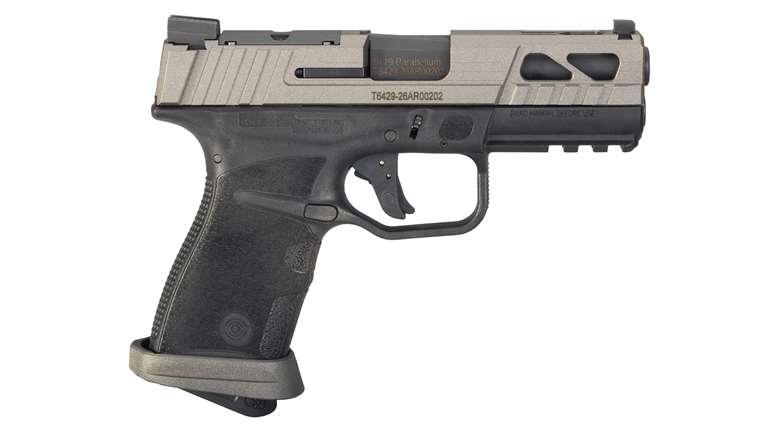
Though the CZ 75’s operating system was eschewed on the P-10 C, its ergonomics were not. The P-10 C’s fiber-reinforced-polymer frame retains the elder’s familiar grip angle, a deeply recessed upper backstrap with ever-so-slightly concave sides (for the trigger finger and thumb) and a mid-grip palm swell. Since the P-10 C lacks a hammer, the lengthy beavertail of the CZ 75-based models is unnecessary and therefore absent. To better fit a range of shooters, accompanying the P-10 C are three sizes of backstraps that are quickly and easily replaced.
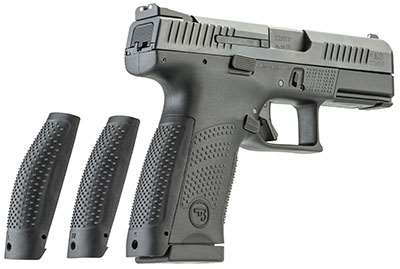
Adorning the sides of the grip, as well as the frontstrap and backstrap, is highly aggressive texturing. Comprised of rows of raised squares, purchase is assured—even in extreme conditions. We can attest to this because evaluation of the P-10 C occurred while fully exposed to a torrential downpour. Not once was grip compromised. The P-10 C’s oversize trigger guard enables use while wearing thick, wintertime gloves, and its perpendicular front mimics that of Glock pistols, which, when combined with a similar slide and frame size to the Austrian handguns, enables them to share holsters. Above the trigger guard and slightly forward of the disassembly pins is another series of rowed squares, albeit not as aggressive as those found on the grip. On the dustcover is a one-slot accessory rail.
On both sides, the nitride-finished steel slide has a series of grooves fore and aft of the ejection port to enhance purchase during disassembly or when racking the slide. Moreover, like the P-07 and P-09, the side of the P-10 C is contoured to ease drawing and holstering, and to remove unnecessary weight. The P-10 C’s overall weight is 26 ozs. Topping the slide are steel, three-dot sights rendered in luminescent paint. While the front is fixed, the dovetailed rear sight is drift-adjustable for windage. The latter has a flat, front face to assist with one-hand cocking.
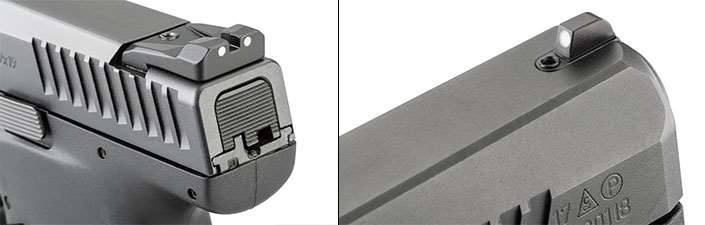
The “C” in P-10 C refers to the pistol’s compact frame and slide. Within that compact slide is a cold-hammer-forged, 4.02" barrel. Unlike some semi-automatic pistols, which have a minimalist feed ramp, that part on the P-10 C is exceptionally beefy. Extraction is by way of a lengthy, spring-loaded extractor similar to that on other P-series pistols, and it works in conjunction with a fixed ejector.
Magazines for the P-10 C are from the same family as the P-07. The 9 mm Luger-chambered P-10 C is fed by steel-bodied, flush-fitting, 15-round, staggered-column magazines. That round count drops to 12 in .40 S&W-chambered models.
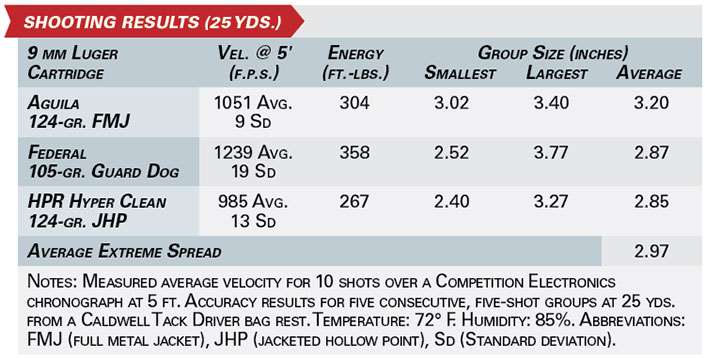
We accuracy tested the new pistol at 25 yds. from a sandbag rest in a nonstop downpour. It was a good opportunity to see how the pistol performed in hostile conditions. Of the three types of ammunition used—Federal Guard Dog 105-gr., HPR Hyper Clean 124-gr. jacketed hollow point and Aguila 124-gr. full metal jacket—there was no standout. In fact, the five consecutive, five-shot averages of the Federal and HPR loads were virtually identical. All things considered, accuracy was respectable and sufficient for the pistol’s intended use.
We experienced several malfunctions, all occurring within the first four magazines loaded with the Aguila and HPR loads. After firing, the slide failed to move rearward enough to expel the spent cartridge case. Meanwhile, the awaiting round in the magazine was pushed upward, into the bottom of the feed ramp, deforming the bullet. This happened on several occasions. Additionally, the mild HPR rounds failed to cycle the slide in several instances. Once the hard-hitting Guard Dog ammunition was fired, however, all subsequent rounds cycled flawlessly—including several boxes of remnants from previous tests. Although not noted in the owner’s manual, perhaps the gun needed a brief “break-in period.”
With accuracy testing completed, we transitioned to high-speed target-acquisition drills, controlled pairs, magazine dumps, etc. We found the P-10 C pointed naturally, and target acquisition was immediate. Trigger dynamics could be summed up with one word: phenomenal. Although the texturing on the grip seemed overly aggressive at first, it grew on us—especially when shooting in conditions that had us drenched to the bone.
We were impressed with the CZ P-10 C. The company might have been a bit late to the striker-fired-pistol party, but it certainly made an entrance when it arrived.
Most Popular