Firearm: vz.27
Manufacturer: Česká zbrojovka (as Böhmische Waffenfabrik AG in Prague)
Caliber: 7.65 mm (.32 ACP)
Manufactured: c. 1942
Condition: NRA Excellent (Modern Gun Standards)
Value: $850
Following the 1938 Munich Agreement, which shamefully resulted in the annexation by Germany of Czechoslovakia’s Sudetenland, hostilities in Europe increased, and in short order, the Nazis engulfed the entire Czech homeland. Accordingly, the conqueror turned the efforts of the country’s manufacturers to its own use. One of the many firms affected included the armsmaker Česká zbrojovka (CZ).
One of the firm’s products, introduced at the beginning of the 1920s, was the .380 ACP-chambered vz.24 (“vz” being an abbreviation of vzor—or “model”) which succeeded the previous vz.22, an erstwhile military arm designed by Zbrojovka Brno engineer Joseph Nickl. Featuring a rotary-barrel, locked-breech action, the vz.24 was considered overly complicated and thus, when the project was taken over by CZ, designers František Myška and Alois Tomiška considered it more practical to work it into a simpler 7.65 mm (.32 ACP) blowback design. Accordingly, in 1927, the vz.27 made its debut.
The vz.27’s silhouette followed the basic look of the vz/CZ line with a distinctively shaped grip and rounded rear portion to the slide. Its mechanics were reliable but undistinguished, basically being composed of a 1903 Colt-like barrel-mounting arrangement. Lockwork hearkened back to that of the Mauser Model 1910. Like the 1910, the vz.27 had a removable sideplate that allowed access to the trigger parts. Grips were normally checkered Bakelite panels with CZ logos.
The safety, consisting of a lever and release button, was robbed from the 1910 Mauser. Sights consisted of a simple fixed, rounded front blade and drift-adjustable notch rear. The pistol has an exposed hammer, though its rounded spur is almost entirely hidden within the rear of the slide, protruding just enough to allow thumb-cocking. A heel-type catch secured the nine-round box magazine.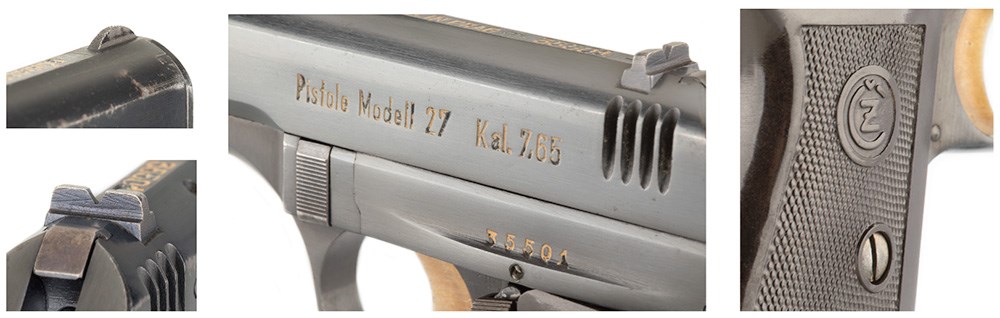
The vz.27 is an interesting piece to disassemble. The slide will lock back on an empty magazine. After pushing the takedown catch downward, remove the magazine while holding the slide to the rear to allow the slide to move forward off the frame.
After removing the recoil spring, guide rod and barrel retainer, extracting the barrel is accomplished by pulling it forward and rotating it until its trio of lugs line up with an internal slide cut. Unlatching the sideplate exposes parts of the trigger mechanism for oiling and servicing.
Initially offered as a commercial piece, with the takeover of CZ by the Germans, the vz.27 was added to the arsenal of the Third Reich and produced under its auspices of the renamed Böhmische Waffenfabrik AG in Prag (Bohemian Weapon Factory Limited in Prague). The pistols produced there during World War II were stamped on their slides “fnh Pistole Modell 27 Kal 7,65,” the “fnh” being the German letter code for the factory.
With the fall of the Reich and the later Communist coup in Czechoslovakia, CZ’s name was once again changed, this time to Česká Zbrojovka Národni Podnik (Czech Weapons Factory National Enterprise). Here, some 200,000 vz pistols, now more commonly known as the “CZ 27,” were made and widely exported. Ultimately, the factory produced a total of 650,000 vz/CZ 27s.
The gun seen here is a typical wartime vz.27 variant. Condition is good, with the pistol showing little use. Many of these little semi-automatics found their way into GI duffel bags by the end of World War II and thus, today, are seen in the U.S. in some abundance. Granted, compared with Lugers, P38s, PPKs and some other German military-issue handguns, vz.27s are not all that heavily sought-after, but decent condition or unusual examples can bring reasonable money. Value on this Nazi-issue piece is reckoned at $850.
Most Popular