Sometimes we can slip into imagining World War II as a far off, distant conflict that does not exert much influence on the 21st century. Though the subject remains popular in the United States today, it sometimes becomes an abstraction in ways that might not be possible in countries that were more directly affected by it. A city like Berlin, with reminders of the conflict practically on every corner, provides opportunities for community recollection that we do not have in the U.S.A. Though the reminders we do have are somewhat less dramatic than they may be in other parts of the world, our World War II past nevertheless reaches into the present on a regular basis to remind us that the Second World War is near—near enough to reach across the decades and resolve the final status of someone missing for 70 years.
In November 1943, the first major battle of the Central Pacific Campaign began with Operation GALVANIC—the opposed amphibious invasion of the former Gilbert Islands. For this operation, the Army’s 27th Infantry Division landed on Butaritari Island in the Makin Atoll, and the 2nd Marine Division landed 118 miles to the south on Betio Island in the Tarawa Atoll. While the Army faced lighter opposition and suffered fewer casualties at Makin, the Marines on Betio endured a brutal 76-hour long battle characterized by significant tactical challenges, and high casualties. In this battle, the 2nd Marine Division fought a Japanese garrison force of nearly 5,000 men under the command of Rear Admiral Keiji Shibazaki on an island just 2.5 miles from end to end and 600 yards wide. The island was declared secure on November 23, 1943 and the following week TIME magazine correspondent Robert Sherrod remembered the battle with these words: “Last week some 2,000 or 3,000 United States Marines, most of them now dead or wounded, gave the nation a name to stand beside those of Concord Bridge, the Bonhomme Richard, the Alamo, Little Bighorn, and Belleau Wood. The name was Tarawa.”
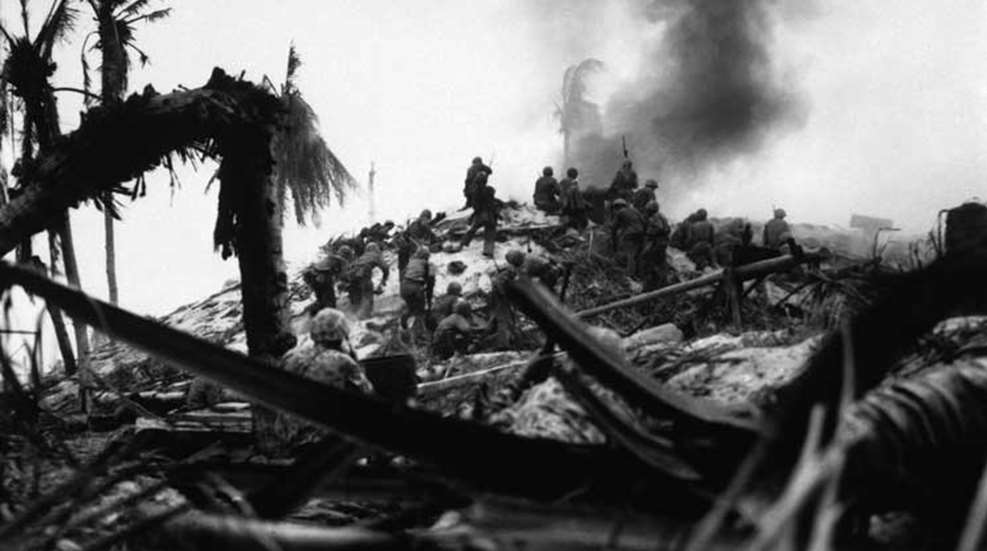
Among the dead of Tarawa were three men who would posthumously receive the Medal of Honor for their relentless fighting spirit: Staff Sargent William James Bordelon who was killed while assaulting Japanese machine gun positions during the first day of the battle, First Lieutenant William Deane Hawkins who was killed while leading a Scout Sniper Platoon on the second day, and First Lieutenant Alexander "Sandy" Bonnyman, Jr. who was killed leading the assault on Admiral Shibazaki’s command bunker on the third day. A former Princeton football player, Bonnyman was seen fighting with both an M1 Carbine and a flamethrower during the course of the battle, and he can even be seen in one of the most famous images captured during the fighting on Betio. The photograph (top) was snapped while Bonnyman and 25 other Marines pushed up the sand slopes of a Japanese position, and it provides a dramatic visual insight into the intensity of the fighting that unfolded during the struggle for the island. Throughout it all, the 33-year-old Lieutenant was at the very front of the attack, providing the kind of critical leadership that was an inspiration to the other men. In the closing moments of his heroic stand, Bonnyman killed three enemy troops before falling from a fatal gunshot wound. Although his body was recovered soon thereafter, circumstances unique to Operation GALVANIC quickly produced intrigue that would go unresolved for the next seven decades. 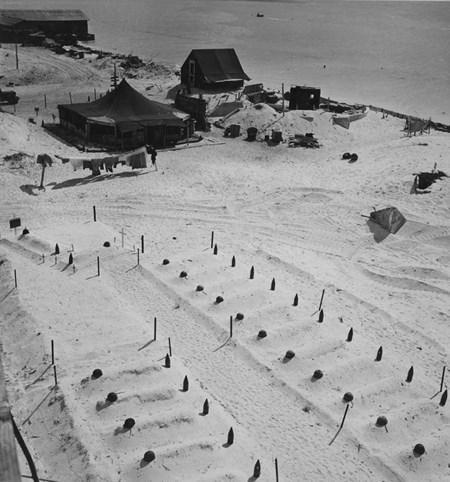
Located just 01° north of the equator, Betio experiences sweltering temperatures even during the winter months. But in addition to the equatorial heat, by November 23, 1943 the island was littered with over 6,000 dead bodies that had to be dealt with immediately. As that was the case, burials of U.S. personnel took place without delay with the understanding that they would only be temporary. It was during this hastily executed effort that Alexander Bonnyman was placed in a grave with 36 other Marines. When a graves registration unit returned to island to exhume the bodies from that temporary grave, the exact spot could not be located. Then during the final 18 months of the war, the conflict followed an intensifying continuum that was characterized by bigger and bigger battles with higher and higher casualties. Overwhelmingly, the emphasis was on winning the war, and that stretched resources thin. After the conflict ended, the new emphasis on the Cold War, the nuclear race, and then the space race also consumed the resources that would have otherwise been committed to locating Alexander Bonnyman. 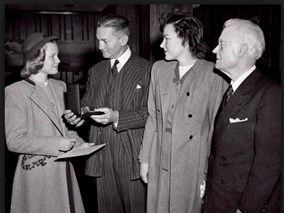
In 1947, he had been posthumously awarded the Medal of Honor in a ceremony during which Secretary of the Navy James Forrestal presented the medal to Bonnyman’s 12-year-old daughter, Frances (image courtesy Clay Bonnyman Evans). Although he was not forgotten, his body remained missing for another 68 years. 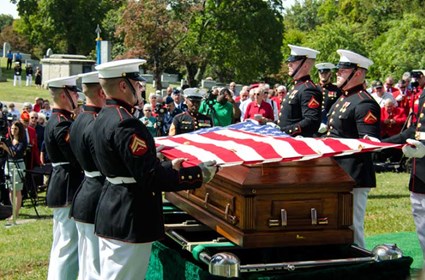
In March 2015, the plot where Bonnyman had been buried on Betio was discovered and the bodies were, at that time, exhumed. On August 27, 2015 Bonnyman’s remains were positively identified and then, on Sept. 28, 2015, he was returned to his childhood home in Knoxville, Tenn. Thus the Marine Medal of Honor recipient who sacrificed his life during Operation GALVANIC in 1943, finally returned home 26,243 days later. Although his war may have ended more than seven decades ago, it was only just reconciled last year. (image by Jeremy Edward Shiok)
See more of Lt. Bonnyman's funeral and repatriation at americanrifleman.org/bonnyman.
Most Popular