We have had the .40 S&W cartridge since 1990, roughly a quarter century of active service. Much of that service was in law enforcement, but many civilian handgunners have also cheerfully climbed aboard the medium-bore bandwagon. When it's evaluated on the basis of actual field performance, the .40 out-performs its closest competitor, the 9 mm Luger, but falls short of the .45 ACP. The amazing fact to be drawn from all of this is that the least-effective cartridge has become most popular. This is a situation in need of some serious examination.
The amazing fact to be drawn from all of this is that the least-effective cartridge has become most popular.
In the 70s and early 80s, American law enforcement put aside their .38 Spl. and .357 Mag. revolvers, replacing them with a new class of 9 mm pistol. Most had some form of DA/SA lockwork, as well as modern sights and controls. However, the most significant feature of all of them was a wide magazine that held anywhere from 14 to 18 rounds of 9 mm ammunition. As illogical as it might seem, we changed to these pistols because of their capacity and not their terminal performance. Essentially we chose the 9 mm cartridge for its size. It happened very quickly, but almost immediately we began to get complaints about felons taking multiple 9 mm hits and continuing the fight. The technology of the arms industry responded in a two-pronged effort, both of which were eminently successful.
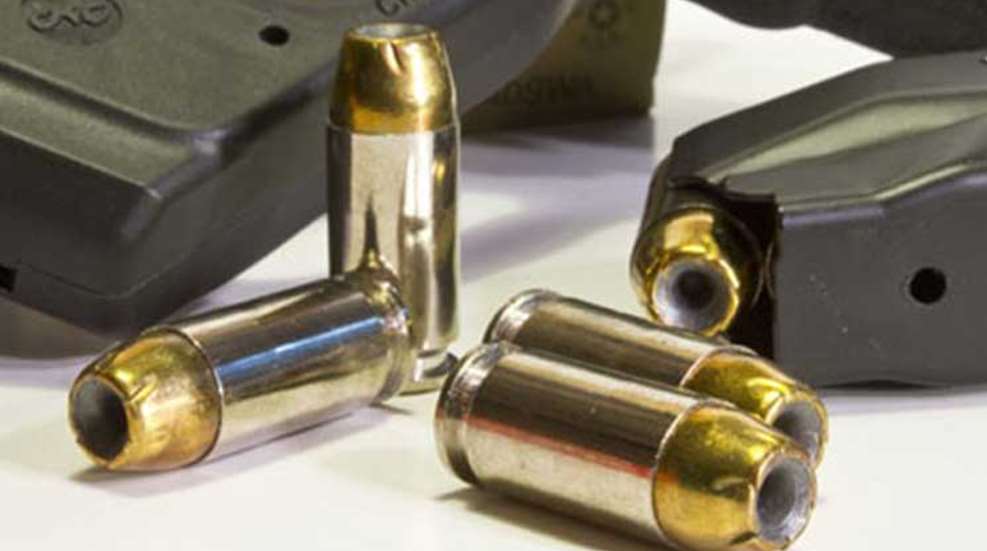
The first approach was to radically improve 9 mm ammunition. Better propellants and way better bullet construction gradually created a new class of excellent ammo. It would penetrate as needed, but expand perfectly. The 9 mm ammo in use today is exponentially better than the 80s breed. But there also came a second way to skin that ballistic cat. In actual police gunfight experience, the .40 was a better performer than the 9 mm. The venerable firm of Smith & Wesson experimented with prototype cartridges and, in concert with Winchester Ammunition, came up with the .40 S&W. It was just about the same length as the 9 mm, thereby making it usable in 9 mm-sized pistols. In a matter of a few months, every pistol maker out there had a .40 S&W gun and every ammo maker was making the ammo for it. The .40 S&W load typically used a 180-gr. (.400”) bullet at 950 to 1000 fps. In actual police gunfight experience, the .40 was a better performer than the 9 mm, although the larger size of the cartridges dropped the capacity two or three rounds.
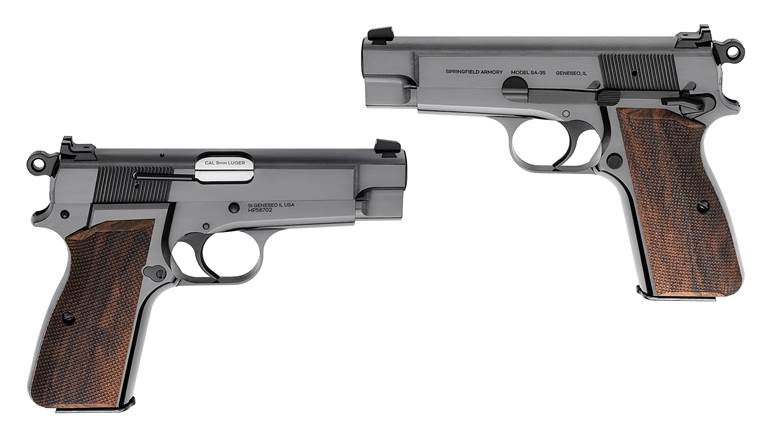
Gun makers also discovered that the .40 S&W was hard on guns and most 9 mm conversions required a little more weight. Witness the .40 S&W Browning Hi-Power—it's 2.5 ozs. heavier and has another locking lug. The point is simply that the .40 S&W is a pretty robust load. It is easy enough to engineer solutions, but you still get plenty of muzzle blast and recoil. For most of the 90s and well into the 21st century, the .40 S&W continued to supplant the 9 mm in police agencies across the country. However, in the past 10 to 15 years, the trend has slowed—and then virtually stopped. There are many fine .40 S&W pistols remaining on the market and plenty of a good ammo for them.
But 9 mm pistol sales are clearly increasing. Organizations which once raced to get rid of their 9 mms and replace them with .40s now turn around and do the opposite. The ammo companies now sell more 9 mm Luger than any other caliber. What the heck happened?
First, in law enforcement, there are now many more officers of lighter weight and smaller stature in the work force. The increased weight, recoil and muzzle blast of the .40 guns and ammo are hard for them to get used to. Confidence in your equipment is essential for an armed officer and too many have not been able to achieve it with a .40 S&W pistol. A lot of these people are far more comfortable with a 9 mm. Second, the ammo used in their guns is now a great deal more effective than the stuff that caused their department to drop the 9 mm these many years past. You really can't argue against the 9 mm using the old ammo. Surprisingly enough, the guns themselves have little to do with the equation. They are superb handguns in either caliber.
The development and deployment of the .40 S&W caliber is an understandable event. In many places, the cartridge will persist for decades and the need for its effectiveness is a very real phenomenon. In my view, the .40 is a better choice than the 9 mm; I was delighted when it was introduced.
The majority does not concur. Close, but no cigar.
Most Popular