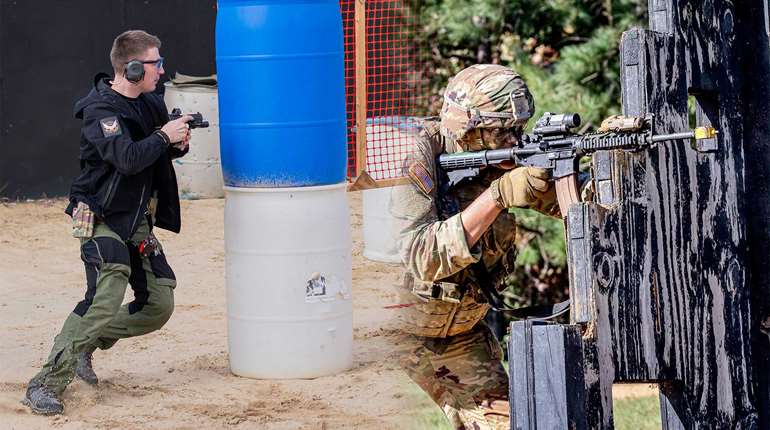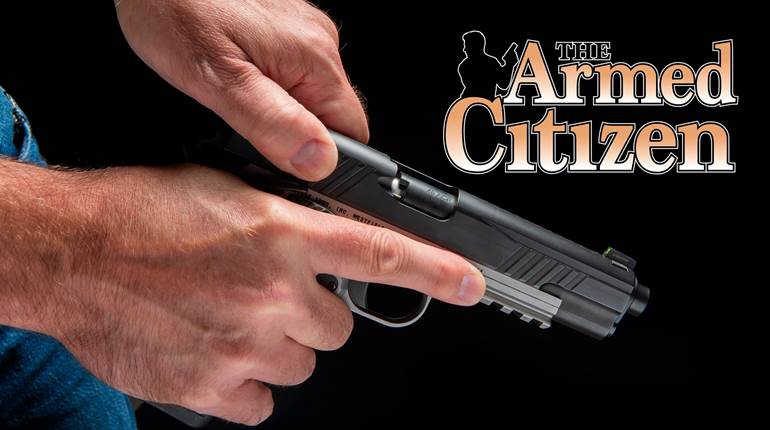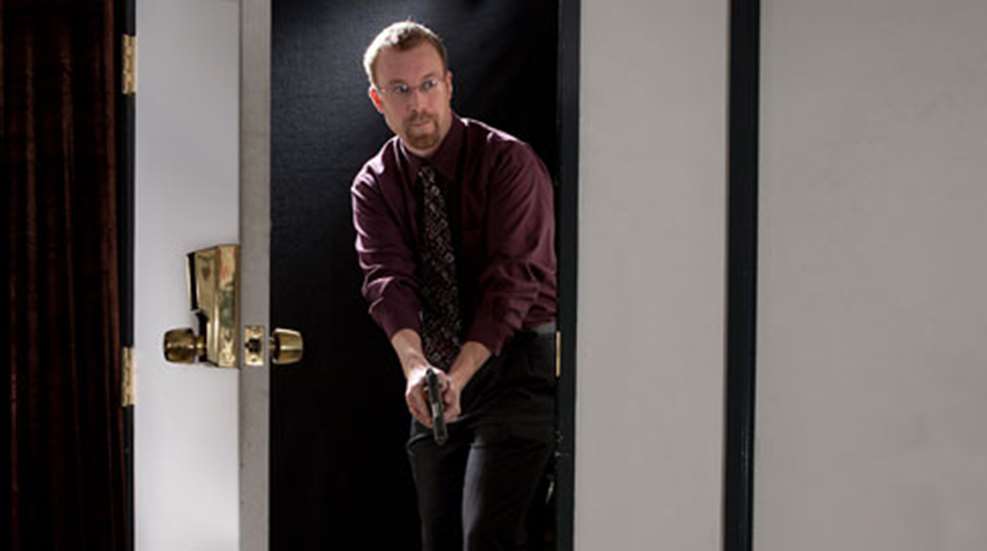
The low ready position is one that we use when we have not identified a specific violent threat, but we know that one may exist in our immediate area. You may use the position when you exit an area where a threat might exist, or as you move through your house, checking for the source of the noise that woke you up. The low ready position is, quite frankly, a very useful position for when you feel that danger may be close by.
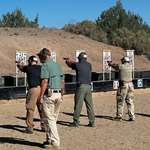
Imagine that you have your defensive handgun in a two-hand hold, in either the Weaver or Isosceles position, and are aimed in on a target. The low ready position is accomplished by lowering the gun and arms to an area below the target without bending the arms. Should the target suddenly become a threat, the handgun can be quickly raised to the vital zone and a shot can be delivered.
How far you lower the handgun in the low ready position depends entirely on what is going on around you. Should you encounter a person in a highly suspicious situation, it would be advisable to have your defensive handgun lowered enough so that you can clearly see the hands and any item that he or she might be holding. In a house clearing situation, it would be advisable to keep the handgun low enough that you do not lead with it as you negotiate corners. That sort of move could give your position away and make it easier for the bad guy to take the gun away from you.
The most important thing about the low ready position is that your finger should be off the trigger and straight along the gun frame. You are using the low ready because you do not have a clearly identified threat, so there is no reason for your finger to be on the trigger. When an immediate threat is realized, there is plenty of time to go to the trigger as the gun is being raised to the target. Stumbling around a dark house with your finger on the trigger is not smart. Too many bad things can happen.
Now, I know that we've all seen the TV guys using the ready position where the handgun is being held right by the shooter's head, with the muzzle pointed up. The only place this works is on TV. In fact, there are some things that are really wrong with this position.
To begin with, we learned long ago that it is quicker and more accurate to bring a gun up into a target zone than to bring it down to the target, and it is much easier to focus on the target and not have it obscured by the movement of gun and arms. In addition, we let gravity help us stop the upward motion of the gun at the precise point that we want to deliver our shot.
Another weakness of the TV-ready position is that the crook can easily stiff arm the gun hand of the shooter and prevent the lowering of the handgun. Even a small woman can block a large man from lowering his handgun simply because her whole body has become part of the block.
In the low ready position, should a crook jump out and attempt to block the shooter from raising the handgun, the proper response is to just start shooting. The bad guy will quickly figure out that he has feet, shins, knee caps and other vital body parts in the general area that the citizen is delivering bullets. Even a really stupid bad guy can be expected to let go pretty quickly.
The low ready position also lends itself to movement. As you exit a bad situation, or as you move through your own house, remember to move your handgun in the same direction that your eyes move. Then, should you see an immediate threat, the gun is quickly raised to the vital zone and a shot can be delivered, if necessary.
Just remember to maintain a proper shooting grip when using the low ready position, but keep your finger off the trigger and straight along the gun's frame. With some practice, you can get on target and deal with a violent threat quickly and effectively.
Most Popular