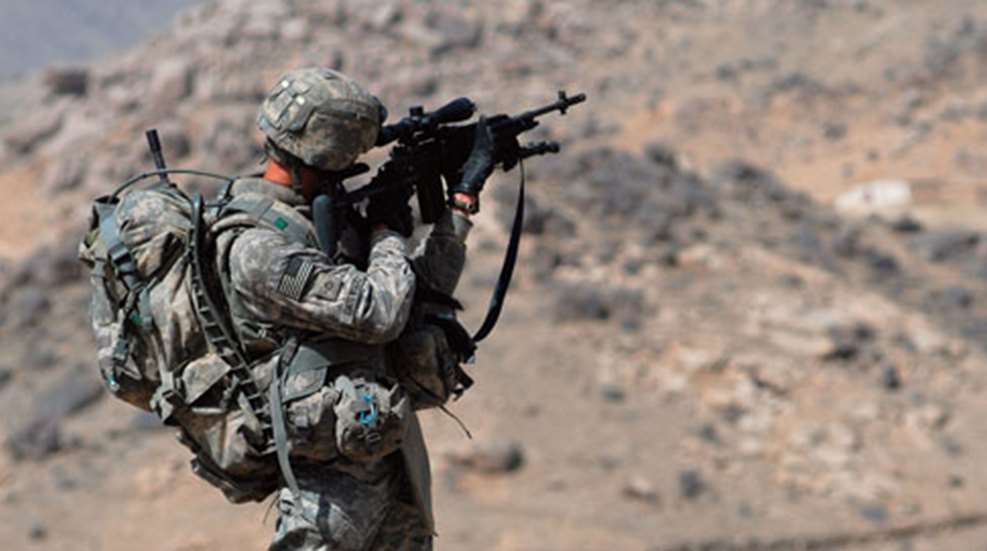
Not long after U.S. forces invaded Afghanistan, al-Qaeda and its Taliban allies came to realize that America’s 5.56x45 mm NATO infantry rifles lost most of their lethality beyond 500 meters. Demonstrating their adaptability, the insurgents exploited Afghanistan’s sprawling valleys and distant mountainsides to seek engagements beyond the M16’s and M4’s effective ranges.
This is borne out by U.S. Army data, which reveals that more than half of the war’s small arms engagements are now beyond 500 meters, with the enemy employing heavier weapons and then withdrawing before air support or artillery fire can arrive.
One solution, military planners could see, was employing a more capable cartridge already in the system: the 7.62x51 mm NATO. Today’s standard U.S. sniper cartridge, the 175-grain, M118 Long Range load, delivers four times the foot-pounds of energy as the standard 62-grain, 5.56 mm round at extended ranges. In other words, at 600 meters the 7.62 mm round packs about as much energy—1,000 ft.-lbs.—as the 5.56 mm round at 100 meters.
Although M14 rifles were pulled from depot storage, fitted with scopes, shipped to Afghanistan and issued to Army and Marine designated riflemen, the guns proved less than ideal for today’s warfare. First, their fixed stocks could not be adjusted to fit the length-of-pull needed for today’s body armor. And second, the 40-year-old rifles could not accommodate modern accessories such as lasers, night vision scopes and lights, which require MIL STD 1913 Picatinny rails. Fortunately, a solution had already been developed by the U.S. Navy’s Surface Warfare Center at Crane, Ind.
The SEAL CQB Rifle
One year before the 2001 terrorist attacks, U.S. Navy SEALs had gone to Crane to request an updated version of the 42-year-old M14. Great believers in the M14’s reliability and the 7.62x51 mm NATO cartridge’s lethality, they wanted a shortened version with a pistol grip and adjustable-length buttstock for close-quarters use.
The design task fell to David Armstrong, an accomplished small arms engineer who previously had developed the well-received SOPMOD (Special Operations Peculiar Modification System) for the M4 carbine. A mechanical engineer, machinist and recreational shooter, Armstrong began by searching for an off-the-shelf collapsible buttstock.
After trying several, he chose a Sage Int’l collapsible, pistol-grip stock made for the Remington Model 870 shotgun. The telescoping design offered five lengths of pull, in 1-inch increments, that worked well with body armor. Armstrong connected the Sage buttstock to the forward section of a modified M14 fiberglass stock. He also replaced the rifle’s standard 22-inch barrel with an 18-inch unit, reducing its overall length by nearly 10 inches, to 35 inches.
The fiberglass stock, however, did not satisfy him. “The [M14] design has always been tough to beat for reliability, but required laborsome bedding and tuning for best accuracy,” he explained. Earlier sniper versions of the M14, especially the M21 Sniper System, which used a resin-impregnated stock with epoxy bedding, proved so temperamental that snipers were instructed not to remove the action from the stock while cleaning it.
Armstrong took the bold step of designing his own chassis stock, machined from aircraft-grade aluminum. Not only would this be more rigid than fiberglass, but it would include an aluminum bedding block and an assortment of Picatinny rails for optical and illumination accessories. The result was a true “drop-in” stock, requiring no bedding or special fitting. “This stock floats the gas system through a replacement operating rod guide screwed to the rigid stock fore-end and a simple spacer replacing the front band,” he said. He also modified the Sage buttstock’s cheek rest to give it 2 inches of vertical adjustment in 1/4-inch increments.
In addition to installing quad Picatinny rails around the fore-end, he attached a short-rail scope mount that replaced the M14’s stripper clip guide. The final additions were a more effective flash suppressor, three ambidextrous 1 1/4-inch sling slot locations, and a Harris Engineering S-LM Series S bipod. Patented to the U.S. Navy with Armstrong as its inventor, the chassis stock is now produced under license by Sage Int’l in Oscoda, Mich.
“Simply adding the chassis stock system cut the group size of a basic M14 in half without the need for glass-bedding,” he reports. Firing five-shot groups with M118 ammunition at 600 yards, Naval technicians at Crane recorded 2 to 2.5 minute-of-angle (m.o.a.) extreme spreads—meaning 12 to 18-inch groups. Standard M80 ball ammunition shot nearly as well.
The EBR & EMR
When the U.S. Army and Marine Corps later sought modernized M14s, Armstrong merely switched the Navy’s Mk. 14 Mod 0 rifle’s short barrel for a full-length 22-inch version to create the Army’s Enhanced Battle Rifle (EBR) and the Marine’s M39 Enhanced Marksman’s Rifle (EMR). These versions measure 38.5 inches overall, with the stocks collapsed, and 45 inches when fully extended.
Although 3 pounds heavier than the standard M14, the EBR and EMR compare favorably to America’s current 7.62 mm sniping platforms, such as the Army’s M24 and M110, and the Marine Corps’ M40A3. The Army is issuing two EBRs per infantry squad, while the Marines have placed the EMR at platoon-level.
The Army EBR is fitted with a Leupold 3.5–10X scope, and the USMC’s EMR optic is the Schmidt & Bender M8541 Scout Sniper Day Scope, the same scope used by Marine snipers. Thus equipped, these designated riflemen have the ability to engage enemy personnel to 800 meters.
Each service is now building its own rifles, with Navy Mk. 14 Model 0’s being produced at the Crane facility, while Army rifles are assembled at Rock Island Arsenal, Ill., and the USMC version at Marine Corps Base Quantico, Va.
Some 5,000 EBRs have been produced at Rock Island Arsenal, with funding for another 1,200. A further 2,000 Sage stocks have reportedly been sold directly to military units and individuals for conversion of M14s. Still more rifles issued to Marines and SEALs suggest that perhaps 10,000 of these modernized M14s are now in service.
Firing The EBR
Thanks to Fulton Armory of Savage, Md., I was able to test fire a platform nearly identical to the EBR. Available to civilian shooters, this semi-automatic-only rifle incorporates Fulton’s own M14 Receiver, installed on the same Sage Int’l chassis stock that David Armstrong designed.
Examining the rifle in my shop, I found that its military two-stage trigger broke cleanly at 3 pounds, 7.5 ounces—about perfect for me. For test-firing, I mounted a Bushnell Elite 6500 4.5–30X Tactical Scope, which was a simple task with the rifle’s Picatinny rails.
Ergonomics had concerned me because of the stock’s square edges. Nonetheless, I found its balance and heft surprisingly good with the center-of-balance at the magazine well. Having trained on the M14 in the 1960s, I already appreciated the reliability of its gas piston and operating rod system, and the action’s resistance to sand and carbon buildup. Of course, I experienced no stoppages or malfunctions of any kind.
Weighing 14 pounds with a scope, a bipod and a loaded 20-round magazine, this weight plus the straight-line stock resulted in a mild recoil “push,” making it very comfortable to fire. This also assisted target reacquisition for follow-up shots.
The basic difference between the military EBR and Fulton Armory’s version is a National Match barrel—and that really showed on the range. Accuracy with the Fulton Armory EBR was impressive. Firing off sandbags at 100 yards, my Federal Gold Medal Match, .308 Win., 168-grain ammunition punched a three-round group measuring 0.721 inches. Switching to the U.S. military’s load specifically designed for sniping—the 175-grain, M118 Long Range round—the rifle fired even better, scoring a 0.50-inch three-round group.
In the hands of a trained marksman, the EBR—especially with a National Match barrel—is more than capable of dealing with insurgents to 800 meters and beyond. Perhaps the Taliban and its allies have proven adaptable; but, as demonstrated by these 21st century M14s, so have we.
Most Popular