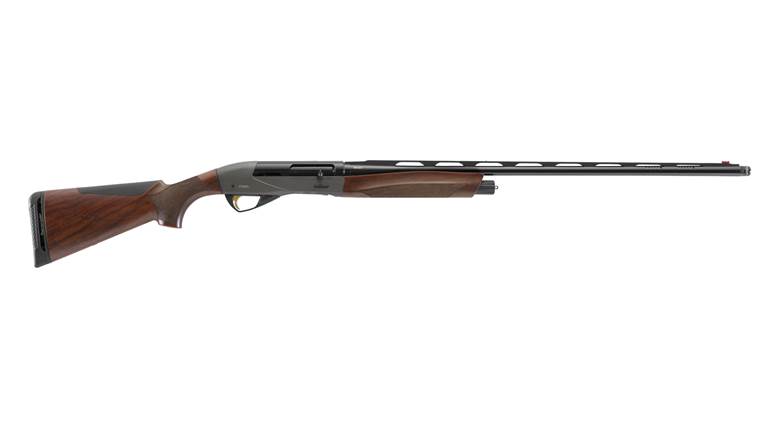
TriStar Sporting Arms’ motto promotes the company as “the value experts,” and its Turkish-made Viper G2 line of gas-operated semi-automatics reflects that, including the Silver 28 gauge; an attractive field and sporting shotgun for a very reasonable price.
In the past decade or so, hunters have begun to realize the great potential of the 28 gauge afield, and with this increase in popularity, a number of manufacturers are adding the 28-gauge chambering to their product lines. The 28’s virtues include little discernible recoil with downrange lethality nearly equal to larger gauges. It’s the perfect gauge for beginners, ladies and those who are recoil-sensitive.
The G2 uses a conventional gas system with ports located in the barrel ring that direct gas to a circular piston that drives back a sleeve attached to the action bars, beginning the extraction, ejection and reloading cycle.
The buttstock of the test gun was made from European walnut with limited figure, and the thin buttplate is of a rubber-like substance. Removing it reveals a slot-head bolt that holds the stock to the receiver. It can be removed with a common, long-shaft flat head screwdriver. The appropriate shim can then be installed at the head of the stock and any one of the included adjusting shims—50 mm, 55 mm, 60 mm or 65 mm, as well as a reversible shim for cast on and cast off—can be installed to enable a better fit of the stock to the shooter.
The test gun’s receiver is bright silver-anodized aircraft-grade aluminum. It makes for a handsome gun, but it might be too flashy for some types of hunting. The stresses of firing are borne solely by the bolt and the steel barrel extension, the receiver being merely a chassis into which the parts fit and slide during operation. Lockup is by way of a conventional-style locking block that rides on an action-bar plate that also holds the operating handle. When in battery, the locking bolt rides up atop a rectangular block on the plate positioning it into the cut at the rear of the barrel extension.
When the G2 is fired, the gas system thrusts back against the action bars that push the plate rearward, allowing the locking bolt to drop, unlocking the action. Next, the bolt assembly travels rearward carrying the extracted hull until it strikes the rear of the receiver. Just before impact, the fired hull is ejected by the ejector on the left side of the action. If there is a fresh round in the magazine, it is released, striking the carrier release, which frees the bolt. The carrier lifts the new round to be picked up the bolt, which drives it into the chamber as the extractor snaps over the shell’s rim.
Disassembly is only slightly tricky with the operating handle’s half-moon projection needing to be precisely lined up with the matching cut on the bolt. The operating handle then slides out, and the bolt and action-bar assembly can then be slid out through the front of the receiver. The trigger group drops out the bottom of the action once its single pin is driven out to either side of the receiver.
The test gun’s 26-inch barrel came with four Beretta-style screw-in choke tubes; skeet 0.003 inch, improved cylinder 0.006 inch, modified 0.0125 inch and full 0.0185 inch. The chokes are identified with the European system of notches beginning with four for improved cylinder, three for modified and one for full; the skeet tube is laser-engraved “Skeet.” On the patterning range, the modified tube produced quite even 40-yard patterns using Winchester Xpert Game/Target No. 6 steel shot. The box states 1,300 fps velocity with 5/8 ounces of the No. 6 steel pellets. Over our chronograph three-foot velocities averaged 1,221 fps. Calculated back to the muzzle the loads averaged 1,323 fps, right on the money. In calculating the downrange energy, which directly translates to lethality, the No. 6 steel pellets ran out of lethal effect just below 30 yards; fine for ducks over decoys or small game birds. Comparable lead shot carries lethal energy out to 50 yards, but patterns begin to thin before that range so that sufficient hits cannot ensure lethality. For all practical purposes, the 28-gauge is an excellent 30- to 35-yard gun—and that’s plenty far.
During patterning we found that the G2 did not fully cycle each time with certain loads. Some spent shells were ejected, others returned to the chamber and yet others remained in the ejection port, causing an easily cleared but nonetheless annoying jam. Firing 3/4-ounce target loads, we had no ejection or feeding problems. We consulted an engineer at Winchester who said that the port pressures of both the steel and lead loads were similar, and in the development of these loads particular attention was paid to selecting a propellant that provided near identical port pressures.
The action was then cleaned and re-lubricated. It is our opinion that in the shipping from Turkey to Kansas City, the lubricant evaporated or dried. Too, the out-of-the-box action was very stiff, also indicating a lack of lubrication. We then took the G2 back to the range, and the function was greatly improved with the steel-shot cartridges. It wasn’t perfect, but it must be borne in mind that some semi-automatic shotguns need a short break-in period, and this particular G2 may be one of them.
The Viper G2 Silver 28 was extremely pleasant to shoot, and in testing on clays performed very well. Shooting low station seven skeet targets indicated that this gun shoots precisely to point of aim, and although a light 5 pound, 10 ounces, we broke clays with regularity from the low-gun position.
For a new shooter, grouse hunter or anyone seeking a lightweight shotgun that performs well in the field or clay range, the Viper G2 Silver packs a lot of punch at a featherweight price.
Manufacturer: Armsan, nklap Mah. Alemda Cad. Siteyolu Sk., www.armsan.com
Importer: TriStar Sporting Arms; (816) 421-1400; www.tristarsportingarms.com
Action Type: gas-operated semi-automatic shotgun
Gauge: 28; 2¾" chamber
Receiver: aircraft-grade aluminum; silver-anodized
Overall Length: 463⁄8" (with 26" barrel)
Barrel Length: 26" (tested), 28"
Weight: 5 lbs., 10 ozs.
Magazine Capacity: four
Trigger: single-stage; 6-lb., 6-oz. pull
Stock: high-gloss checkered European walnut: length of pull, 14"; drop at comb, 1"; drop at heel, 2"
Sights: ventilated rib with small fluorescent red bead
Accessories: four choke tubes, choke tube wrench and five stock-adjusting shims
Suggested Retail Price: $669
Most Popular