By Hans Roedder
In order not to be misrepresenting things, I want to say right now that this appellation refers to outer dimensions only. In caliber, the gun I am about to describe, is .22 long rifle.
For some reason known perhaps to the makers, at least to them only, our native target pistols have always been afflicted with grips, fitting a seven-year-old boy to perfection. The proof of this can be seen at any assembly of pistol shooters, when one looks over the diversified attempts at correcting this shortcoming. There are hardly any of these arms that do not boast of either a special grip, more or less home-made, or additions, "back porches," pads, tape, and whatnot.
On the other hand, pistols of European manufacture, up to very recently did not meet the requirements of the man of the U.S.R.A. Length of barrel, form of lock, shape and pitch of grip, as well as sights made them unfit for our purpose. It must be admitted that a long and heavily barreled pistol with a very sloping handle, the latter compelling an extremely flexed wrist, is capable of very fine work. This applies particularly to the shooting of short series on the finely ringed 35 mm. target. In spite of this, the tendency on the other side of the ocean appears to be toward the plain trigger, comfortably stocked pistol.
Several splendid arms of this type have been brought out over there in recent years. These 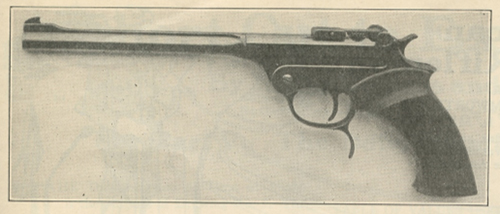 were not developed as a sort of compromise from existing arms, but designed from the ground up, for the intended purpose. The best of this class appears illustrated in this article. It is the product of Friedrich Pickert of Mehlis, Germany, and approaches more than any other the ideal form of target weapon. It combines the good points of a moderate weight with a perfect balance, low line of sight, a full, comfortable grip, quick lock, and an accurate barrel. In addition is to be mentioned a sight equipment with several novel features. The front sight, Patridge pattern, is clamped in a longitudinal slot of the raised matted rib. The rear sight is adjustable by clicks, for both elevation and windage. The rear sight blade being divided, allows the notch to be set at any width desired. The trigger pull is also adjustable for any reasonable weight. It will be noticed that the barrel proper is screw into the breech piece, making it easy of replacement, since the extractor and mechanism remain undisturbed.
The gun is obtainable in two models, the hammer type, with 10-inch barrel and plain trigger, and in the "free" variety. In this latter form the hammer is inclosed, and is cocked by the backward movement of the locking bolt. It has also thumb and index finger rests, as well as a fine set trigger. Both models operate with tip-up barrel, actuated by guard lever. The workmanship is of the best, bluing and checkering being of the prewar class. The whole shows careful design.
While this was intended primarily as a description of the pistol per se, a few words about its performance would be appropriate. No matter how correct an arm might be in construction, its shooting qualities will form the final basis for its valuation. By this is meant not so much the accuracy of the barrel alone, but in the combination with a form tending to eliminate or modify the disturbing factors.
Whether the better performance of a comfortably stocked pistol, over one not so 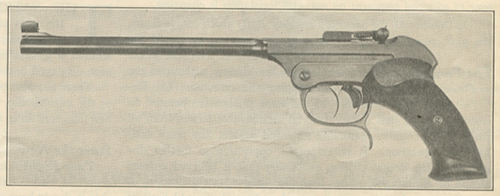 endowed, in the hands of the same shooter is due to anatomical or psychological influences, is problematical, and may remain so. Every practical shooter has had some experiences, satisfying to himself, on this point. Having a fairly large hand, I have been able, in the past, to do better and more consistent work with a home-made Remington pistol, than with a S.&W., relined with a tube of wonderful precision. Still, machine rest groups made with the latter were just one third the size of those produced by the former. For the same reason I prefer one make of revolver with a nice full grip to one with a deficient handle, although this has it over the first in point of accuracy.
The barrels of my pistols showed two points of marked difference to our accepted standards of boring and rifling. The bore itself is tighter by several thousandths of an inch, and the twist is rather quick, being less than fifteen inches to the turn. The rifling appears a bit deeper than that in our standard make. According to our lights, the tight bore and quick twist are not adapted to get the best results, but again the eating of the pudding always tells.
In my tests for accuracy, I employed a modification of Henry Walton Fry's six point rest in lieu of a machine rest. With it on a bed rock foundation, the human factor is almost entirely eliminated. The distance was 50 yards, weather conditions good to excellent. In all, four makes of ammunition were tried, three of which ran very much alike, with Peters Tackhole in the lead. The fourth was a pour fourth indeed. It was bought at a local store and may have been old. In fairness to its makers, and to the gun as well, I refrain from mentioning its illustrious name, nor is it included in the following list. Thirty 10-shot targets were shot, all of which showed a greater height than width, with the exception of one, the poorest by the way, which was broader than high, by an inch and one half. Total, as fired in order, not at one time:
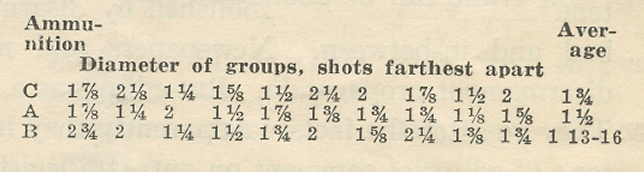
In this test, the "free type" pistol was used solely for the fact that the set trigger permits a let-off almost free from jar. I have no doubt but that this performance could be bettered somewhat, if the shooting were done from a solidly constructed machine rest; but even under the handicap of the improvised holder, the results were pleasing.
Summing up, the makers of this pistol have succeeded in combining more good features in one arm of this class, than we ever saw so assembled. Starting with an accurate barrel, which we take more or less for granted, plus a mechanical make-up, assuring easy of handling and long life, its greatest individual claim to distinction lies in the form, pitch, and size of the grip, and the relationship of the latter part to both the trigger and the line of sight. In these points lie the factors that make a pistol feel right and inspire confidence, which are conducive to good scores.
Most Popular