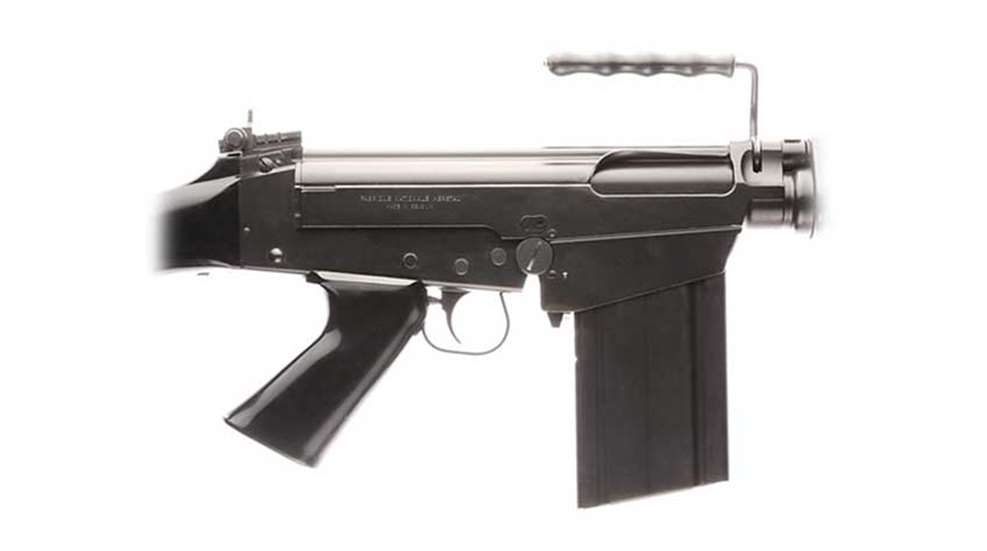
The FN FAL is one of the most revered battle rifles of the 20th century, often referred to as the "right arm of the free world," due to its use by so many NATO countries. While it's a popular rifle, there are many facts and myths that surround the gun, so let's clear up a few of them:
1. FAL Pronunciation and Grammar: Soon after the introduction of the rifle, Fabrique Nationale (FN) offered an abbreviation for the English speaking world: L.A.R (Light Automatic Rifle). However, this abbreviation never caught on, and instead we commonly pronounce the model by its French language abbreviation F-A-L. In countries where the rifle was adopted, the letters FAL quickly became an acronym and is pronounced in one word instead of an abbreviation.
The heavy-barrel version was named FALO, it is a blended word between FAL and Lourd (heavy), and the letter ‘L’ was not duplicated. It too is pronounced in many countries as one word, while in the U.S. we usually hear FAL-O.
Grammar of the French spelling has always caused some confusion: The rifle is properly spelled Fusil Automatique Léger (no letter “e” at the end of Léger). While the CAL, the FAL’s younger cousin in 5.56 mm, is spelled Carabine Automatique Légère (Light Automatic Carbine, Légère with an “e”). The reason is that the French language assigns genders to nouns. Fusil is a masculine and Carabine is a feminine word, feminine words often get an extra “e” in spelling and are pronounced differently.
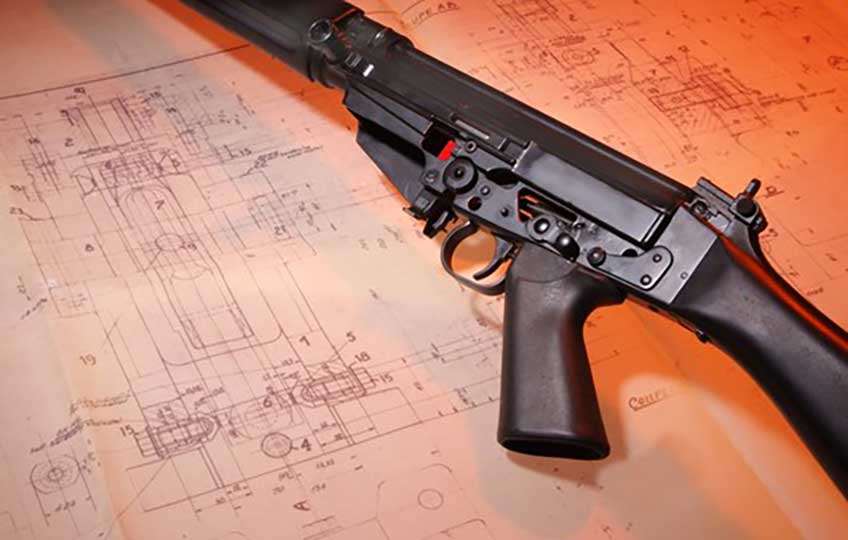
2. Germany Wanted the FAL, not the CETME: Germany adopted the FN FAL in 1956 and gave it the nomenclature Deutsche Bundeswehr Gewehr 1 (German Armed Forces Rifle 1 or G1). FN was happy to accommodate the German special features but drew the line at selling Germany a manufacturing license.
FN did not have problems with selling manufacturing licenses and did so with many nations. Yet it did not trust the Germans only 11 years after the end of WWII. The Germans were adamant at producing the rifle domestically and pursued adapting the Spanish CETME to fit their needs. The CETME design evolved to become the German G3.
The Germans did not abandon the FAL for performance or technical reasons but rather for logistics and politics. If FN had sold Germany the manufacturing rights to the FAL, we may never have seen a G3 (or HK91). It would certainly have had a major impact on the development of the H&K company.
3. The Beauty of Belgian Steel: Long before the AISI/SAE steel grades were established, FN used a proprietary steel alloy and heat treatment process for Mauser rifles and other guns. This steel was ordered from world- renowned steel suppliers like Cockerill and remained FN’s standard for decades.
Many people confuse the modern grading system with quality and believe that modern steels are better than what was available a century ago. The grading system is a guideline that can certify the composition of an alloy, and does not indicate quality but helps manufacturers obtain alloys with certain specifications without having to necessarily test the steel. FAL production was licensed to several countries and it was also copied extensively.
No matter where it was made, each FAL receiver has its own steel signature in hardness. There is no harder and longer wearing steel than what is found on a FN. Hardness tests quickly reveal the massive differences in quality between FN and American (commercial variants), Argentine, Australian, Austrian, Brazilian, British, Canadian, Indian and South-African production.
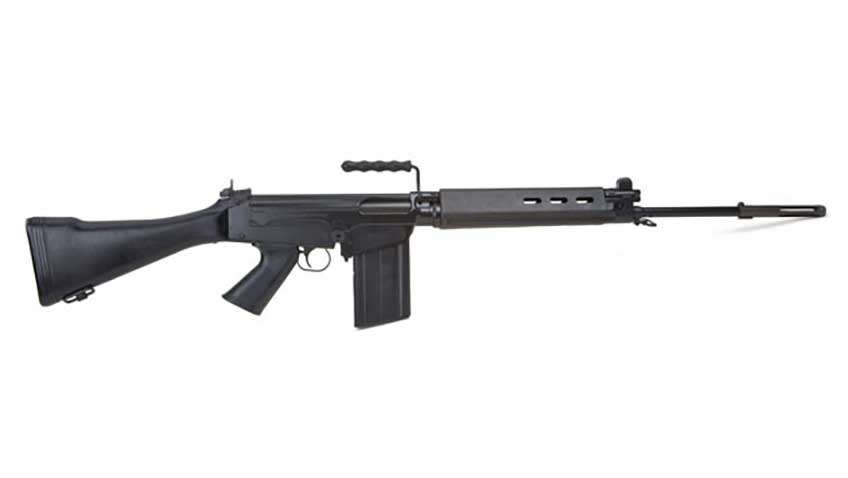
4. Not Every FAL is an FN: American enthusiasts have often been shortchanged by rifles that look like FALs but are far from the quality of a true FN. Many outfits and individuals have gotten involved at marrying used (some worn) parts kits from surplus sources with newly made receivers of various qualities.
The reality is that most of what is on the U.S. market may look like a FAL but does not function like a true FN FAL. Certainly parts are interchangeable, but building a FAL from new parts or used parts requires expertise. FN used more than 10 different locking shoulder dimensions to achieve the right fit and headspace, most assemblers here use a fraction of that. It is not an easy rifle to assemble: FN’s were built by craftsmen who had numerous parts at their disposal.
Much was done by subjective feel, like a custom rifle. If one part did not feel right, it was substituted. In contrast, many of the rifles on the commercial market are a compromise of worn parts, new and used parts, and barrels, many which are worn or of dubious quality. Unless you have fired and owned an FN FAL or a quality made version as made by DSA, you have not truly experienced the classic FAL.
5. For the FAL, 7.62 NATO is Not .308 Win.: Although similar in appearance and dimensions, the two cartridges have different characteristics. Commercially imported FN FAL rifles that are .308 marked will handle both .308 and 7.62 NATO rounds, but the thinner .308 case can affect extraction. U.S.-assembled parts guns can experience myriad problems. I have witnessed rifles that will cycle .308 and not 7.62 and vice versa. Such problems stem from the lack of expertise by the assembler.
It is not just headspace that is critical, chamber diameter and other factors play an equal role. These problems have often frustrated shooters as the solutions are not always obvious. A well-built FAL rifle will handle just about any (quality) ammo. That said, many FAL owners buy NATO-spec ammo, designated by the cross in a circle marking found on casings.
Many would assume that this ammunition is uniformly the same among countries and manufacturers, but it is not. Almost each country uses different cartridge and bullet lengths and weights as well as propellants. While the ammo is interoperable and totally functional, you can expect significant ballistic variances from one country manufacturer to another.
I am often asked what the best gas plug setting is for the FAL, and the answer is that there is not one; it all depends on the individual rifle more than the ammo. FN recommends shooting one round and opening the port one click and repeat the operation until the rifle stops cycling. At that point close the port back two clicks. This old method is still the best and most often ensures reliable operation with most types of ammunition.