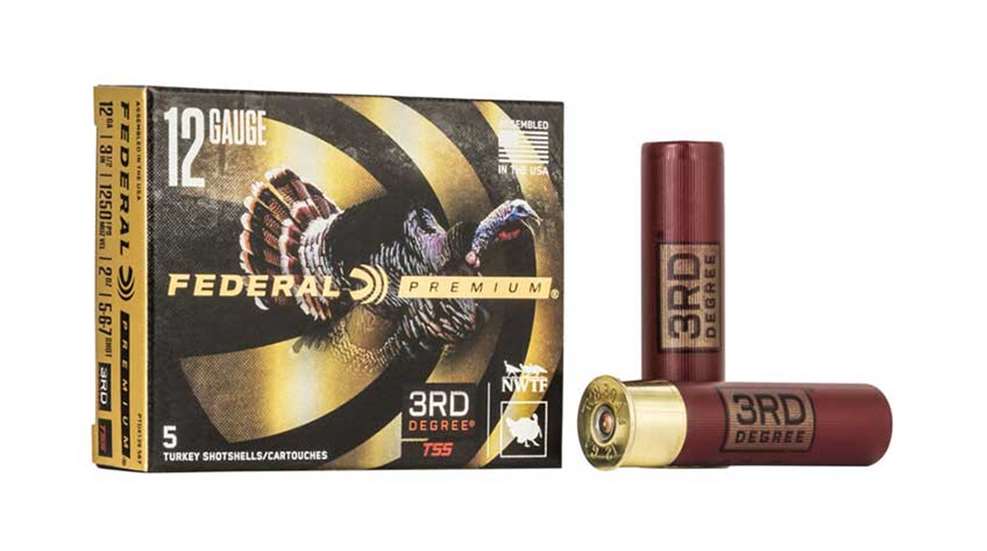
This article, "Tested: Federal Premium 3rd Degree Turkey Loads," appeared originally in the January 2015 issue of American Rifleman. To subscribe to the magazine, visit the NRA membership page here and select American Rifleman as your member magazine.
Turkey hunting is unlike most other shotgunning pursuits in that it’s typically a single-shot affair; seldom does the just-educated tom afford an opportunity for redemption. To make the first shot count, especially on gobblers that oftentimes stall at extended ranges, diehard hunters spend considerable time and money to maximize the effective range of their shotguns.
Problem is, in creating a stellar long-range setup, these individuals handicap themselves at closer distances, where ultra-tight patterns produce devastating hits or complete misses. The Holy Grail of turkey loads, then, would offer sufficient spreading at close range and yet deliver gobbler-getting patterns at extended range, too. That’s exactly the premise behind Federal Premium 3rd Degree.
Instead of the traditional practice of altering the one-piece wad or separate shotcup to attain the desired effect, Federal reconsidered the payload. Specifically, the company utilizes three distinct layers of pellets that differ with regard with regard to one or more of the following characteristics: composition, size and shape.
“Duplex” (and even triplex) shotshells aren’t new technologies; however, until recently companies typically used two or three sizes of spherical (or almost so) shot made from the same material. Federal Premium, on the other hand, selected specific shot types to achieve the desired patterns.
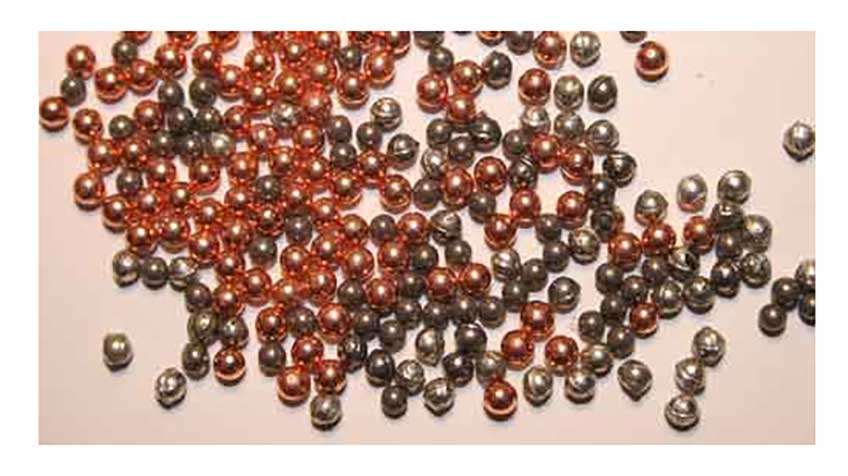
Rearmost in the wad is found No. 7 Heavyweight shot, which are tungsten-based pellets that approach the weight (and thus energy) of No. 5 lead shot. Weighing several pellets on a Hornady GS-1500 electronic scale showed that they averaged 2.3 grs.; for comparison, the load’s copper-plated lead No. 5s weighed 2.8 grs. and the lead No. 6s were 2.5 grs.
Designed to fill the pattern’s core for long-range lethality, 40 percent of the payload consist of this shot type. Ahead of the No. 7s are the copper-plated No. 5s, which also comprise 40 percent of the total shot charge. Perhaps the most popular pellet size and type for tackling toms, No. 5 is a good compromise between the enhanced pattern density offered by No. 6s and increased penetration of No. 4s.
Moreover, copper plating improves the “slipperiness” (i.e. reduces viscosity) so that pellets are less deformed after traversing the bore and are less likely to wad up in feathers that push into the wound channel, which lessens penetration. The final 20 percent of the payload consists of nickel-plated lead Flitestopper No. 6 shot.
Featuring protruding bands circumscribing their mid regions, these shot quickly migrate to the pattern’s fringe, which betters the odds of connecting with near misses at close range. The bands also increase the damage done to vital organs and skeletal structures for improved lethality.
As with the company’s other “premium” turkey loads, 3rd Degree has the innovative one-piece Flitecontrol wad. Unlike traditional wads, which have multiple petals that “bloom,” or fold rearward, to slow their advance and release the shot, the Flitecontrol has six petals integral to the gas seal that, upon exiting the muzzle, flare to slow the wad’s forward momentum.
Further slowing its advance are three small cutouts the wad’s otherwise solid body that open in flight. The wad’s clean and delayed release of the shot results in “tight” patterns, even without a specialized “turkey” choke; in fact, Federal recommends not using chokes that strip the wad or reduce muzzle pressure.

To test 3rd Degree, we shot the 12-ga., 3” 1¾-oz. load in a Savage Model 24 equipped with an extra-full turkey choke and topped with a Burris 3-9X ShortMag scope at 15 and 50 yds. For comparison sake, we also patterned Federal’s Mag-Shok 12-ga., 3”, 1¾-oz. No. 5 load. The shot distances were purposefully selected to illustrate pattern density at close range and the load’s effectiveness at beyond-normal range (especially if a bead-sighted shotgun is used).
Keep in mind that most full choke-equipped 12-ga. shotguns loaded with value-priced turkey shells are capable of bagging gobblers at 40 yds., so we opted to stretch the distance to 50 yds. Out of curiosity, though, we did shoot a single 3rd Degree at 40 yds. and it put nearly 33 percent (113 pellets) of the payload into a 10” circle surrounding the point of aim.
Studying the patterns at 15 yds. revealed that, with 3rd Degree, the entirety of the shot charge impacted within a 16” circle. Furthermore, in addition to a dense core, pellet distribution was such that up to 7” to the left or right of the pattern’s center (i.e. point of aim) would result in a bird in hand.
At the same distance, the Mag-Shok load also kept all ofthe pellets within a 16” circle; however, the margin for error was noticeably smaller—4½” to either side of the pattern’s center (point of aim). Additionally, the pattern’s core was considerably tighter in the latter. The aforementioned results confirmed Federals claims about 3rd Degree being forgiving at close range.
Moving back to 50 yds., 3rd Degree delivered 64 shot—approximately 19 percent of the 343-pellet payload—in a 10” circle, with seven being in the Champion VisiColor turkey target’s “kill zone.” Particularly noteworthy was the superb distribution of pellets within that circle; even without a perfect aim the bird would be hit with a nearly equivalent number of shot.
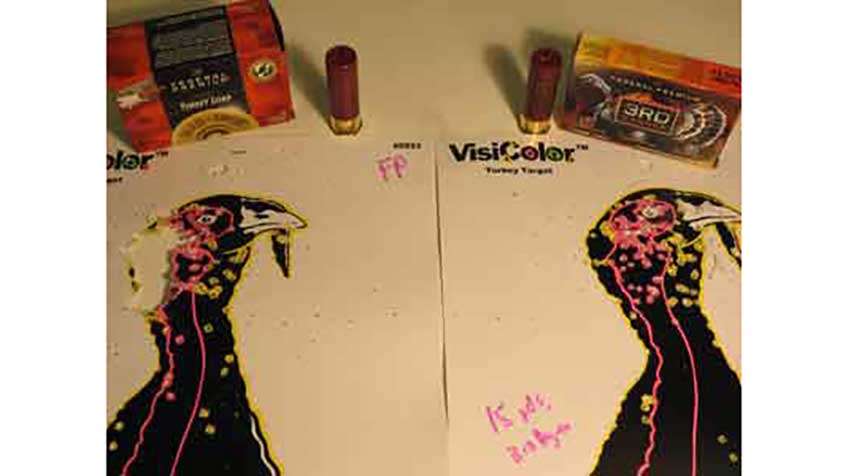
As for the Mag-Shok load, 39 pellets—or 12 percent of the 316 shot—struck with a 10” circle surrounding the point of aim. Unlike 3rd Degree, though, there were especially prominentholes on both sides of the head/neck region, meaning that anything other than a perfect aim would have resulted in a miss or, much worse, a wounded bird. Given that only four pellets hit within the “kill zone,” as well as pellet-free holes surrounding it, in this gun the Mag-Shok load is not suitable for taking 50-yd. shots.
That being said, as with at close range, 3rd Degree proved to be the superior load at extended range, so, as Federal claimed, it offers “effective patterns at close range and hit[s] distant birds hard.” Lastly, an RCBS AmmoMaster chronograph showed that, 3 ft. from the Model 24’s 24” barrel, 3rd Degree’s average velocity was within 38 f.p.s. of the published 1250 f.p.s.
For a long time the trend has been “tighter is better”; however, through our testing Federal 3rd Degree has shown considerable potential for bagging birds at both close and long range, even with a less-than-ideal aim or unexpected movement. In the end, that forgiveness makes it preferable for the majority of turkey hunters.
Most Popular