by
Support NRA American Rifleman
DONATE
** When you buy products through the links on our site, we may earn a commission that supports NRA's mission to protect, preserve and defend the Second Amendment. **
There are few new frontiers for the avid reloader. Once one-hole groups and sub-MOA performance are achieved at extended distances, we need to get creative to keep the joy alive. Up until the time of this writing, I had never cracked the 4,000 f.p.s. barrier. Few cartridges are capable of this velocity and none more notorious than the .220 Swift. Fellow outdoors writers Hunter Elliot and Larry Case sat down with me to explain some of the intricacies of this round and frankly, I was intrigued.
This hotrod was introduced way back in 1935 and to this day remains the fastest commercial cartridge available. Unfortunately, this little rocket fell out of fashion, because it just was a little too hard on the barrels of the day, especially with heavier bullets. Today, however, we manufacture far better barrels, and we know more about metal and its maintenance than ever before. I’ll admit that, after the conversation, I had no intention of “getting into” .220 Swift.
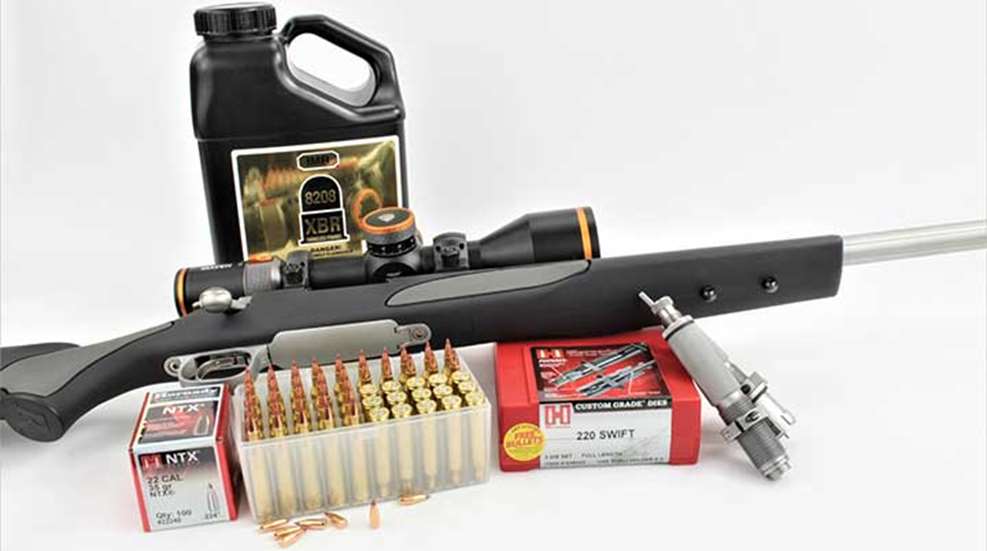
I just didn’t have the need for another cartridge in my life. However, when I started looking at some of the numbers and the possibilities, I was further persuaded. To start the process, I needed a rifle. You can count on one hand how many companies still chamber a gun in this cartridge. Luckily, Remington didn’t let me down, as it still chambered a 700 Varmint SF in this classic cartridge. I topped the rifle off with the new Maven RS 4 5-30X Precision Rifle Scope, and I had quite the little varmint package for my testing.
It was an attractive setup for sure, and with the heavy, fluted varmint barrel, it was sure to hold up to the heat. With the test rifle complete, I turned my attention to components. My goal was to reach some new velocities in my career, so picking the right bullet and powder was going to be critical. Starting with bullets, I knew that I wanted to keep it as light as possible. The .220 Swift was never intended for medium game or extended distances, so half of the barrel-life issue is simply trying to make the gun something it isn’t.
The Hornady X manual has loads for bullets as light as 35 grains, so I stayed right there. The lighter bullets are going to take less of a toll on the rifling, and their use makes cracking 4,000 f.p.s. easier. The non-lead 35-gr. NTX is listed as the first option, and I had some available, so it was an easy pick. With this bullet, there are a few different powders that can get you to 4,500 f.p.s., but IMR 8208 XBR stuck out to me, as I have extensive experience with it. It also has a unique history that ties into the .220 Swift story.
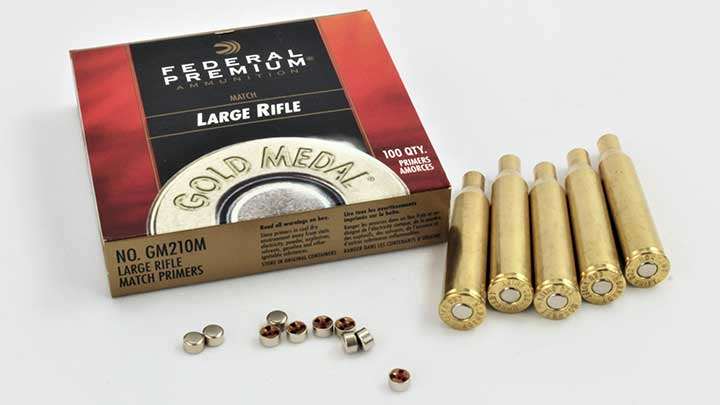
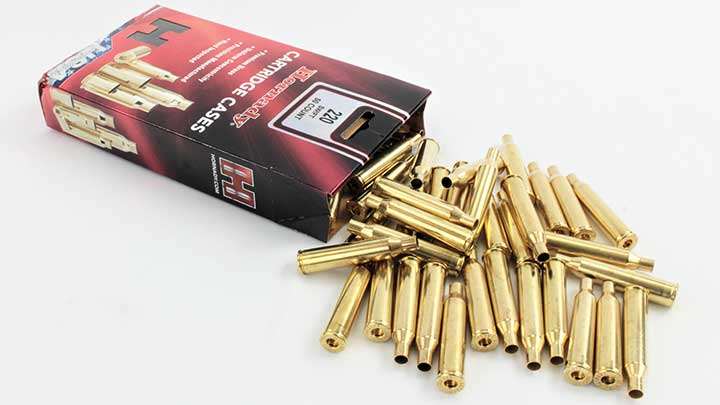
I like to believe that, back in the day, a handful of the legends stuffed some of the old “T-powder” this was based on into Swift cases to try to get to where I was going. Last, we needed cases and primers, and to my surprise, Hornady still sells factory-fresh brass to those that still seek heart-pounding speed. These take plain old large rifle primers, so we went with Federal Gold Medal Match, because they are among the most consistent. I wish I had a few words to tell you how interesting the loading process was, but I don’t.
These rounds came together like any other bottleneck cartridge that you would make. I ran off five rounds in half-grain powder increments from the minimum to just shy of the maximum and seated the bullets to the recommended COL listed in the manual. We used a Hornady Custom Die Set we found to be readily available online, so even that wasn’t too hard to come by. In short, tooling and components should not be a deterrent to owning something chambered in this cartridge.
After completion of the rounds, I thought about my current chronograph and had a valid concern that it wasn’t up to the task. Often, it doesn’t pick up 5.56x45 mm NATO as the fast, light bullets beat out the photosensors. So instead of rushing to the range, I ordered a new Caldwell G2 Chronograph and delayed testing for a few days. I am glad that I did so, because aside from being far easier to work with, it also upgraded me to Bluetooth technology that not only saved all of the information per string but calculated average velocity and standard deviation (among other data) as well.
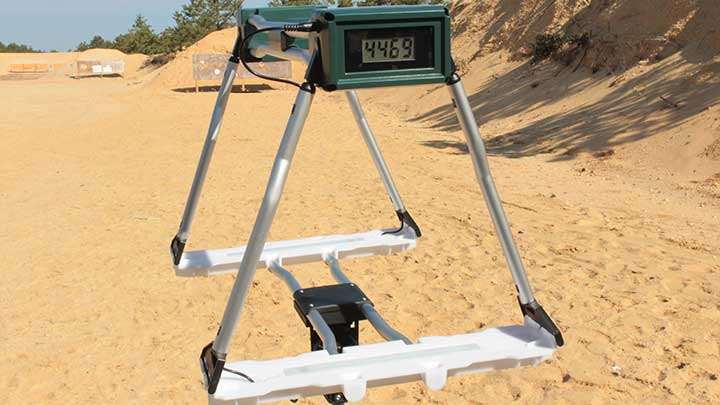
While loading the cartridge was basic and bland, shooting it was not. Right out of the gate, I found that 37 grains of powder yielded an average velocity of 4,085 f.p.s., and my first four shots fell neatly into the same hole. These five shots also barely warmed the barrel, so it was difficult to justify going any further in my testing. Luckily, I like to shoot, so I worked up to just shy of the maximum charge and found another tight group at 40 grains with a smoking average velocity of 4,465 f.p.s. and an SD of only 5.5.
Recoil throughout the entire spectrum was minuscule, about on par with .22 WMR, making this one of the most enjoyable rounds that I’ve ever sent downrange. My range session left me completely satisfied with just one question left: which load should I go with? That's a tough call. From a longevity standpoint, the light 37-gr. load seems to make a lot of sense because even at more than 4,000 f.p.s., it didn't heat the barrel up as much as the 40-gr. load.
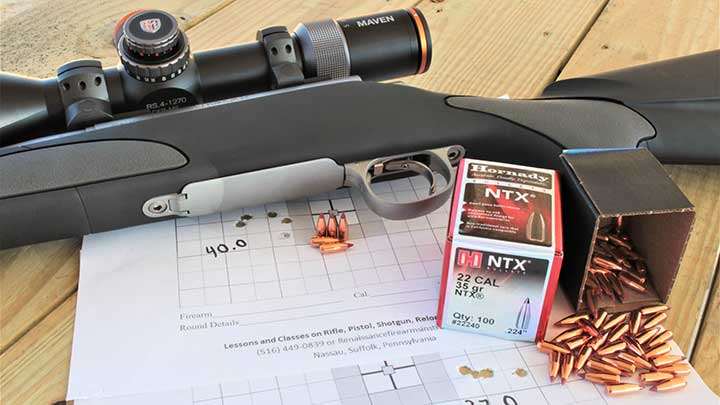
However, when you have the fastest commercial cartridge in your hands, it's hard to settle for anything less than its maximum velocity, particularly when you are looking at a single-digit standard deviation and m.o.a. accuracy. In this type of situation, I would usually go back to the range and fire two 10-round strings and let that do the deciding for me, but I doubt this rifle would ever see that many rounds in a row, so it is almost a moot point. With that in mind, I turned to ballistics tables to help solve the dilemma.
After running the numbers, I found that the faster load only gives me about 3” less drop at 300 yds., making it tough to justify all of that extra pressure. On the other hand, that is still enough to miss a prairie dog from poor range estimation, so it was back to the drawing board. Either way I decide to go, one thing is for sure: .220 Swift is in it for the long haul, and with the right loads and the right practices, your factory barrel will live to a ripe, old age. It's doubtful if you can say the same for varmints in the same zip code.
This hotrod was introduced way back in 1935 and to this day remains the fastest commercial cartridge available. Unfortunately, this little rocket fell out of fashion, because it just was a little too hard on the barrels of the day, especially with heavier bullets. Today, however, we manufacture far better barrels, and we know more about metal and its maintenance than ever before. I’ll admit that, after the conversation, I had no intention of “getting into” .220 Swift.
I just didn’t have the need for another cartridge in my life. However, when I started looking at some of the numbers and the possibilities, I was further persuaded. To start the process, I needed a rifle. You can count on one hand how many companies still chamber a gun in this cartridge. Luckily, Remington didn’t let me down, as it still chambered a 700 Varmint SF in this classic cartridge. I topped the rifle off with the new Maven RS 4 5-30X Precision Rifle Scope, and I had quite the little varmint package for my testing.
It was an attractive setup for sure, and with the heavy, fluted varmint barrel, it was sure to hold up to the heat. With the test rifle complete, I turned my attention to components. My goal was to reach some new velocities in my career, so picking the right bullet and powder was going to be critical. Starting with bullets, I knew that I wanted to keep it as light as possible. The .220 Swift was never intended for medium game or extended distances, so half of the barrel-life issue is simply trying to make the gun something it isn’t.
The Hornady X manual has loads for bullets as light as 35 grains, so I stayed right there. The lighter bullets are going to take less of a toll on the rifling, and their use makes cracking 4,000 f.p.s. easier. The non-lead 35-gr. NTX is listed as the first option, and I had some available, so it was an easy pick. With this bullet, there are a few different powders that can get you to 4,500 f.p.s., but IMR 8208 XBR stuck out to me, as I have extensive experience with it. It also has a unique history that ties into the .220 Swift story.
I like to believe that, back in the day, a handful of the legends stuffed some of the old “T-powder” this was based on into Swift cases to try to get to where I was going. Last, we needed cases and primers, and to my surprise, Hornady still sells factory-fresh brass to those that still seek heart-pounding speed. These take plain old large rifle primers, so we went with Federal Gold Medal Match, because they are among the most consistent. I wish I had a few words to tell you how interesting the loading process was, but I don’t.
These rounds came together like any other bottleneck cartridge that you would make. I ran off five rounds in half-grain powder increments from the minimum to just shy of the maximum and seated the bullets to the recommended COL listed in the manual. We used a Hornady Custom Die Set we found to be readily available online, so even that wasn’t too hard to come by. In short, tooling and components should not be a deterrent to owning something chambered in this cartridge.
After completion of the rounds, I thought about my current chronograph and had a valid concern that it wasn’t up to the task. Often, it doesn’t pick up 5.56x45 mm NATO as the fast, light bullets beat out the photosensors. So instead of rushing to the range, I ordered a new Caldwell G2 Chronograph and delayed testing for a few days. I am glad that I did so, because aside from being far easier to work with, it also upgraded me to Bluetooth technology that not only saved all of the information per string but calculated average velocity and standard deviation (among other data) as well.
While loading the cartridge was basic and bland, shooting it was not. Right out of the gate, I found that 37 grains of powder yielded an average velocity of 4,085 f.p.s., and my first four shots fell neatly into the same hole. These five shots also barely warmed the barrel, so it was difficult to justify going any further in my testing. Luckily, I like to shoot, so I worked up to just shy of the maximum charge and found another tight group at 40 grains with a smoking average velocity of 4,465 f.p.s. and an SD of only 5.5.
Recoil throughout the entire spectrum was minuscule, about on par with .22 WMR, making this one of the most enjoyable rounds that I’ve ever sent downrange. My range session left me completely satisfied with just one question left: which load should I go with? That's a tough call. From a longevity standpoint, the light 37-gr. load seems to make a lot of sense because even at more than 4,000 f.p.s., it didn't heat the barrel up as much as the 40-gr. load.
However, when you have the fastest commercial cartridge in your hands, it's hard to settle for anything less than its maximum velocity, particularly when you are looking at a single-digit standard deviation and m.o.a. accuracy. In this type of situation, I would usually go back to the range and fire two 10-round strings and let that do the deciding for me, but I doubt this rifle would ever see that many rounds in a row, so it is almost a moot point. With that in mind, I turned to ballistics tables to help solve the dilemma.
After running the numbers, I found that the faster load only gives me about 3” less drop at 300 yds., making it tough to justify all of that extra pressure. On the other hand, that is still enough to miss a prairie dog from poor range estimation, so it was back to the drawing board. Either way I decide to go, one thing is for sure: .220 Swift is in it for the long haul, and with the right loads and the right practices, your factory barrel will live to a ripe, old age. It's doubtful if you can say the same for varmints in the same zip code.
Most Popular