The considerable accomplishments of the United States Marine Corps in World War II have been the subject of innumerable books, articles, movies and television programs. Anyone with a modicum of knowledge of the Pacific campaigns is well aware of the pivotal and heroic role played by the Corps during the war. What is not as well-known is the interesting story of the Marine Corps Parachute units of World War II.
Although the U.S. Army explored the concept of dropping troops by parachute as early as World War I, little real progress was made in the interwar period and the actual fielding of parachute units remained more theoretical than practical. In 1927, the U.S. Marine Corps experimented with the idea of paratroopers by dropping a dozen Marines by parachute over Anacostia in Washington, D.C., but, again, no real progress was forthcoming. It was not until late 1939/early 1940 that realization of the need for designated airborne units for the American military became apparent. The impetus for this renewed interest was the notable successes of airborne troops by Germany as part of the Blitzkrieg campaigns. American military planners took notice and began preparations for the implementation of enhanced airborne capability for the Army. Fort Benning, Ga., was selected as the site for training the Army’s new paratroopers. Not wishing to be left behind, the U.S. Marine Corps and Navy sent representatives to Fort Benning to observe the Army’s activities in this regard. In the month of May 1940, the Marine Corps Commandant directed plans to be prepared for the organization and utilization of parachute troops.
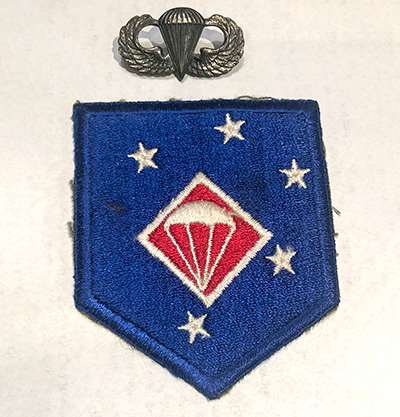
The new Marine parachute units were, to some extent, intended to be modeled after the German Fallschirmjäger outfits, including distinctive smock uniforms. The Marines began preliminary parachute training at Lakehurst, N.J., in October 1940. Additional parachute-training facilities were subsequently established near San Diego, Calif., and New River, N.C. The Marine paratroopers were soon popularly known as “Paramarines,” but this was not an official designation, and the appellation was reportedly not universally popular.
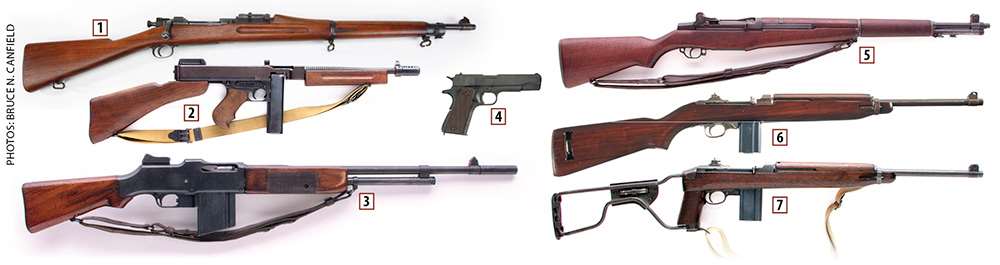
One of the first decisions the Marine Corps Equipment Board had to make was to determine the most suitable firearms for arming the Paramarines when they were eventually deployed to combat zones. Typically, the Marine Corps was a “customer” of U.S. Army Ordnance when it came to the acquisition of small arms. In 1940, the primary small arms of Marine Corps combat units were the venerable M1911 .45 ACP pistol, M1903 Springfield rifle, M1928 Thompson submachine gun and M1918 Browning Automatic Rifle, which was also the case with the U.S. Army. The Army standardized the M1 rifle in 1936, and, although the Marines adopted the M1 in March 1941, it was not until June 1942 that the Garand was approved by the Commandant for issue to Marine Corps combat units.
It was decided that Marine paratroopers needed small arms that could be carried during the descent and be immediately available for use upon landing. None of the standardized firearms currently in inventory (with the exception of the .45 pistol) were deemed suitable, which resulted in the need to look outside normal procurement channels. It was eventually determined that two non-standard firearms—the Model 55 Reising submachine gun and the Model 1941 Johnson light machine gun—would be the most suitable for arming the Paramarines.
Model 55 Reising Submachine Gun
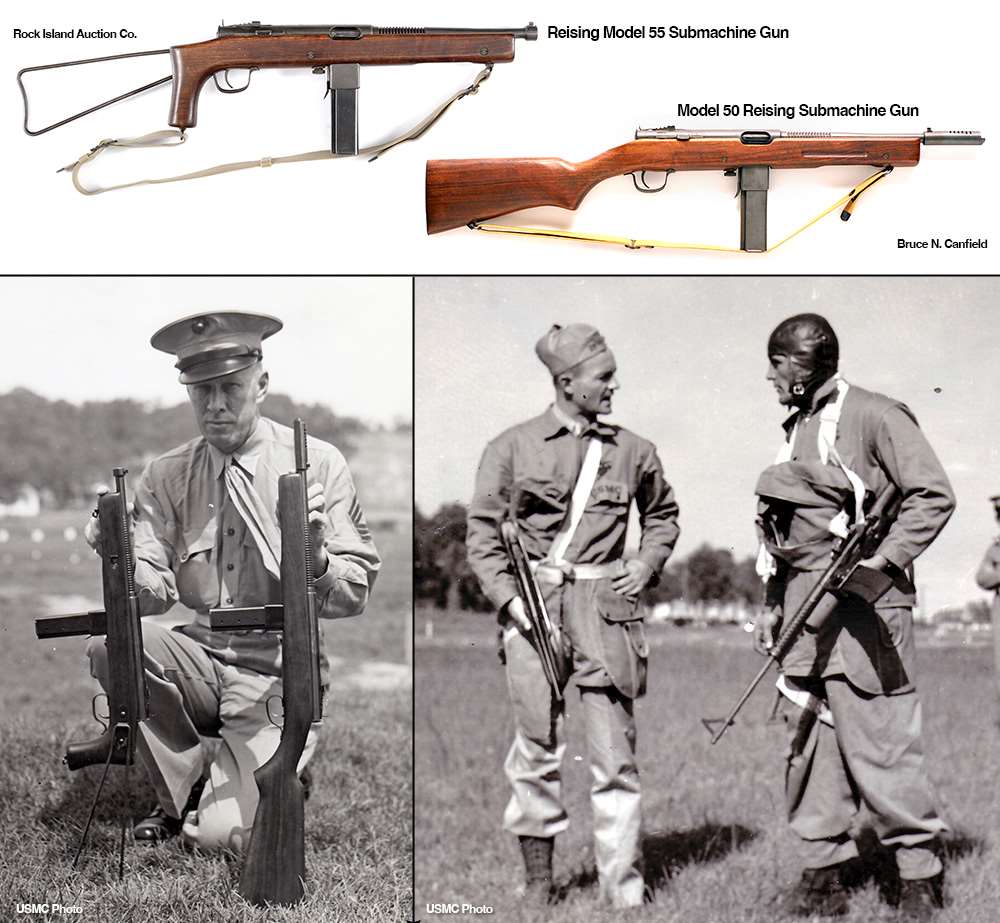
In February 1941, the Marine Corps tested a submachine gun designed by Eugene Reising and manufactured by the Harrington & Richardson Arms Co. The version of the gun that the Marines tested, the Model 50, was chambered for the .45 ACP cartridge. It had a full-length wooden stock, an 11-inch barrel fitted with a compensator and a 20-round, detachable-box magazine. It was lighter, more accurate and less expensive to manufacture than the Thompson submachine gun. The USMC Equipment Board determined that the gun had some interesting and potentially valuable features but declined to recommend procurement at the time.
However, H&R introduced another variant of the Reising, the Model 55, with a folding metal stock and a slightly shorter barrel without a compensator, which made for a compact firearm (22.5 inches with the stock folded) and weighed less than 6 pounds without a magazine. Mechanically, the Model 55 and the Model 50 were identical. With the Model 55 now on the scene, the Marines showed renewed interest, as it was felt the gun would be ideal for issue to the Paramarines. On Sept. 11, 1941, the Marine Corps Equipment Board tested the Model 55 Reising and stated: “Personnel using both the Thompson submachine gun and the Reising submachine gun, made considerably better scores when using the Reising submachine gun than when using the Thompson submachine gun.” On Sept. 19, 1941, Capt. Robert H. Williams of the 1st Parachute Battalion, 1st Marine Division, jumped from a plane with a Model 55 Reising strapped to his leg and reported “ … the gun interfered in no way with the jump.” The test report concluded, “The weapon does not require disassembly for parachute jumping and is ready for action the moment the parachute trooper reaches the ground.”
The Marines also acquired a number of Model 50 (full-length stock) Reisings for issue to units other than the Parachute Battalions.
Model 1941 Johnson Light Machine Gun
Contemporaneously, a Boston attorney and Marine Corps Reserve Captain by the name of Melvin M. Johnson, Jr., was attempting to market a semi-automatic rifle and light machine gun he had designed. Both weapons featured a recoil-operated mechanism rather than the more common gas-operated designs. The selective-fire Johnson light machine gun, more properly described as an automatic rifle, fed from a 20-round, detachable-box magazine and weighed slightly more than 12 pounds. The Johnson semi-automatic rifle had an unusual 10-round (non-detachable) rotary magazine and weighed approximately 9.5 pounds, comparable to the M1 Garand. After some rather cursory testing by the Ordnance Depart-ment, both Johnson weapons were rejected. Despite this snub by the U.S. Army, the Netherlands Purchasing Commission ordered a number of Johnson rifles and light machine guns, both designated as the “Model of 1941,” to equip their colonial troops garrisoning the Dutch East Indies. The guns, manufactured by Johnson Automatics, Inc. at a plant in Cranston, R.I., were chambered for the standard U.S. .30-‘06 Sprg. cartridge. However, relatively few of the Johnsons were shipped before the East Indies fell to the Japanese onslaught, and the bulk of the guns were embargoed stateside to prevent them from falling into enemy hands.
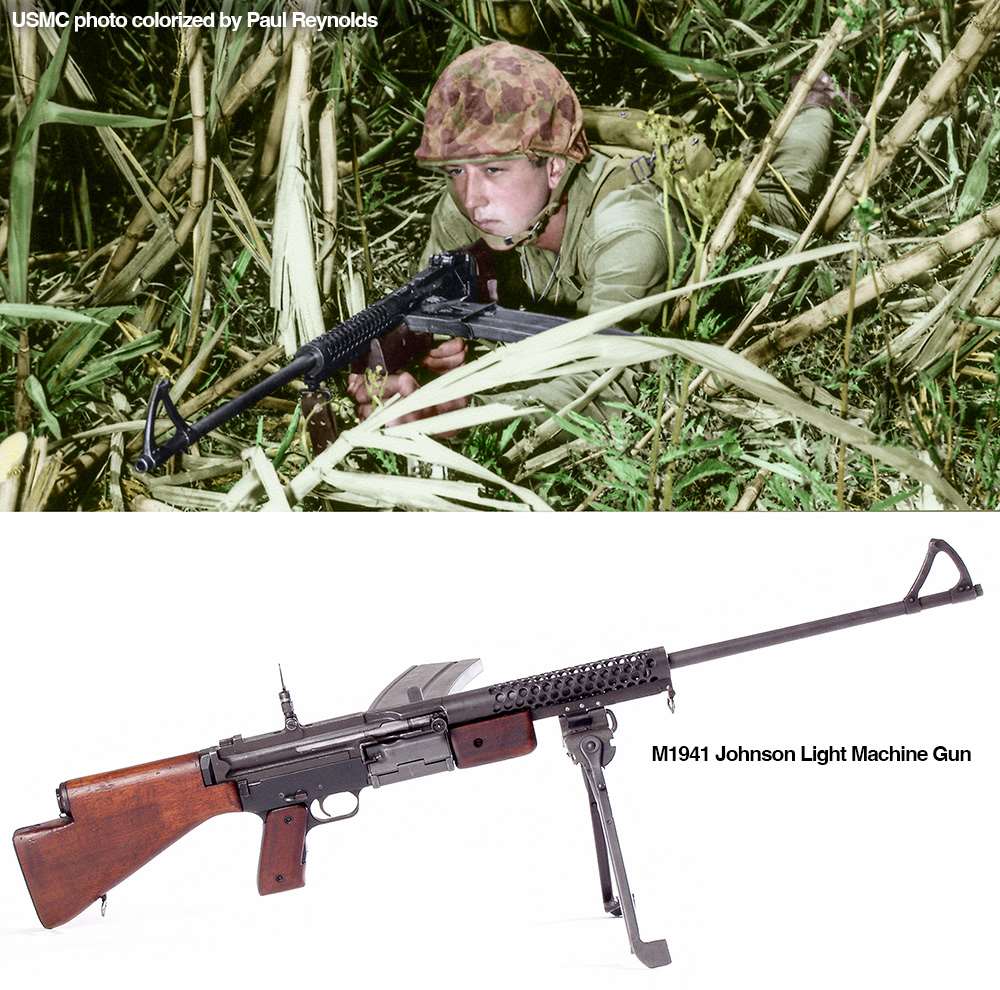
Since the Johnson rifle and light machine gun had barrels that could be easily removed and quickly reattached, the firearms at- tracted the attention of the Marine Corps Equipment Board, then in the process of evaluating the most suitable weaponry for the newly organized parachute units. However, initially, the Marines showed more interest in the Johnson light machine gun than the Johnson rifle.
In September 1941, a Marine paratrooper, Lt. Harry Torgerson, demonstrated the capability of the Johnson light machine gun by parachuting from a plane with a disassembled LMG secured in a canvas pouch on his chest. The demonstration was very impressive, as Torgerson was able to jump from the plane, land, assemble the LMG and hit targets 200 yards away within a span of 130 seconds. This demonstration confirmed the belief that the Johnson light machine gun could effectively provide squad-level firepower for the Paramarines. Since the Johnson guns were the property of the Dutch government, procurement had to be coordinated through the Netherlands Purchasing Commission.
A Sept. 25, 1941, USMC Equipment Board report detailed the tactical reasons behind the decision to procure Model 55 Reising submachine guns and Johnson light machine guns for the Parachute units:
“In an effort to find a production weapon that may be carried on the individual parachute troopers when jumping from planes, the Board has conducted tests that are sufficiently conclusive to enable definite recommendations to be made. The two weapons which lend themselves to this particular employment are the Johnson Light Machine Gun and the Reising Submachine Gun.
“… Opinion was expressed that a combination of the Reising Submachine Gun and the Johnson Light Machine Gun, as weapons for parachute troops... (These weapons) would accrue maximum firepower for parachute troops and would enable the trooper to jump with a weapon suitable for immediate action against the enemy on the ground … By arming alternate parachute troopers with Johnson Light Machine Guns and Reising Submachine Guns, the submachine gunners are equipped to commence firing at targets within close range immediately upon landing and furnish protection to the troopers armed with the light machine gun while the latter are assembling their weapons. After the light machine gunners have assembled their weapons and are ready for action, the submachine gunner in every pair would be available as an ammunition carrier for the light machine gunner and would be charged with the ammunition resupply when ammunition is later dropped from the air.
“It is contemplated that each submachine gunner would jump with four loaded 20-round magazines and that every light machine gunner would jump with four loaded 20-round magazines.”
The Marines were optimistic that the Reising and Johnson LMG would be effective and dependable weapons for the Paramarines. However, when the 1st Marine Division invaded Guadalcanal in August 1942 and the guns began to see actual field use, this optimism, in the case of the Reising, quickly turned to pessimism. When exposed to even moderate amounts of the inevitable grit and grime of combat, it was soon discovered that the Reising had a troublesome tendency to malfunction. The Model 55 was the topic of a scathing report dated Sept. 9, 1942, from the 2nd Parachute Battalion:
“Subject: Change in armament of Parachute Battalion, Marine Division, necessitated by defects of Reising Submachine gun, caliber .45, M55.”
“… This weapon (is) unsatisfactory as the basic weapon of the Parachute Battalion, Marine Division. Its tactical use is limited, and from the results of field-firing it has been found mechanically defective in its present form. Due to this poor performance, there is an apparent lack of confidence in the weapon on the part of Parachutists. Furthermore, it is not suited to the purpose of collective action upon which a successful Parachute Operation is dependent.”
Eventually, most of the Reisings were withdrawn from combat duty and replaced by other weapons, such as Thompson submachine guns and M1 or M1A1 carbines. The Reising was one of those things that looked good in training but was found to be a disappointment on the battlefield.
Once employed in combat, the Johnson light machine gun, unlike the Reising submachine gun, proved to be reliable and effective and received many accolades from those who had the opportunity to use it. One such example was related in a memo to the Marine Corps Commandant from Lt. Col. Victor Krulak regarding the performance of the arms used by Marine paratroopers during the Solomon Islands campaigns:
“Johnson Light Machine Gun (Automatic Rifle): The most praiseworthy single weapon. It showed no weaknesses. Functioned perfectly under most arduous conditions. It is extremely light weight (12.5 pounds) for an automatic rifle, which makes it ideal for jungle combat. It is short and comfortable to carry. The magazines are most rugged. It is accurate, with an easily adjustable sight and, for the jungle task, far superior to the BAR [Browning Automatic Rifle] which is itself a splendid weapon.”
In addition to being acquired for the Paramarines, some Marine Raider units were also issued Johnson light machine gun. Interestingly, the Marine Raiders and Paramarines weren’t the only special units of the American military that favored the M1941 Johnson light machine guns, as the U.S. Army also procured 125 of the weapons for the elite joint American/Canadian First Special Service Force, which used them with what was noted as considerable effectiveness.
Model 1941 Johnson Rifle
The semi-automatic rifle developed by Melvin Johnson was also evaluated by the Marine Corps Equipment Board. However, as mentioned, only the Johnson light machine gun was initially selected for issuance to Paramarines.
Although the Marines had declined to procure any Johnson rifles for the time being, Johnson “unofficially donated” 23 of the M1941 semi-automatic rifles to the 1st Parachute Battalion just prior to deployment to Guadalcanal. Johnson later remarked that these rifles were provided on “ … more or less lend-lease which developed into a gift.” Harry Torgerson (recently promoted to Captain) stated that the Johnson rifles were used by “ … select scout-snipers.”
While the 23 rifles “donated” by Johnson obviously weren’t a huge part of the Marines’ armament during the initial campaign, the paratroopers and their Johnson rifles (and light machine guns) played important roles in the Tulagi and Gavutu operations, as well as the key “Battle of Bloody Ridge” on Guadalcanal. After the Paramarines were withdrawn from Guadalcanal, the Marine Corps made plans to procure additional Johnson rifles for the parachute units from the Netherlands Purchasing Commission, with 750 ultimately acquired.
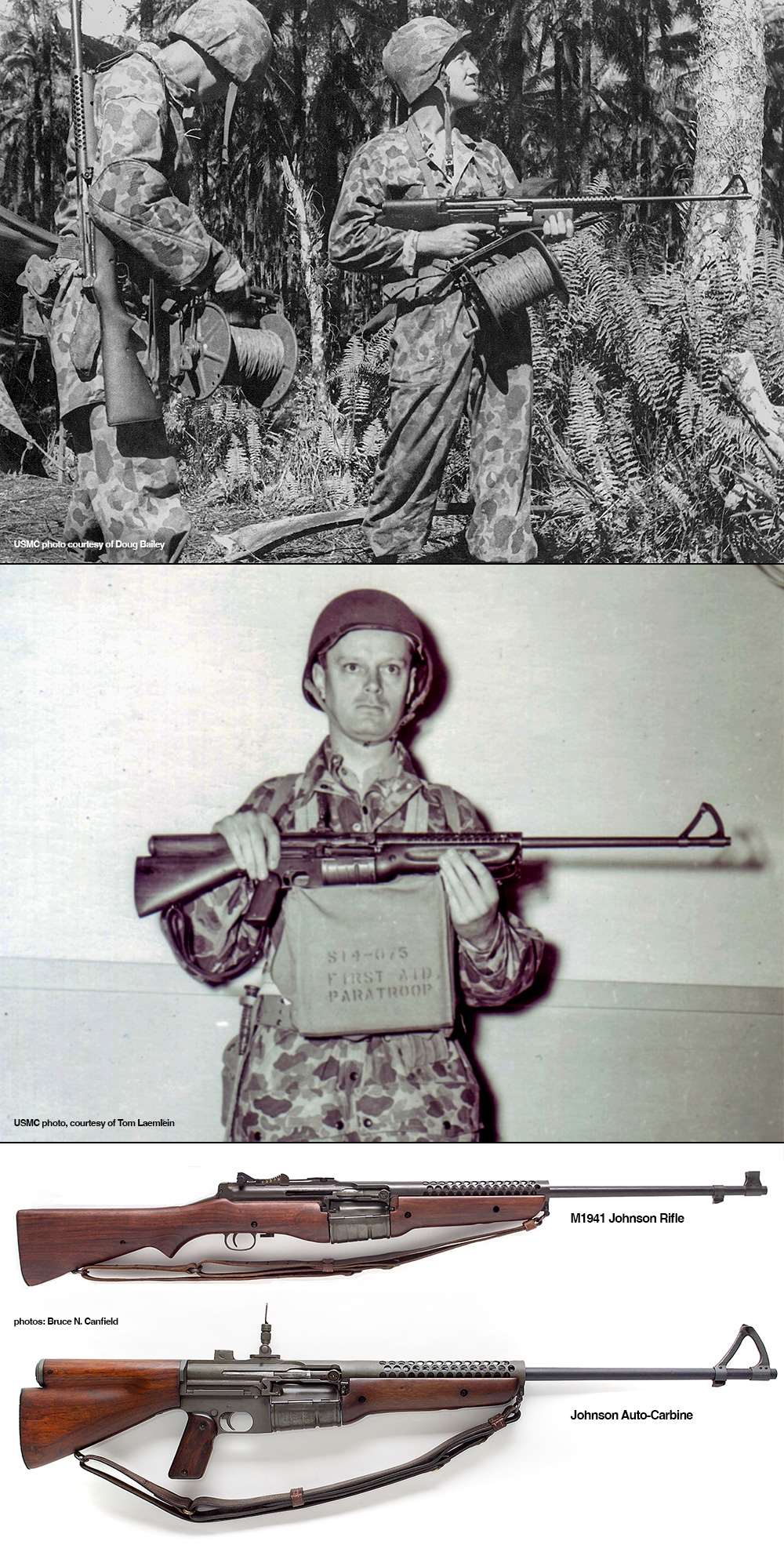
On April 1, 1943, the USMC 1st Parachute Regiment was formed on New Caledonia from the 1st, 2nd and 3rd Parachute Battalions as part of the First Marine Amphibious Corps. The Table of Organization and Equipment for the 1st Parachute Regiment authorized 243 Johnson rifles (along with 261 Johnson light machine guns). The remaining 507 Johnson rifles procured by the Marine Corps (750 less the 243 authorized for the 1st Parachute Regiment) were apparently never issued. Thus, the 1st Parachute Regiment was the only U.S. Military unit to have Johnson rifles issued and reflected in its TO&E. It is often claimed that the Johnson rifles were also issued to Raiders or other Marine Corps units, but this is not correct.
Private Clifford E. Goodin, 1st Parachute Regiment, Headquarters & Service Company, was one Marine paratrooper who acquired a M1941 Johnson rifle on New Caledonia. Goodin was assigned to the regimental armory, where he worked with GySgt Ed Floreck whom he described as “ … a very good weapons expert … he thought highly of the Johnson rifle and urged me to give it a try in action.” Goodin stated that he “ … had a choice—Reising gun, M1 carbine, M1903 rifle or Johnson rifle.” His last parachute jump with the Marines was a combat training jump on New Caledonia with full gear, including the Johnson rifle. The barrel was removed and the weapon placed in a canvas bag positioned on his chest. Goodin remarked that “ … this arrangement worked out satisfactorily … .”
After departing New Caledonia, the Marine paratroopers and their Johnson rifles (and light machine guns) were deployed to Bougainville. The engagement in which the 1st Parachute Regiment saw the most extensive combat action occurred on November 1943 when elements of the unit made an amphibious assault at Empress Augusta Bay on Bougainville. In his report on the performance of the weapons used by his paratroopers during the campaign, Lt. Col. Krulak stated: “Johnson Rifle, caliber .30. Performed similarly with the M1. Found little difference between the two.” Given the reputation that the M1 Garand had garnered in combat, Krulak obviously held the Johnson rifle in high regard. He was not alone in his esteem for the Johnson rifle. Several of the Marine Paratroopers who used the weapon in combat on Bougainville held similar opinions, including PFC Goodin, who participated in the battle and stated: “ … my Johnson rifle (was) very dependable and accurate … (and) proved itself to be a very good combat weapon.”
The Johnson Auto-Carbine
In addition to his semi-automatic rifle and light machine gun, Melvin Johnson, Jr. developed a prototype “carbine” that was, almost literally, a cross between the two guns. It had the same action and rotary magazine as the M1941 Johnson rifle, but the stock, barrel and sights were similar to the light machine gun. Dubbed the “Auto-Carbine,” it combined the power and accuracy of a .30-‘06 Sprg. rifle in a compact platform with excellent handling characteristics. Torgerson (now promoted to Major) was a strong advocate of all the Johnson weapons, and while on a visit to the Cranston plant before being redeployed overseas, Johnson gave him one of the Auto-Carbines. Torgerson took the weapon to Bougainville, where it attracted a lot of interest among his fellow Paramarines. However, despite its attractive attributes, there were no committed buyers, and no more than a half-dozen Auto-Carbines were made. Torgerson’s was the only one to leave the factory. Several photos have been published of other Marine paratroopers posing with Torgerson’s Auto-Carbine, which may suggest more than one was fielded, but that was not the case.
It should not be inferred that the Paramarines were only armed with Reising submachine guns and the Johnson guns. As events transpired, for a variety of reasons, the elite Paramarines were never deployed in combat via parachute and were utilized in much the same manner as the Marine Raiders. Thus, there was no longer any incentive to provide firearms such as the Reising and Johnsons simply because of their perceived efficacy for airborne use. As related by PFC Goodin, he could have selected other types of weapons from the regimental armory, but chose a Johnson rifle, as did a number of other paratroopers. Other Paramarines that fought on Bougainville were armed with the same weapons used by the Raiders and other Marine Corps combat units. These included M1 Garand rifles, Thompson submachine guns, M1903 rifles, Browning Automatic Rifles and .30-caliber carbines, either the standard M1 variant or the folding-stock M1A1.
After the conclusion of the Bougainville campaign, the 1st Parachute Regiment was deactivated and officially disbanded in February 1944 as the perceived need for Marines being deployed in combat via parachute never materialized. With the deactivation of the only Marine airborne unit, many of those previously serving as Paramarines were subsequently transferred to other units of the 5th Marine Division.
Despite their excellent performance in combat, the Marine Corps did not standardize the Johnson rifle or light machine gun and ordered the weapons purged from inventory. The deactivation of the 1st Parachute Regiment and a directive from the Equipment Board to “ … eliminate Johnson weapons from Marine Corps requirements” marked the end of the Johnson rifle and light machine gun as Marine Corps small arms.
The Paramarines never made any combat jumps, but these highly trained Marines played a role in the key battles of the Pacific Theater and should not be forgotten. As aptly stated in the book “U.S. Marine Corps Special Units of World War II,” published by the History and Museums Division, Headquarters, U.S. Marine Corps:
“[T]he parachute units had made noteworthy contributions to the tradition of the Corps, and the esprit and high state of professionalism inculcated in their personnel would be apparent one year later when the 5th Marine Division went ashore on Iwo Jima.”
Most Popular