The 7.62x51 mm NATO-chambered M110 Semi-Automatic Sniper System (SASS) rifle—developed by Knight’s Armament Co. of Titusville, Fla.—has been fielded by the U.S. Army and Marine Corps since the late 2000s. But, as early as 2011, the Army sought to reconfigure (or replace) the M110, and a year later began converting existing M110 rifles into the improved Compact Semi-Automatic Sniper System (CSASS). Fast-forward to 2014, when the Army formally invited manufacturers to compete for a lavish $44.5-million contract to produce around 3,600 CSASS rifles to replace the Knight’s Armament Co. M110 SASS. In 2016, the Army announced that Heckler & Koch (H&K) had won the CSASS contract.
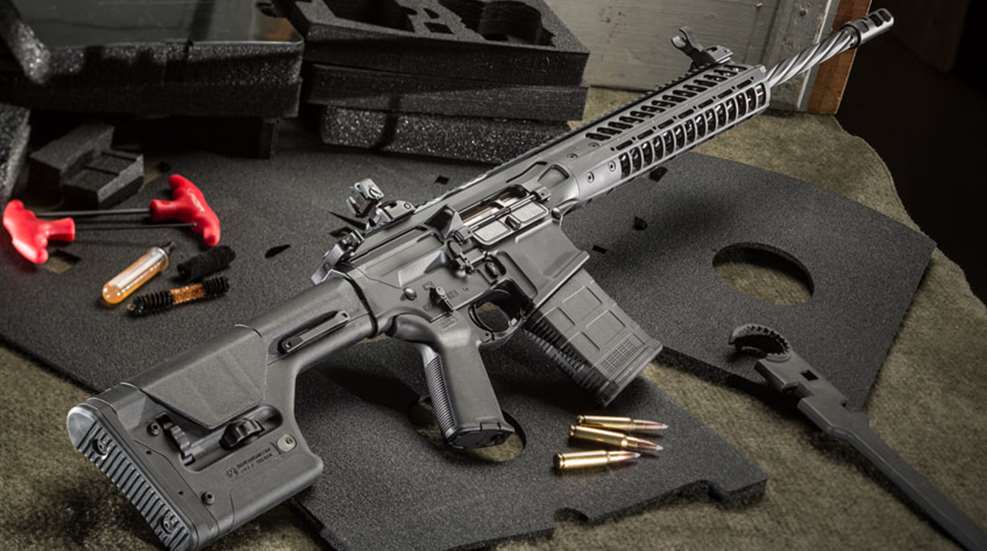
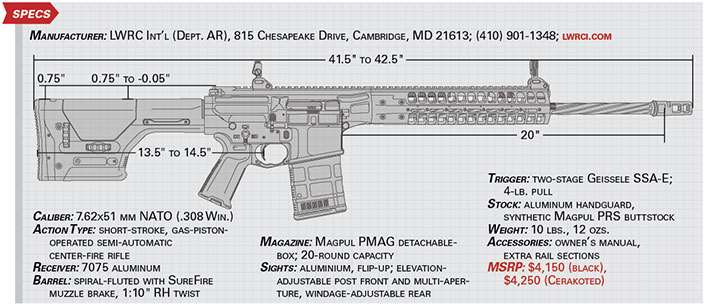
Although an H&K G28 variant is the Army’s new CSASS, the “request for proposal” process resulted in a new class of rifle that supplants its predecessor. LWRC International’s new R.E.P.R. MKII (a Lipsey's distributor exclusive) is among them. In most cases, the new rifle is consistent with the Army’s vision of the CSASS. For example, among the numerous criteria for the new CSASS was an unloaded weight of 9 lbs. or less. The 12.7"- and 16.1"-barreled R.E.P.R. MKII versions, which weigh 8 lbs. and 8 lbs., 12 ozs., respectively, meet that specification, while the 20"-barreled variant tested here doesn’t—it weighs in at 10 lbs., 12 ozs. To achieve said weight, without sacrificing strength, required the use of aerospace-grade 7075 aluminum for the receivers.
Its two-piece, 12.5"-long aluminum handguard, which is coined the “Modular Rail System,” is easily removed. Withdraw the two screws at the fore of the handguard and the top half is easily detached. A foolproof system of pins, slots and holes ensures that the unit returns to its pre-removal location. Rail attachment points are found in the 3, 6 and 9 o’clock positions. When the integral, numbered top rail is paired with that atop the upper receiver, there is ample space to add an optic. Topping the rail is the windage-adjustable Skirmish back-up iron sight with multiple apertures and an elevation-adjustable post front sight. Both are made from aluminum.
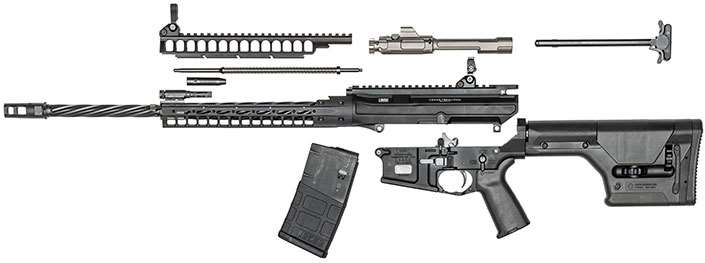
The cold-hammer-forged, NiCorr-treated barrel has a heavy profile; in fact, it measures more than an inch in diameter ahead of the receiver and, at the gas block, is slightly less than an inch. Forward of the gas block, the barrel is noticeably thinner, measuring 0.720" wide just behind a SureFire muzzle brake. The barrel features deep, spiral fluting—not the superficial fluting done solely for appearance so common these days.
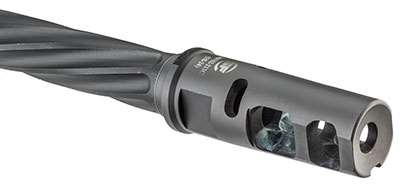
The muzzle brake on the test rifle is SureFire’s 5/8x24 MB762-211C. The unit is made from heat-treated, stainless steel bar stock with a black Ionbond DLC coating and pulls double duty as a suppressor attachment point. To stabilize a variety of bullet weights common to 7.62x51 mm NATO (.308 Win.) ammunition, the barrel has 1:10" RH-twist rifling.
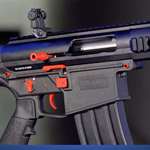
Its ejection port is positioned for right-hand shooters; however, the R.E.P.R. MKII rifle has numerous bilateral controls, including the bolt release, safety, magazine release and AR-style charging handle (a departure from the norm for LWRC Int’l). As for the magazine release button, we found that an empty PMAG 20 magazine wouldn’t fall free when it was pressed. The Geissele SSA-E two-stage trigger broke at 4 lbs. with neither creep nor overtravel. Reset was quite short.
The operating system of the new rifle differs slightly from its R.E.P.R. predecessor. While short-stroke, gas-piston operation remains the heart of the system, the range of adjustment in the MKII is vastly greater. For example, whereas the R.E.P.R. rifles have a two-position gas block for switching between suppressed and unsuppressed loads, the R.E.P.R. MKII has 20 positions from which to choose.
To protect the bolt carrier group from wear and corrosion, as well as to provide lubricity, it is coated with nickel-Teflon. Except for the machining of unnecessary material to reduce weight, the bolt carrier group is consistent with other guns of the pattern.
Where the LWRC Int’l rifle departs from the Army’s vision is in its buttstock. While its Magpul PRS is adjustable for length of pull and comb height, the latter of which aids eye-to-sight alignment, the mandated dimensions aren’t there. For example, the Army stipulated that the length of pull in the shortest position be no greater than 12"; that measurement on the R.E.P.R. MKII is 13 1/2". At its longest, the stock provides a 141/2" length of pull; the Army requested no less than 16". The stock also prevents the MKII from meeting the military’s demand for a 36" overall length; even with the 16.1" barrel, the gun’s shortest overall length is 37.5". Nonetheless, the Magpul furniture (including an MOE+ pistol grip) make the gun adaptable and more comfortable to shoot. Lastly, the LWRC Int’l R.E.P.R. MKII is available in four colors: black, flat dark earth, olive drab and patriot brown.
To test the rifle, we topped it with a Leupold VX-3 8.5-25X 50 mm Long Range scope in a Weaver SPR optics mount and gathered three types of .308 Win. ammunition: Nosler 125-gr. Ballistic Tip; Nosler 155-gr. Match Grade; and Federal Premium 175-gr. Gold Medal.
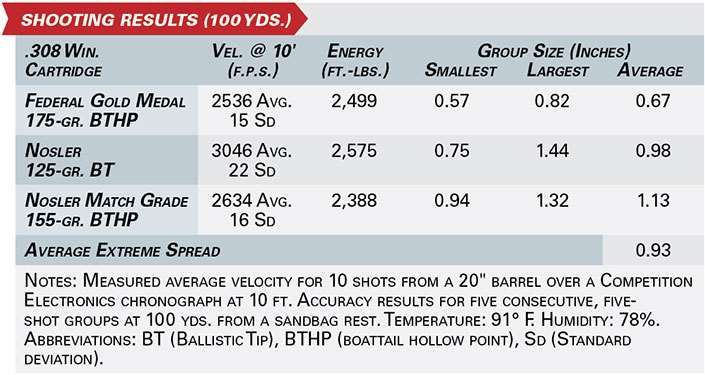
Despite the 90° F or higher temperatures, the rifle exhibited superb accuracy, as can be seen in the nearby tabulated results. The Nosler 125-gr. Ballistic Tip load was the only one that caused the rifle to malfunction, apparently over-gassing the system consistantly—regardless of the gas setting.
Is the LWRC Int’l version 100 percent true to the Army’s concept of a CSASS rifle? No, but as we discovered, the company’s R.E.P.R. MKII is an accurate and thoughtfully designed rifle that would serve faithfully in a host of environments and situations. That’s good enough for us.
Most Popular