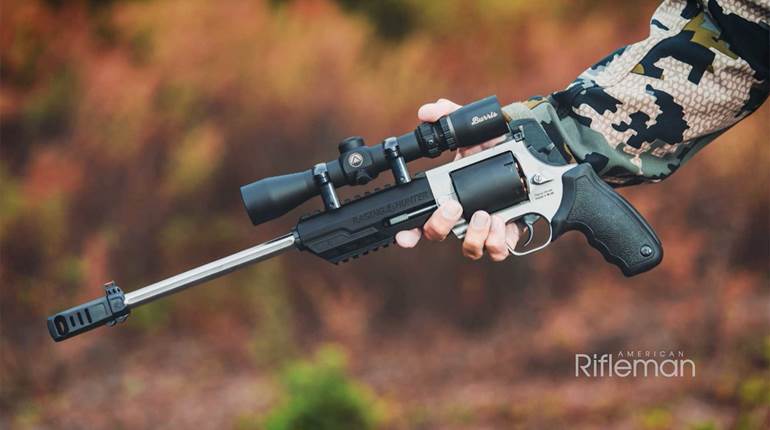
There’s a popular new breed of space-saving “compact” riflescopes on the market today, and they bring another important feature to the game. On average, these kinds of optics offer a more generous field-of-view. Considering the current demand for shorty optics, there’s a trend brewing just around the corner.
EOTech’s Vudu 4-12x36 mm FFP is a member of that tribe of optics, measuring in at only 7.1 inches in length. It was introduced in January and covered for American Rifleman by Jeremiah Knupp last month.
Comparing its measurements to nine popular centerfire 4-12X riflescopes puts the optic’s space-saving virtue into perspective. We conducted an unscientific survey by identifying models with an identical 4X zoom factor and the same 4-12X magnification range currently offered by six different major manufacturers. This Vudu riflescope has an overall length of 7.1 inches. Those in our brief poll of competitors averaged 13.0 inches. The closest any one of them came was off by 5.4 inches. The difference is large enough that EOTech, which makes the Vudu line, ships the optic wearing a Picatinny rail mount tailored to anchor the abbreviated optic.
Being suspicious of anything new, I drilled into two other numbers. The Vudu’s field of view (FOV) at 100 yards is 28.5 feet at 4X and 9.5 feet and 12X. The nine competitors averaged worse, 25.4 and 9.01 feet, respectively. Only one riflescope had a wider FOV at low magnification (by only six inches). Admittedly three did better at the highest setting, but not by much.
Being an inquisitive sort, I asked EOTech Vice President of Marketing John Bailey, "What gives?"
“The increased FOV is a desirable byproduct of the shortened optical path length,” he explained. “Older riflescope designs forced the light to travel through a longer ‘tunnel,’ and as the tube gets shorter, more of the light collected at the edges of the objective lens can pass through the optical system to the operator’s eye. But the increased FOV adds complexity to the optical design requirements for the best performance.”
When I inquired if anything was lost in the shrinking process, he said, “There always is a compromise, but we were able to spread it across several different areas to minimize it. Areas like eye relief, field curvature, distortion, resolution and zoom range may have all been a bit reduced from a normal riflescope.”
I’ve tested the Vudu and found the optics crystal-clear, color rendition true and even the edges seemed free of any annoying chromatic aberration. If there was any perceivable distortion, I didn’t detect it.
An Isolated FOV Anomaly?
In January 2025, German Precision Optics (GPO) introduced its GPO Centuri 4X 4-16x44i Super Compact. It’s also in high demand and earned a prestigious Golden Bullseye Award from NRA’s American Hunter this year.
It’s only 9.9 inches long. Specifications from nine scopes with the same 4-16X magnification range—from six different major manufacturers—were collected for comparison. The other optics had an average length measurement of 13.27 inches, 3.37 more than the GPO. As was the case with Vudu, none of the surveyed riflescopes were shorter.
The Super Compact’s FOV is 34 or 9 feet at 100 yards, depending on magnification. Its competitors averaged 25.63 and 6.47. None came close to eclipsing the GPO figures.
I’ve spent quite a few pleasant hours behind the scope at the range. I was shocked when I took a close look at FOV numbers after my firing-line time was done.
The discovery, of course, forced me to send another inquisitive email. The answer was that the shorter length, “…allows the image to escape the objective at a broader angle,” a company spokesperson responded.
They explained there is a compromise. “If you notice, the only slight sacrifice on the scope optically isn’t the eye relief, but the eye box sensitivity. You have little play in attaining the full field of view. Experienced shooters don’t see this. They have an instinctive feeling on getting the eyebox field accurately. Beginners might see the sensitivity. This narrower eyebox allows, somehow, the stretching of the FOV.”
I didn’t detect it while testing the scope. Cheek weld was intuitive, and light transmission through the optic was crystal-clear.
Future Focus
As for riflescopes shrinking more anytime soon, Bailey said, “…any shorter, and we can’t fit the moving zoom lenses into the system. Shorter optical designs require erector prisms and no variable magnification.”
He did caution that engineers are still at it. “As new optical glass materials become available—glass technology improvements—the designs should be able to drive even shorter without sacrificing performance.”
How soon that happens is yet to be seen. In the meantime, readers are encouraged to take a closer look at this new short-scope trend at their nearest FFL or sporting goods retailer.
Most Popular