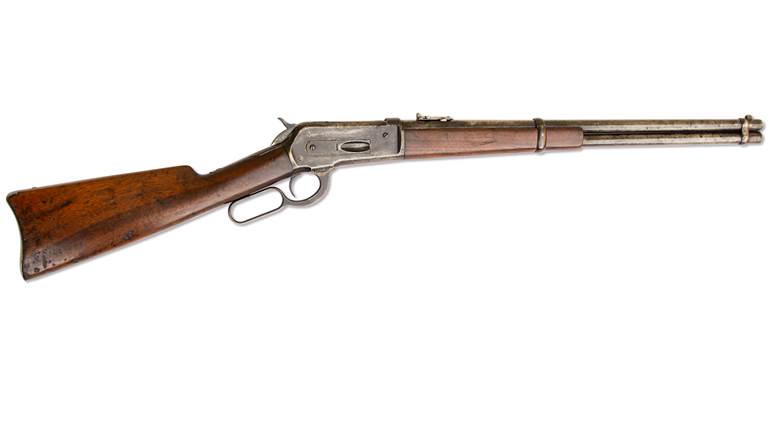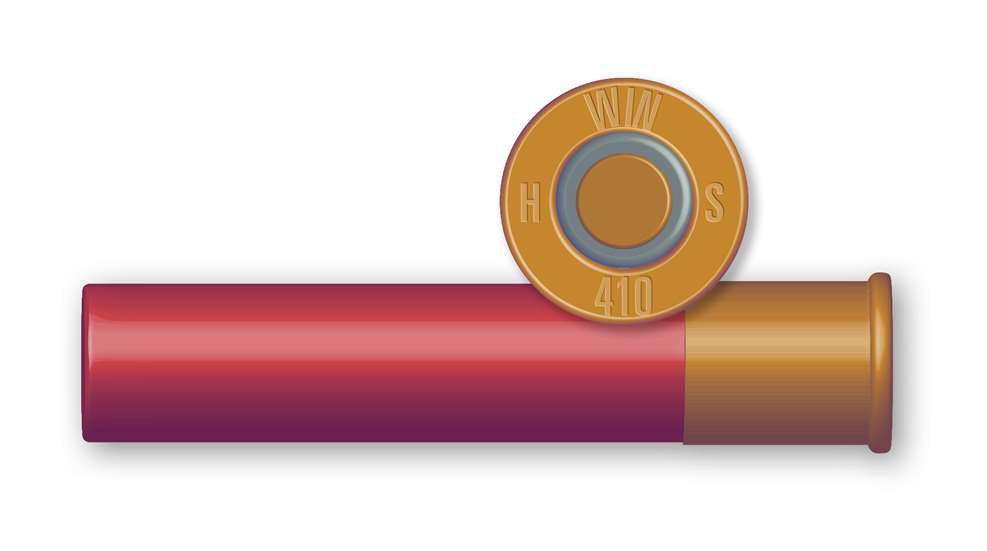
If ever handloading shotshells can pay off, it’s in the loading of .410 bore. Prices of factory .410 2½" shotshells are about double that of factory 12-ga. shells, despite the fact .410s contain only half the shot and powder. I feel like I’ve saved some serious money each time I use my MEC 600 Jr. Mark V press to load .410 shells. Before pulling the handle, however, consider what a final load should entail. There are both 2½" and 3" versions of the .410 bore, and lots of old shotguns—like the Henry lever-action used to shoot this recipe—are chambered only for the shorter shell, with shot weight limited to 1/2 oz. The longer shells can fire up to 3/4 oz. of shot. Shot columns in both shells are long and narrow.
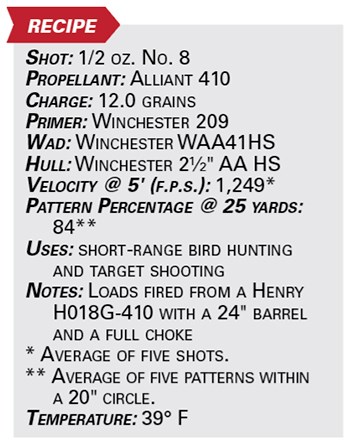 To leave enough room for an adequate amount of shot, wads like the recipe’s Winchester WAA41HS have no cushioning legs, and its shot cup’s protective petals are thin. All this leads to poor patterns, as the pellets deform as they travel down the bore. After shooting five .410-bore guns over the years, I’ve concluded that lead shot larger than No. 6 is a poor choice; the .410 performs just right shooting No. 7½ or 8 shot.
The Henry’s full choke printed 84 percent of the recipe’s load of No. 8 shot in a 20" circle at 25 yards. Effective pattern diameter was about 15", which contained an average of 61 percent of the load’s shot. That concentration of pellets would work fine for clay targets and birds a step or two past 25 yards. Propellants for the .410 are pretty much limited to Hodgdon Lil’ Gun and W296 and Alliant’s 2400, Power Pro 300-MP and 410. They are all capable of firing 1/2 oz. of shot about 1,200 f.p.s. The recipe’s load of 12.0 grains of 410 propelled the 1/2-oz. payload at an average velocity of 1,249 f.p.s. from the Henry’s 24" barrel.
Comparing component costs of handloaded 1-oz. 12-ga. shells to 1/2-oz. .410-bore shells, outlay for the .410s is about half that of the 12s. That adds up to plenty of thrifty shooting with the otherwise-expensive-to-shoot .410 bore.