This sidebar article originally appeared in "From Bunker Hill To Baghdad: 250 Years Of U.S. Infantry Longarms" in the June 2025 issue of American Rifleman. To subscribe to the monthly magazine, visit NRA’s membership page.
Any survey of military firearms isn’t complete without also discussing the development of ammunition across this past quarter-millennium. From a conceptual standpoint, very little has changed. Then, as now, the pull of a trigger unleashes a spring-loaded mechanism that sets off the priming powder or primer, which in turn ignites the main propellant charge, creating the expanding gases that push a projectile out of a barrel. However, the components involved in each step have seen dramatic evolutions.
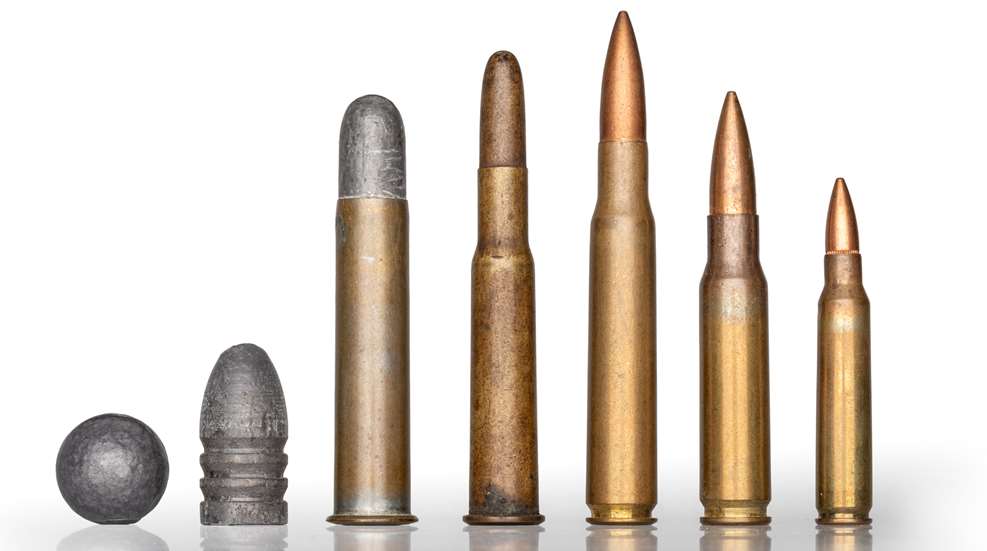
The men who fought at Bunker Hill in June 1775 had already largely transitioned from powder horns and loose musket balls to the paper cartridge, an early attempt at combining the separate components of a complete ammunition load into an easily handled package that could be loaded and fired with greater rapidity. For nearly a century, the paper cartridge was the basis of the standard infantryman’s ammunition load, though priming and projectiles changed significantly within that time. In addition to single- projectile cartridges containing a .67-cal. round ball fired at a muzzle velocity of roughly 1,000 f.p.s., buckshot cartridges were also issued from 1777 until the end of the American Civil War.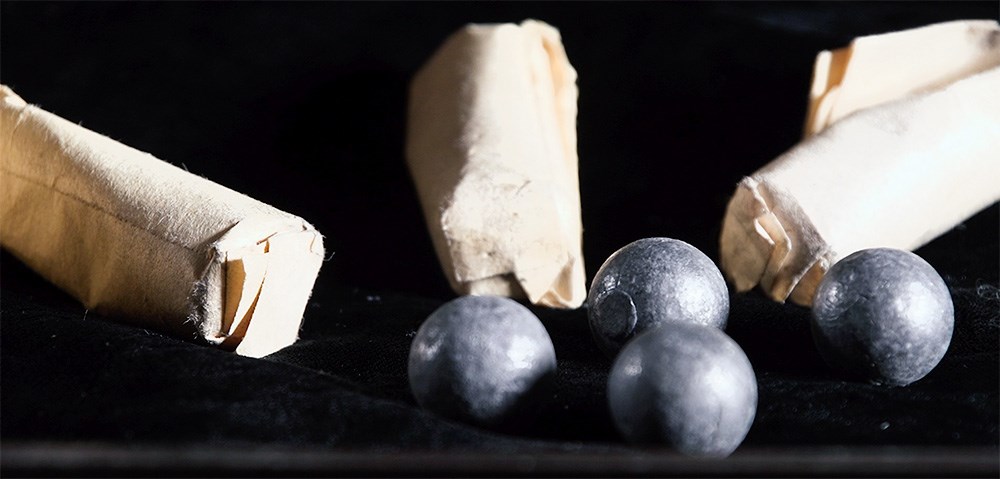
The advent of the percussion priming cap in the early 19th century, a small copper cup with a dash of mercury fulminate at its base, eliminated the necessity of pouring a small amount of powder from a torn-open cartridge into a priming pan and presaged the end of the flint-and-steel firing mechanisms so instrumental in the nation’s founding battles. From the 1840s on, soldiers were issued separate priming caps that would be placed on a hollow, cone-shaped protrusion threaded into a gun’s breech and struck by an external hammer to ignite the propellant. Paper cartridges contained the main propellant charge, but, from 1855 on, the spherical musket ball was replaced by the Delvigne-Minié hollow-base conical projectile later refined by James Burton and James Benton. This .58-cal. bullet was the last of the muzzleloading projectiles before the advent of the cartridge era.
The official changeover into the age of the self-contained cartridge for the U.S. began as the Civil War concluded, with early arms firing a .58-cal. rimfire round before a rapid evolution into centerfire and smaller-caliber cartridge designs such as the .45-70 Gov’t. The nomenclature outlined its composition: a .458" projectile weighing 405 grains and propelled by 70 grains of blackpowder to a velocity of about 1,300 f.p.s. The development of a nitrocellulose powder in the 1880s offered a cleaner-burning “smokeless” propellant that produced more energy than blackpowder. The U.S. Army’s first smokeless-powder cartridge, the .30-40 Krag, fired a .308", 220-grain, round-nose projectile clad in a thin, metal jacket to prevent lead smearing in a firearm’s bore due to the higher velocities. The new propellant more than doubled the chamber pressure of the .45-70 Gov’t, leading to a muzzle velocity of 2,000 f.p.s.
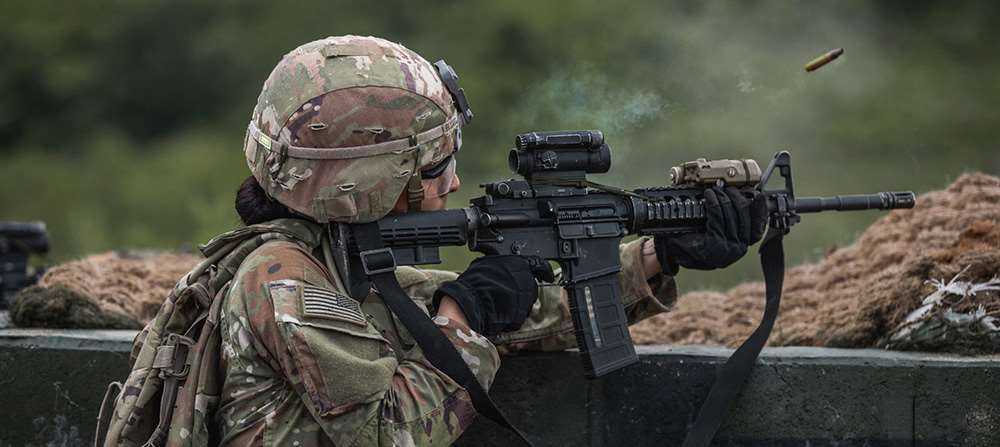
As the 19th century closed, several foreign nations adopted more capable military cartridges, notably the 7 mm and 8 mm Mausers, pushing the U.S. Ordnance Dept. to develop the .30-’06 Sprg., which was loaded with a .308", flat-based, spitzer-style projectile weighing 150 grains and propelled to a muzzle velocity of 2,700 f.p.s. More than 40 years later, following several design updates to the original .30-’06 cartridge, the U.S. military adopted the experimental T65E5 ammunition design as the 7.62x51 mm cartridge, which was further codified as the standard NATO round in 1954. Ballistically, the 7.62 NATO was similar to the previously issued .30-’06 Sprg., albeit with a shortened case more easily accommodated in semi-automatic receivers and detachable box magazines.
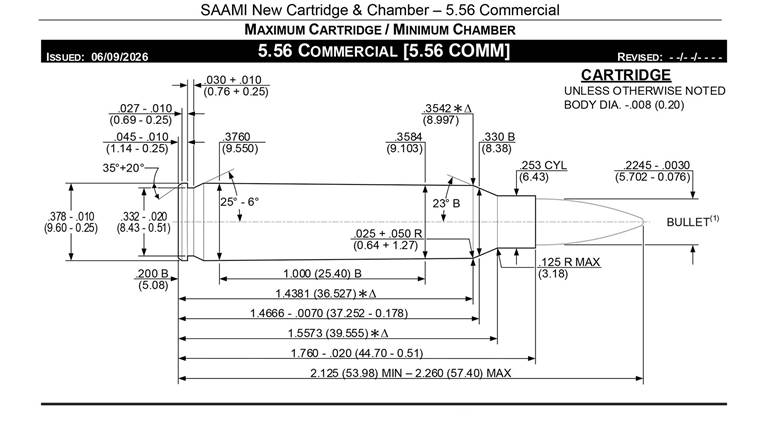
Only a decade later, lingering questions over contemporary U.S. issue arms, along with recent testing and fielding of intermediate cartridges, led to a significant shift in U.S. infantry firepower doctrine, with the small-caliber, high-velocity concept emerging as the dominant guiding principle, realized in the official adoption of the 5.56 NATO. The cartridge’s .224", 55-grain, full-metal-jacketed projectile exited the muzzle of the XM16E1 rifle at 3,250 f.p.s., and the lighter, smaller cartridge allowed troops to carry more ammunition while also providing more controllable full-automatic fire, lighter-weight firearms and an increased hit probability within the cartridge’s “point-blank” range of approximately 300 yards.
Most Popular