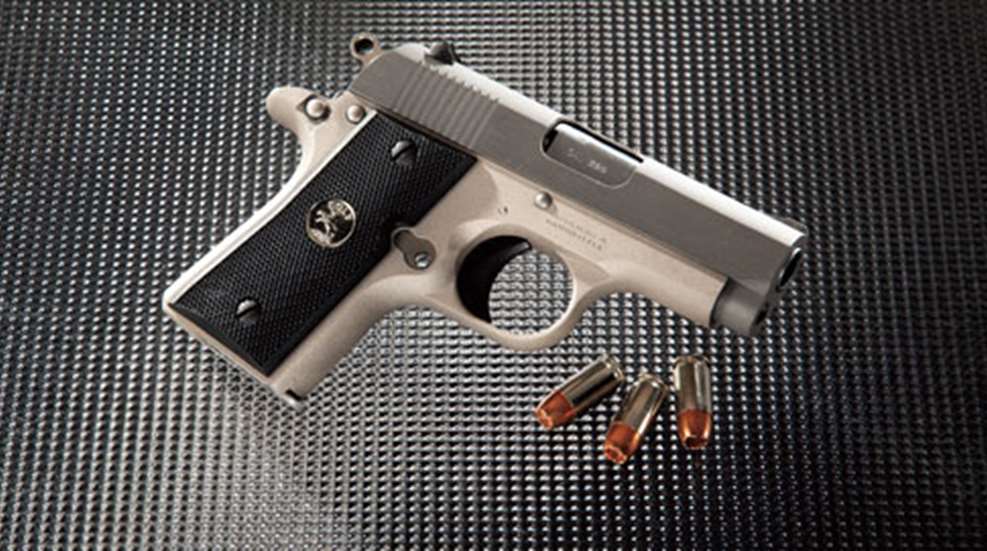
Colt's Mfg. Co. has been in the .380 ACP (Automatic Colt Pistol) pistol business since the introduction of the cartridge with its "Automatic Colt Calibre .380 Hammerless" of 1908. Production of the Model M ceased in 1945, but later factory .380s came in the form of the Government Model .380, and the 2 3/4-inch-barreled Mustang, which were followed by the aluminum-frame Mustang PocketLite in 1992. Colt stopped offering .380 ACPs altogether by 1998. But, after witnessing the surge in interest in single-action sub-compacts from other makers-and a spike in used PocketLite pricing-Colt is back in the .380 business with the Mustang .380 PocketLite.
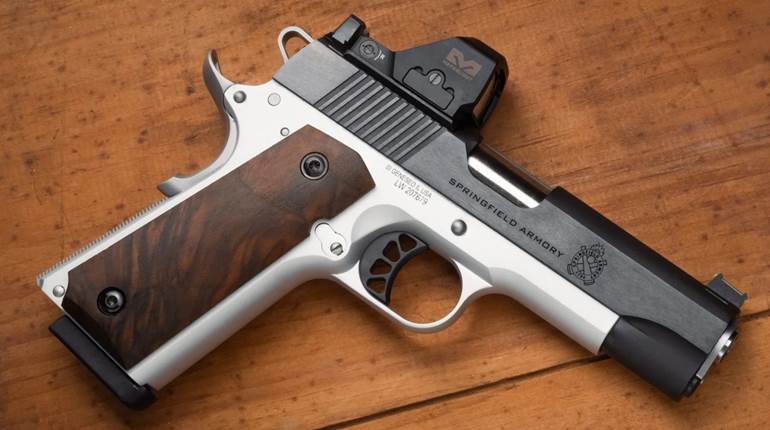
The semi-automatic, single-action, recoil-operated Pocketlite derives its name from its aluminum frame. It mimics the lines of a stainless Combat Commander in diminutive form, including the rowel hammer. The pistol is small, a mere 11⁄16-inch wide, 4-inch tall and 5 1/2-inch long, and weighs 13.7 ounces unloaded. The finish of the frame is brushed matte, and its grip angle and controls follow those of the M1911 with some differences in internal design. The tang is integral and is of the beavertail variety, keeping the rowel hammer and recoiling slide well away from the shooter's hands even with a proper high grip. Stocks are black checkered plastic with a silver-tone Rampant Colt escutcheon on each side.
A locked-breech design (many .380s are blowbacks), the PocketLite has two lugs on the 2 3/4-inch-long barrel's top that engage corresponding recesses on the underside of the slide. Under the barrel, a kidney-shaped cut guides barrel travel around the slide stop. The latter is tensioned in the frame by a hairpin spring riding in a recess on the frame's left. Lockwork is of the Series 80 style, in which a trigger release lever is raised when the trigger is pulled, depressing a plunger in the slide's left rear underside and allowing the firing pin to travel forward after being struck by the hammer. This passive firing pin safety system is intended to prevent an accidental discharge should the gun be dropped on its muzzle. The trigger release on the frame's rear left also does double duty as the ejector. An internal extractor is fitted inside the ejection port on the breech face's right. The aluminum trigger blade is anodized black and grooved on its front face. The average trigger pull weight was 6 pounds, 11 ounces, with a short squishy take-up, a crisp break and little overtravel.
The top of the stainless slide is bead blasted matte to reduce glare, and the sides are polished with 10 rear vertical grasping grooves on each side. The square-notch rear sight, which is drift-adjustable for windage, is dovetailed into the slide's rear. The front sight is an integrally machined fixed ramp.
A pair of coil recoil springs, one inside the other, surrounds the black polymer guide rod, which rides under the barrel and extends through the hole in the slide's front as the slide moves rearward. A steel washer between the springs and the guide rod's base prevents them from removing material.
Mounted on the frame's left behind and below the trigger, the non-reversible magazine release is in the familiar M1911 position. The body of the detachable box magazine is of steel, as is the follower, and capacity is six rounds. The baseplate protrudes to the front slightly, about 1/8 inch, providing a stop for the ring finger, as most will only be able to get two fingers on the frame below the trigger guard. Tensioned by a stiff detent, the left-side-only manual safety blocks the sear when pressed upward into the "on" position, but still allows the slide to be manipulated when the hammer is cocked. If applied with the hammer down, the slide is immobilized.
The Colt Mustang PocketLite was function-fired with more than 200 rounds, and accuracy results are given for a more practicable distance of 7 yards in lieu of our standard 25 yards as the sight radius is less than 4 inches and the gun is designed for close personal protection. Unlike the Colt .380s tested in the 1980s, there were no malfunctions of any kind. One evaluator who regularly carries a polymer-frame .380 remarked on how controllable and fun to shoot the PocketLite was on the range. We attributed much of that to the tang and smoothly contoured radius where the web of the hand engages the back of the gun. There is no frontstrap checkering, which some would like to have seen, but the magazine baseplate aids the shooter in keeping the fingers from sliding down the grip frame's front under recoil. As the front sight is integral to the frame and sandblasted, several older evaluators had difficulty picking it up, especially in lower light; a situation easily remedied by a judicious dollop of luminous paint.
For those interested in a pocket-size, old-school, single-action .380 ACP, the Mustang PocketLite, while not inexpensive, proves that the Hartford, Conn., maker can still produce a quality little gun.
Manufacturer: Colt's Mfg. Co. ; (800) 962-2658; www.coltsmfg.com
Caliber: .380 ACP
Action Type: recoil-operated, semi-automatic center-fire pistol
Frame: brushed anodized aluminum
Barrel: 23⁄4"
Rifling: six-groove, 1:16" RH twist
Magazine: detachable box, six-round capacity
Sights: fixed-blade front, square-notch drift adjustable for windage
Trigger: single-action; 6-lb., 11-oz. pull
Overall Length: 5½"
Width: 11⁄16"
Height: 4"
Weight: 13.7 ozs.
Accessories: hard case, lock, spare magazine, owner's manual
Suggested Retail Price: $599
Most Popular