Having trained everyone from first-time gun owners to specialty military and law-enforcement teams over multiple decades, I've repeatedly encountered an interesting phenomenon that eventually catches up with many shooters as their skills improve. I've even experienced it myself more than once, and if you stay in this game long enough, chances are you will, too. I call it the "Bulletproof Bubble."
It's one of the most frustrating things a shooter can experience, because it doesn't make any sense. You haven't forgotten how to shoot. Your fundamentals haven't suddenly disappeared. In many cases, you're still shooting respectable groups. The problem is that every round seems to land all around the exact center of your point of aim instead of in it.
It's almost as though someone drew an invisible circle around your intended point of impact and declared it off-limits. On days like that, it seems like the safest place to stand on the range is the dead-center of your target. I've watched this happen with pistols, carbines and precision rifles. Different tools. Same pattern. The center becomes strangely unattainable.
The shooter usually starts with a good enough group, just not where they want it. They make a correction The next shot lands on the opposite side. They make another correction. Pretty soon they're chasing individual bullet holes instead of executing the same process that produced good hits only moments earlier. The harder they try to force the next round into the middle, the larger the bubble seems to expand.
Eventually, they conclude that it’s got to be the gear, right? Maybe the sights shifted. Maybe the optic came loose. Maybe it's the ammunition. Maybe something else isn't right. Those things certainly can happen, but in my experience, they're rarely the cause. More often than not, the problem isn't mechanical. It's that the shooter has stopped trusting the process and started chasing the outcome.
Many shooters call this "target panic," and they're not entirely wrong. Target panic can certainly produce the Bulletproof Bubble, but so can anticipation, overcorrection, excessive conscious control, visual over-confirmation or simply rolling up your sleeves and trying too hard. The Bubble isn't a diagnosis, it’s a visible shooting pattern caused by underlying causes.
One thing I've noticed over time is that the bubble often appears after a shooter has made significant progress. They've improved enough to know exactly what a good shot looks like. Now they desperately want the next round to be perfect. That's when trouble starts.
Instead of allowing the shooting process to unfold on its own, they try to steer the bullet into the center. Their attention shifts away from grip, sights, trigger control and follow-through, and they become fixated on the desired result. Ironically, that's usually the moment accuracy begins to falter.
The process hasn't failed. The shooter has decided to chase the result instead of following the process. Fortunately, the remedy is remarkably consistent regardless of what caused the bubble in the first place.
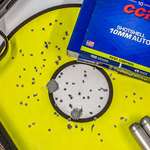
The first method is to remove the target altogether. One of the oldest marksmanship training methods is blank-target training. Instead of aiming at a bullseye, you stand just a few yards from a blank target backer and execute perfect shots without caring where they land. The objective isn't to hit the center. The objective is to execute a perfect shot.
Proper stance. Proper grip. Clean sight picture. Smooth trigger press. Good follow-through. With no aiming point to obsess over, the shooter naturally returns to the process instead of the result.
The second remedy is even simpler. Quit trying to hit the target. That probably sounds ridiculous until you've watched it work. Nearly every accomplished coach eventually tells struggling shooters some version of the same thing. Stop trying to make this shot hit the X. Instead, execute the shot correctly. Concentrate on the timeless fundamentals of sight alignment, hard visual focus, trigger control and follow-through. Let the process produce the hit rather than trying to force the hit into existence.
Accuracy is a byproduct of good control, and it has an interesting habit of returning the moment the shooter stops chasing it.
The third approach surprises some. Aim without shooting. Present the firearm. Acquire a perfect sight picture. Hold the sights exactly where they belong. Get to the wall, then lower the muzzle without pressing the trigger. Repeat. Eventually repeat it again, this time holding slightly longer before lowering the gun.
Only after the shooter becomes comfortable seeing the sights settle naturally on the intended point of impact is the full trigger press to a clean shot break re-introduced. The purpose of the drill isn't marksmanship. It's a brain retrain.
The shooter gradually re-learns that seeing the center of the target doesn't require an immediate trigger press. Patience and confidence return, and the process starts working again.
Although these three methods may look different, they're all accomplishing exactly the same thing. Blank target training removes the target. Process-based training removes the obsession with the result. Aim-without-shooting removes the compulsion to fire. All three break the cycle of trying to force the perfect shot and replace it with deliberate, repeatable execution.
The Bulletproof Bubble isn't evidence that you're getting worse. It’s evidence that you may have become so focused on the outcome that you've abandoned the process that produced the outcome in the first place. When that happens, stop chasing the center of the target. When using one or more of the three methods to rehab your fundamentals and fully trusting in the shooting process, the bubble usually pops on its own.
Most Popular