Images from nramuseum.org
Just as with the turn of the 21st century, where we had—and have—an ongoing flurry of activity and inventions in technology, the same was true when the 20th century came about. The engine of industrial revolution was running at top speed, and when it came to firearms, there was no lagging.
Semi-automatics covered the workbenches of many arms designers and inventors of the time. Thomas Crosley (T.C.) Johnson, who had been in the employment of Winchester since 1885, was one of the company’s brightest designers. Johnson had been working on blowback semi-automatics for several years. In 1903, the company brought out a lightweight blowback rifle with a tubular magazine that rested in the buttstock, chambered in .22 Winchester Automatic Rimfire—similar to the .22 LR but with more consistent and peppy powder charges in order to reliably operate the blowback action.
Two years later Winchester introduced a Model 1905, nearly identical to the 1903 but scaled up slightly to accommodate two new center-fire cartridges, the .32SL and .35SL. The Model 1905 also had a five-round detachable magazine, and a 10-round was available as well. While it was an interesting concept, the 1905 wasn’t much of a success largely due to the rather anemic cartridges for which it was chambered. Both cartridges had short cases that more resembled a handgun cartridge, and even the 35SL with a 180-gr. round-nose jacketed bullet at 1,396 f.p.s. was pitifully underpowered for deer. The Model 1905 with a 10-round magazine did enjoy some popularity with law enforcement, but savvy law dogs still wanted something with more steam to it. 
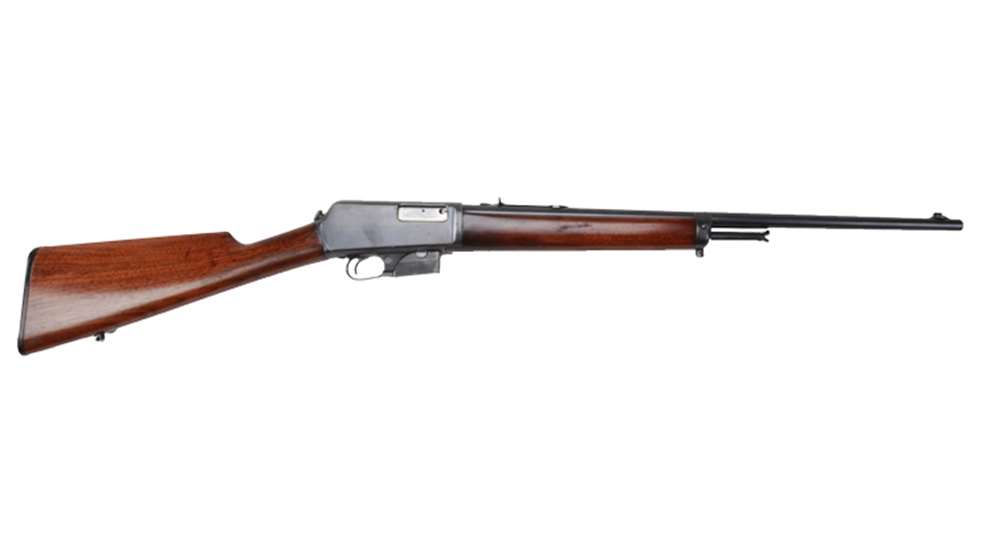
So, T.C. Johnson went back to his workbench and redesigned the Model 1905, scaling up the size again to accommodate a .35-cal. cartridge nearly a quarter-inch longer than its parent .35SL cartridge. The result was the Model 1907 rifle and the .351 Winchester SL cartridge.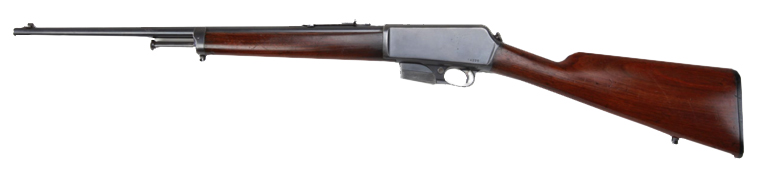
The Winchester Model 1907 is a blowback—some refer to it as “weighted blowback” because of the relatively heavy breechblock—operated semi-automatic rifle that takes down at the receiver. Some were converted to selective fire for military use. Small and handy, with a barrel a bit shy of 21", its cartridge has just a little less thump than the .30-30 Win. If these characteristics are ringing your déjà vu bell, congratulations. Yes, a short-barreled, handy selective-fire rifle feeding an intermediate-powered cartridge from detachable box magazines are among the key characteristics of the German Sturmgewehr—often mislabeled as “assault rifle.” The Germans may have refined the concept, but T.C. Johnson perfected the original concept some 40 years prior to the Germans.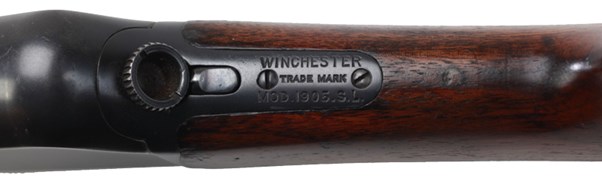
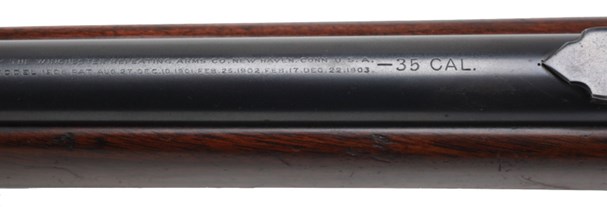
As with prior fast-firing Winchesters dating back to 1866, the Model 1907 featured a flat-sided, somewhat rectangular receiver to contain the guts of the rifle. During this time period, many new arms retained features that made them easier to handle on horseback, even though most people were transitioning to motor cars. There is a crossbolt manual safety located just forward of the trigger guard. Standard magazines held five rounds, but 10- and even 15-rounders were made for law enforcement and military work. An operating plunger with a round button tip protruding from the front of the semi-beavertail fore-end allows for manual cycling of the action.
The .351 Winchester SL cartridge had but one loading, a 180-gr. FMJ bullet at 1,870 f.p.s. with 1,400 ft.-lbs. of energy. It was noticeably better than its pappy, and although many gave it a whirl as a deer rifle, the FMJ bullets did little to improve the terminal ballistic performance of the round. For a while, Winchester loaded a soft-point bullet in the .351 Winchester SL, and this renewed some interest as a deer rifle, but this load is obsolete now, as are most loads. Ammunition, consequently, is tough to find and expensive. Buffalo Arms has a supply of .351 Winchester SL ammo at about $1.50 per round. Interestingly, virtually all .35-cal. rounds use a .358" diameter bullet, but the .351 Winchester SL uses a true .351" bullet.
While the 1907 and its cartridge may not have set the hunting world on fire, both rifle and cartridge gained a following among police and even a few militaries. Some were converted to fire full auto. The rifle saw service in World War I as an auxiliary arm for British and French pilots. Russia bought a small quantity during World War I as well. In the U.S., early recon pilots looking for Pancho Villa kept a 1907 handy in their cockpits. The rifle enjoyed considerable popularity among law enforcement in the 1930s but was eventually overtaken by the Thompson Submachine Gun. It also was quite popular for prison guard use, eventually coming from the factory with a threaded muzzle to accept a flash suppressor. 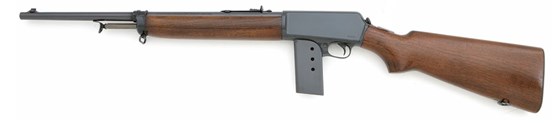
Recently, the Model 1907 has enjoyed something of a renaissance as a co-star in the A&E mini-series “The Son,” (right) as Eli McCullough’s—played by Pierce Bronson—rifle of choice in the turn-of-the-century drama. The Model 1907 had a pretty good run—1907 through 1957—with just fewer than 59,000 produced. Collector interest has been ho-hum, but with the recent television appearance, prices have spiked by $300 to $500. The Model 1907 was a solidly built and reliable rifle, in some ways well ahead of its time. And like many of the fine firearms of yesteryear, it was pushed aside as too expensive to make and lacking a more modern cartridge. That’s a pity—because it oozes cool.
Most Popular